


The Thumb. Part 2
Description
This section is from the book "The Laws Of Scientific Hand Reading", by William G. Benham. Also available from Amazon: The Laws of Scientific Hand Reading.
The Thumb. Part 2
Most animals live together as individuals, not as a community governed by one head. Each animal does what it likes, looks out for itself, goes or comes as it pleases, seeks its own food, and protects itself when attacked. One animal has no power to rule or govern another. Even the young remain at the mother's breast and under the mother's control only long enough to gain sufficient strength to enable them to strike out for themselves. This comparatively early age reached, they become individuals, each looking after its separate interests, and one has no control over any other. Knowing that ability to command others is shown by the thumb, and knowing that the thumb is absent in the animal, we see why it is that they do not gather into communities and are not governed and ruled by some one of their own kind. This will also explain in some degree why man is so immensely superior to the animal in his achievements. He unites with his kind and presents a common front to an enemy. When man plants a settlement in the wilderness he drives out the native animals because a body of human beings united is stronger than a body of animals, each of which is an individual, to whom the qualities of the thumb are lacking.
It is thumb quality opposed to a lack of it; it is the triumph of the hand and its thumb over the paw which has it not.
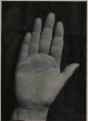
No. 63. SMALL THUMB.
Physiologically the thumb is more abundantly supplied with muscles than the fingers, which have only flexor and extensor muscles that give them the ability to open and close in a vertical way. The strong muscular development of the thumb is so arranged that it can move in a rotary direction, enabling it to oppose itself in turn to each of the fingers. It is this opposing power of the thumb that makes the human hand so skilful in large or small things, that makes it able to master arts and sciences, hold tools, operate engines, or grasp pens and pencils; instruments which have made, developed, and recorded human history. It is the thumb which enables humanity to invent, manufacture, and use all the devices which we have to-day. It is the lack of the thumb that forces the animal to tear food with its teeth, holding it on the ground with its paw, in which case the ground performs the duty of the thumb.
We say the thumb shows will power, and it shows as well the exercise of it. The child when first born has no will; it is entirely under the control of others. For the first few weeks of life, if healthy, it sleeps about twenty-two out of twenty-four hours. During this time the thumb is closed in the hand, the fingers concealing it; in other words the will, represented by the thumb, is dormant, - it has not begun to assert itself. Soon the child does not sleep so much; it begins to have some ideas of its own, and often shows that it has a temper. At once the thumb comes from its hiding-place in the palm, the fingers no longer close over it, for will is beginning to exert itself, and when it does, the thumb, its indicator, appears. In examining the hands of idiots - those poor souls whose minds have been destroyed by some shock, or some illness, or who perhaps were born witless, - you will find weak thumbs. These idiots are unable to exert control over themselves or others. If the idiocy is of a congenital nature, the thumb will be very poorly formed, small and weak looking. This formation, which amounts sometimes to a deformity of the hand, will show that the subject was born idiotic, and that the mind and will never existed.
If a thumb indicating good strength of will is found on the hand of an idiot, then the thumb is carried in a lifeless, unsteady manner, and when the hand is not in use the thumb is closed into the palm. This shows that the mind and will were once present, but are now weakened or gone. This idiocy is produced by shock or disease, and is not congenital.
Epileptics also show confirmations of thumb quality. Just before a seizure, and before any other warning has been given, the thumb closes in the palm. It is beyond the power of the patient's will to prevent the seizure; disease temporarily displaces the will, and its indicator, the thumb, gives way and hides itself. When persons are very ill it is important to note how their thumbs are held. In battling against disease the will must be strongly called into play, in order that life may remain. If will is holding its own, it is an indication that disease has not gained the mastery. When, however, the thumb folds into the palm, the brain is much disturbed, and the will cannot hold out a great deal longer. This operation of the thumb can be seen even in those who are unconscious or suffering with high fever. I believe this action of the thumb which is often seen on dying people comes from the fact that man alone has a knowledge of death, man alone has the faculty of reason, man by reason of his knowledge of death opposes his will to its operation. So long as he does this, the thumb stands.
When the thumb folds into the palm as death approaches both will and reason are in abeyance, the faculties give way, and the dissolution of reasoning power and will takes place.
There are two kinds of will power to be borne in mind : instinctive will, which gives us a faculty of being stubborn without any definite purpose, and the will born of reason. Instinctive will is possessed by animals, and leads them to fight obstinately against others of their kind, through mere inherent stubbornness. Animals have also a sort of instinctive logic and instinctive decision. The kind of will which is represented by the thumb is not this animal instinct, but the will of reason, the logic of reason, the decision of reason. In this case, a human mind is back of the forces, giving them direction. In the development of the hand we find its most primitive formation in the Amoeba (Drummond), a small jelly-like, water growth which is headless, legless, and armless. Whenever it has use for a hand to grasp its food, it bulges out at some point in its circumference, touches the object it wishes, flows over it and absorbs it. This bulge, or hand, in its side, appears at any point when a need demands it, and disappears whenever the need is satisfied. This is the first and lowest form of hand, belonging to a bit of protoplasm which has neither form nor shape. From this amoebic hand, as intelligence increases, there is a steady development in paws or hands.
Continue to:


My Books

