


The Thumb. Part 3
Description
This section is from the book "The Laws Of Scientific Hand Reading", by William G. Benham. Also available from Amazon: The Laws of Scientific Hand Reading.
The Thumb. Part 3
First a few tendrils operate as fingers, as in the case of sea anemones, then through the car-nivora, where toes and claws appear, until we come to the monkey. Here we find the nearest approach to the human hand, and.on the monkey's paw the nearest approach to the thumb. It consists of a bit of cartilage covered with skin and sets very high on the paw, is loose, and is without great stiffness. It is the kind of thumb which cannot oppose itself firmly to the fingers, has little strength, and serves to impress us that Man only has a real thumb. Two things to remember concerning the monkey's thumb are the fact that it sets very high on the side of the paw, and that it lacks the ability to oppose the fingers. Also bear in mind, that the more intelligent the monkey, the nearer this "finger" approaches to a thumb. Those found in the wild state have little approach to such a member, those bred and reared in zoological gardens are developing better thumbs, and there will be a continued improvement in this regard as the monkey more closely approaches the human species in intelligence.

No. 64. HIGH-SET THUMB.
In noting the thumbs on your client's hand, have him hold the hand up in front of you, palm in your direction, very much as you had him do when examining the carriage of the fingers. This is in order to find whether the thumb sets high at the side of the hand, is low, or in the medium position. Remembering how the monkey's thumb is placed high at the side of its paw, and also that the idiot's thumb is also high, at once reason that the higher the thumb grows out from the side of the hand (64), the lower the grade of intelligence, and the less adaptability has the subject. The smaller the thumb thus highly placed, the nearer it approaches the monkey thumb, and the nearer the approach of the subject to the qualities of the monkey. Monkeys may be bright and shrewd, but in an animal way, lacking entirely the human quality, character. If the thumb sets low it generally follows that it will Open wide from, and will not lie close along, the side of the hand. This low-set thumb, leaving a large space between itself and the finger of Jupiter (65), will indicate a nature full of the highest human qualities. It speaks of generosity, independence, love of liberty for itself and others, sympathy for all who are in distress, and a readiness to share with less fortunate brethren.
While this low-set thumb does not bear all the qualities of the supple thumb, in that the low thumb, while liberal and generous, does not throw money away as do the supple thumbs, still the low thumb is the intensely human thumb. Its possessor is filled with the greatest strength of Venusian qualities, sympathy and generosity (this thumb forming as it does the lower part of Venus), and he is fired with warmth, which, while it may not mean passion, does bespeak one who is not cold-blooded. If you ask a favor, this man with the low-set thumb will grant it if possible. You know in asking that the cold response of a selfish person will not be given you, but that, having a feeling of common humanity, he will do for you all he can. This low-set thumb is generally long, and if so it means power and force of character, which, with determination and reason, will intensify generous and sympathetic qualities. If the thumb is short, it will take away much of the good of its low setting, for, while the position is good, the thumb itself is nearer the smallness of the monkey formation, which will tend to give it monkey will and selfishness. With a low-set small thumb the good quality it has will be independence, and this comes from selfish motives.
The low-set small thumb is rare, however, and you will generally find it close to the hand. If such a thumb is found, see which phalanx is deficient, which rules, and whether it is close to the hand or falling wide open. After noting all its landmarks, look at the tip, and with this combination of evidence you will be able to judge it aright.

No. SB. LOW-SET THUMB.
Before proceeding farther, I must speak of the two phalanges, the first and second. For brevity I shall call these two, respectively, will and logic. In all thumbs, long or short, see whether one or the other phalanx is deficient or in excess. The normal length of the thumb, with a medium setting, is when the end of the first phalanx teaches about to the middle of the third phalanx of the finger of Jupiter, when the thumb is held against the side of the hand (66). If the thumb is much shorter than this it is a short thumb, unless it be set so low that, while the thumb itself is of normal length, the low setting accounts for its shortness. Again, if set very high it might overreach this measurement and still be only of normal length. In judging individual phalanges of the thumb see that the first phalanx is a trifle shorter than the second. This gives normal development. If the will phalanx is longer than logic (67), will is in excess of reason, and the person will act first and think afterward.

No. 66. THUMB NORMAL LENGTH.
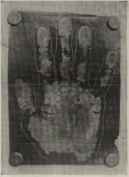
No. 67. WILL LONGER THAN LOGIC.
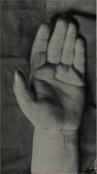
No. 68. LOGIC LONGER THAN WILL.
He is set and determined in his ways, and makes mistakes because he has allowed these qualities to rule reason. He is stubborn, and cannot see that it is better to acknowledge and correct an error than to suffer the consequences of unreasonable obstinacy. If the second phalanx is much the longer (68), reason is in excess of will, and this person can reason cleverly, but is not good in carrying the results into execution. He is the reasoner who does not act. He knows how things should be done, but does not carry this knowledge into operation. Some time ago, during one of my lectures, I was asked, "Do you believe that a person naturally deficient in will power, and knowing his weakness, can school himself so that he will develop strong will?" To this question I answered, "No. " Since then I have given this matter most careful observation and study; have taken subjects whom I knew to be deficient in will, found good situations for them, surrounded them with the best influences, and put before them every incentive for effort. They developed the most tremendous determination for a while; when they thought they were being watched or put to a test they were as obstinate and immovable as a rock, but taken off their guard, they succumbed to the first temptation.
Continue to:


My Books

