


Chapter II. Telepathy
Description
This section is from the book "Proofs Of The Spirit World", by L. Chevreuil. Also available from Amazon: Proofs Of The Spirit World.
Chapter II. Telepathy
The action of one being upon another at a distance, is a scientific fact, as certain as the existence of Paris, Napoleon, oxygen or Sirius.
C. FLAMMARION.
About 1882, a committee of well-known Englishmen, who were more interested in intellectual facts than in the physical phenomena previously studied by Sir William Crookes and Russel Wallace, resolved to devote scientific study to thought-transference. With this in view, they founded the Society for Psychical Research. Having taken all precautions to eliminate any possibility of a code of ingenious signals being used, they were convinced of the reality of thought-transference.
In the first volume of the organ of this society, Proceedings of the Society for Psychical Research, will be found the reports of these experiments, with drawings and diagrams that give an idea of the results obtained.
In 1883 and 1884, in Liverpool, Mr. Malcolm Guthrie discovered two sensitive subjects among the employees of a large woolen house, and began a series of experiments with which the great physician, Sir Oliver Lodge, was associated.
Telepathic action is to-day a verified fact, but it is also true that it remains indefinable. This action from a distance requires an intermediary, but no one is able to say whether this intermediary is of a physical order. The inner life of the soul rises from a region unknown to science, a region which by hypothesis or for convenience of speech we may call the psychic element. Yet despite this, and whatever it may be, it is quite certain that the soul cannot be made manifest to this material world except by means of a physical expression.
Telepathic action would be incomprehensible and even inconceivable if there were not, in the ether, a dynamic element that holds all being in its embrace.
It is only by the intermediary of this element that the relations between body and soul may be explained, more especially the telepathic communications which experience and repeated observations have forced us to admit.
Telepathy is the universal phenomenon diffused throughout the world, the one phenomenon uniting all human beings and reaching as well to matter in which it calls forth life.
Existent in the cosmos is an element which is to the life of the soul, what oxygen is to physical life. The effects of this upon ourselves we shall observe.
The first experimenters declared that, if spontaneous telepathy gave the results of which we have many witnesses, there must be some faculty in man, even if it be but a germ, which it must be possible to control.
It was M. Charles Richet, I believe, who first endeavored to establish the matter mathematically by applying the experiments to the divinations of numbers in the mind of another: he obtained only rather inconclusive results.
In 1886, the Misses Wingfield used Dr. Richet's method, but limited the experiment to a number consisting of two figures, from ten to ninety-nine. Two thousand, six hundred and fourteen trials gave two hundred and seventy-five successful results: the average probability would have been only twenty-nine.
Four hundred trials of another series, whose probability would have been four, gave twenty-seven successful results.
Enlarging the field of experiments, Mr. Guthrie of Liverpool conceived the idea of trying the transference of sensations of taste, smell and touch. Messrs. Gurney and Myers tasted, smelled and touched while the mediums R------ and E------ diagnosed their sensations.
But the most decisive result obtained was recorded through visual sensations. The first trials in this class were due, I believe, to the initiative of Mr. Rawson. They consisted in obtaining the graphic reproduction of a very simple design, such as a triangle, ring or flower. These experiments were successfully taken up by Mr. Guthrie, repeated on the Avenue de Villiers by M. Schmoll and observed anew by Lombroso and many other psychologists: briefly, they are now incontestable.
In all these trials, the drawings have been reproduced with an exactitude that leaves no doubt of the transmission of picture. Nevertheless it is certain that the percipient does not always see the picture traced upon the model, but that he is struck by the idea sent to him by the Agent: this is perception of an active thought.
In this way a ring traced flat upon the paper:
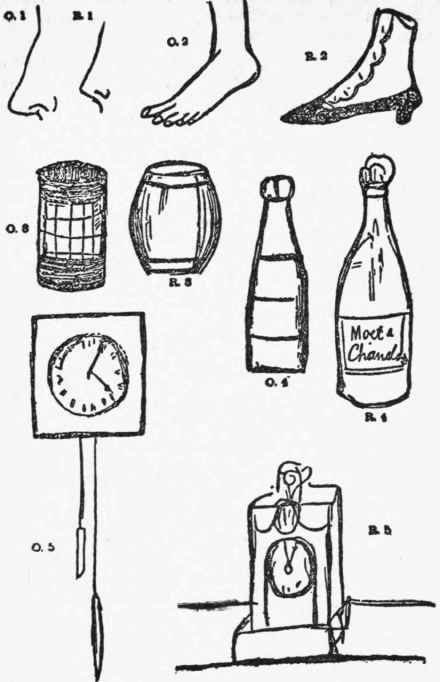
was drawn in perspective: a foot drawn bare was represented with a shoe in the replica: a hand is indeed reproduced, but not in the same position, etc. Therefore we cannot attribute these results to the sensitiveness of lower centers.
It is the normal and conscious sensitiveness which registers this kind of perception; also the experiment demands a severe effort upon the part of the percipient and greatly fatigues him.
We would also mention the attempts of Commandant Darget which tended to prove that the emission of a thought would have enough objective force to make an impression upon a photographic plate. He has made many communications upon this subject to the Academy of Sciences. All psy-chists know of the films representing the bottles photographed by Commandant Darget's thought-radiation.
But let us return to telepathy. Images perceived by the brain are often rather vague; those are much clearer which are obtained when the agent succeeds in influencing the lower organs, whose response, in this case, becomes purely automatic. Yet this kind of experimentation cannot be undertaken except with the aid of specially endowed subjects. We have valuable examples of it in the Proceedings of the Society for Psychical Research.
In 1871, during a period of eight months, Mr. Newnham carried on a series of experiments through the mediumship of his wife, with whom he was able to communicate automatically.
An exchange of questions and replies was made by the indirect way of a motive center, which set in movement Mrs. Newnham's hand, without her having the least consciousness of the questions addressed to her or the answers which she made. Her husband's questions were never formulated, even in a low voice: he wrote them with a pencil well out of reach of her glances.
In the course of his long experiments the replies were always in accord with the questions and we must note the important fact that five or six questions were often put, one after the other, without Mrs. Newnham's knowing of what they treated.
Thus, there was no communication of thought - only movement was communicated. Mr. Newnham made three hundred and nine of these experiments. We will cite the following:
"At that time," recounts Mr. Newnham, "I had a young man studying with me as a private pupil. On the 12th of February he returned from his vacation, having heard of our experiments, and expressed his incredulity in a rather rough fashion. I told him that he might try whatever proof he desired, with this reserve alone, that I should see the question he put.
"In consequence of this, Mrs. Newnham took her place in my study in her accustomed armchair while we retired into the living room and closed the door behind us. That done, the young man wrote upon a piece of paper, 'What is my eldest sister's first name?' We returned immediately to the desk where the answer already awaited us - 'Mina.' It is the familiar abbreviation of the name Wilhelmina. I assure you this was completely unknown to me."
This last remark of the professor has little importance, the value of the experiment lies in the fact that a secondary center received, from a strange thought, movement and direction without passing through the central conscientiousness of the medium.
In space, it is unimportant whether the motive agent should have been the husband's thought, that of the young man, or the thought of an unknown entity.
This so-called telepathic phenomenon acts in us constantly without in the least attracting our attention. In this way we are in telepathic communication with all our organs.
We also take no note of the telepathic action which is translated to us by inspiration. Who is able to affirm whether he, himself, is the author of a brilliant idea or of an obsession?
Who is sure of being the author of his own ideas? From a thousand obscure sensations, from reservoirs of our memory, we create within ourselves combinations which we call our thought, but we have only made manifest a synthesis of sensations already received which have come to us from sources of which we know nothing.
But we are able to affirm that exterior thought flows in upon us in a more direct fashion, and we are able to say this from the observations which have been made. This influence can be localized: sometimes it reaches the brain directly and that seems natural. Sometimes it flows directly into secondary centers and that seems incredible, supernatural. The lower centers act, in this case, according to the normal process known to them alone, for they perceive telepathically, being like ourselves incapable of determining whence the perception comes to them. It is this which gives rise to automatisms.
It is in observing ourselves and in observing the automatisms whose source we have been able to control, that it has sometimes been possible to determine the origin of the phenomena. As these sources are exterior, it is perfectly certain to-day that thought, emotion, and desire may influence at a distance either the brain or the sense organs. We shall quote some examples.
Continue to:


My Books

