


An All-Season Star Map
Description
This section is from the book "Time Out for Living", by Ernest DeAlton Partridge and Catherine Mooney. Also available from Amazon: Time Out for Living.
An All-Season Star Map
Turn the map until the proper month comes at the bottom. You can then see how the northern heavens appear at about 9 p.m. Use the North Star (Polaris) to get your bearings.
Another way to understand the movement of the stars around Polaris, the North Star, is to make yourself a small planetarium in an umbrella, by marking the main constellations lightly in chalk on the inside of an open umbrella, and having the point where the handle or rod passes through the umbrella as the North Star. You can now hold the umbrella above and in front of you and turn it slowly counter-clockwise. The way in which the chalk marks move around the center of the umbrella is much the same as the way the stars appear to move about Polaris. In this way you can learn to recognize the various constellations in every possible position.

Above, it was stated that the stars appeared to revolve around the North Star. An interesting thing in this connection is the fact that Polaris has not always been the North Star and it will not be several thousand years from now. When the Egyptians in 3000 b.C. looked at the northern heavens they perceived that Thuban, in the constellation Draco, was the North Star. In 3,000 years from now the North Star will be Gamma Cepheus. See if you can locate these stars in the heavens from the maps shown in this chapter. The reason for this change in the Pole Star is the wobble in the movement of the earth. The earth, as it whirls around on its axis, wobbles slowly in a circle, so that the North Pole is slowly changing its direction of point. Many thousands of years from now Polaris will again occupy the position of North Star after the wobble has been completed.
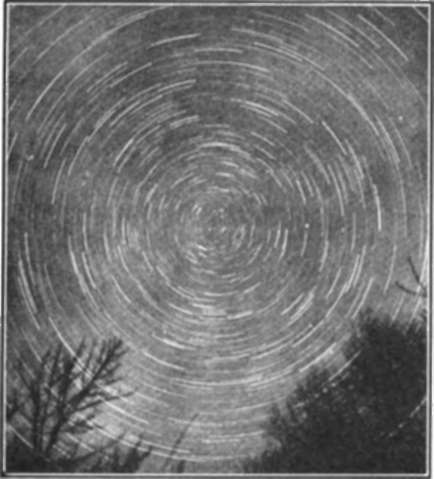
Some amateur astronomers make photographs of the star movements. Make them in the following way: Place a camera with a large lens (one with a lens as fast as 6.3 is preferable) facing the North Star on a dark, clear night. Focus the camera on infinity, or the longest distance on the scale, then open the shutter and leave it to expose for about six hours, making certain that the shutter is closed before you go to bed, since the daylight will spoil your picture. When the picture is developed, you will see how the stars revolve about Polaris.
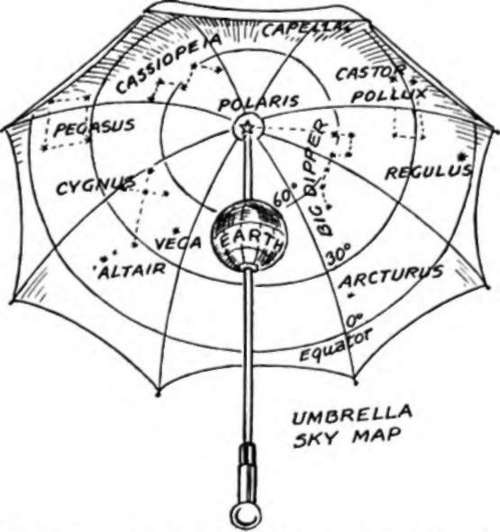
The use of a planetarium like the one shown here will help you find the important constellations and understand how they move around the North Star.
If you take a picture of the stars directly overhead, you will see that they trace a path nearly straight across the film. This is because they do actually travel across the sky in that fashion. In the Southern Hemisphere the stars move in a clockwise direction when you face them.
If you take a picture of the stars, you may be lucky enough to catch a shooting star on the film. They are not stars, however, but tiny meteors that are falling to earth constantly. You can see many of them in the night time, if you watch for them. Pieces of them have been found on the earth. These tiny meteors sometimes travel in swarms like bees. These swarms consist of tens of thousands of minute fragments of rock and iron. They are traveling around the sun, and sometimes one of these groups crosses the earth's path. It is then a "grade crossing" and there are no traffic lights. Consequently, for a few hours there are thousands of collisions. The tiny meteors are destroyed but the air shields us here on the earth from destruction.
The friction with the air as the little meteors dash through it, sometimes at the rate of fifty miles a second, turns them into gas and dust before they reach the surface of the earth. When the meteor plunges into the air, it becomes white-hot by friction with the particles of oxygen and nitrogen. Then the pressure of the air is so great that the soft parts of the meteor are brushed away. Finally the meteor is completely destroyed.
Astronomers like to know when the earth passes through the very center of the swarm. Anyone can assist astronomers in getting this information. If you know that a "meteor shower" is expected on a certain night, you should start as soon as it is dark to count every meteor which you see, and record the time at which it appeared. Count as long as you conveniently can or until there are no more meteors visible.
Star Trails
On some dark night point your camera toward the North Star and leave it for a few hours. Be sure to close the shutter before daylight. You may get a picture like this one.
Continue to:


My Books

