


Good Road Manners
Description
This section is from the book "Time Out for Living", by Ernest DeAlton Partridge and Catherine Mooney. Also available from Amazon: Time Out for Living.
Good Road Manners
The automobile is such a recent development in the history of the human race that man has hardly yet learned co-operation in the use of it. A man who is courteous and considerate at home or in the office, a Dr. Jekyll, often becomes a Mr. Hyde behind the wheel. His lack of consideration may cause accidents. If drivers of cars would be as helpful and considerate of the other fellow as pedestrians are of each other, many unfortunate experiences would be avoided.
Some common points of courtesy that help everyone concerned are listed below. The next time you are out driving, check how well the driver of the car observes them.
1. The right of way usually is granted to the car that approaches an intersection from your right. To deny the other driver this privilege is like grabbing the seat that has been assigned him at a theater, or taking the food out of his hand at a party.
2. When you are going to turn in either direction off a road or street, it is considerate of you to advise any cars that are behind you what you intend to do. Your signal helps you, too, because it may save a crash from behind. Make your signal with simple hand motions. (See illustrations.)
3. Taking more than your share of the road is to be compared with sitting on two chairs, one of which belongs to someone else. Slow drivers especially should keep well to the right.
4. When it is necessary to stop, do not stop suddenly unless it is in an emergency. Slamming on the brakes to turn a corner after you have passed it or stopping suddenly to inquire about directions may not give the driver behind you sufficient time to stop his car. Signal your intentions in plenty of time.
5. Express your thanks to a motorist who has extended a courtesy to you. Thank him with a motion of the hand and a nod of the head. An expression of thanks helps to foster good road manners and makes everyone feel better.
6. Keep in line when waiting for a traffic light or a passing train. Those who are there first are entitled to their places and should not need to get out of the way for a discourteous person who crowds in from the side of the road, or who goes in the wrong lane of traffic. We would not think of pushing people ahead of us out of the way if we were standing in line to buy a ticket. Keeping in line is proper on the road, too.
No doubt you can think of other rules that could be added to this list.
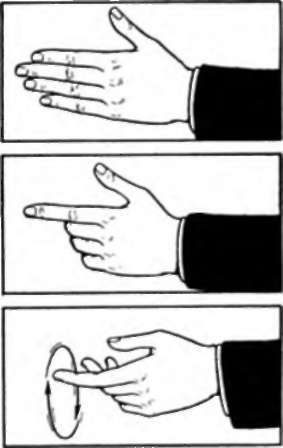
Eastern System of Signaling. From top to bottom, (1) stop or slow; (2) left turn; (3) right turn.
The Policeman
It is difficult for some people, especially drivers, to realize that the policeman is paid to protect everyone. The purpose of traffic laws is to regulate the movement of automobiles so that there will be fewer accidents and more freedom from traffic jams and road hogs. The only time to fear a policeman is when you are actually breaking the law. Then it becomes his duty, in order to protect others, to take measures that will stop you from taking advantage of those who obey the law. If there were no traffic policemen, it would be impossible to use automobiles. The roads would be choked at crowded intersections. The open highway would be dangerous because of those who would speed along taking advantage of everyone else.
The policeman is your servant. He is paid from taxes collected from everyone and is upholding laws agreed upon by the representatives the voters elect. He should not be blamed for doing the job for which he is paid - keeping the highways safe for everyone.
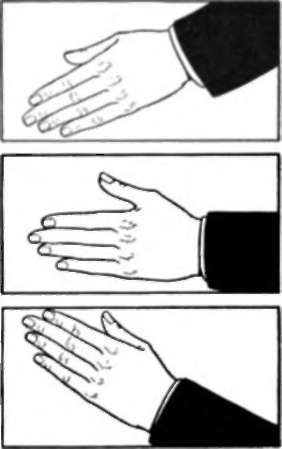
Western System of Signaling. From top to bottom, (1) stop or slow; (2) left turn; (3) right turn.
Continue to:


My Books

