


Photography
Description
This section is from the book "Time Out for Living", by Ernest DeAlton Partridge and Catherine Mooney. Also available from Amazon: Time Out for Living.
Photography
Camera Ready
If you ever had an opportunity to get a close look at one of the modern sound cameras used in Hollywood, you would see that the job of cameraman is no simple one. Without a skillful cameraman many of the interesting parts of a movie would be impossible. If you will watch closely the next time you attend the flickers, there will be many trick effects that add to your interest in the film. The director may have had the ideas for the effects, but it is up to the man in charge of the camera to know how they can be done and then to see that they are done.
Watching for the different effects produced by the camera is a very interesting thing to do when seeing a picture. It is
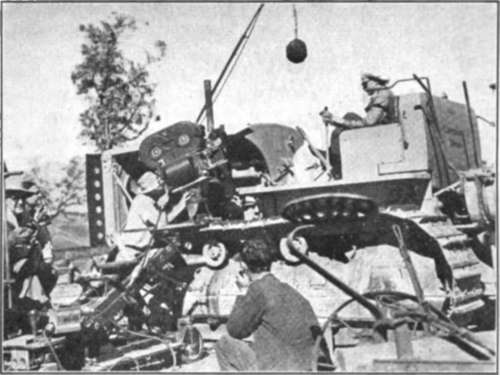
The script calls for an upward angle for a scene in "The Grapes of Wrath." fun to try to figure out the angle at which each shot was taken. For example, is it at the regulation height of about four feet, or is it unusually low, or is it above the heads of the actors? By varying the angle at which the camera takes the picture, the cameraman does not bore the audience. If you saw every picture from the same angle and at about the same distance from the camera, movies would not be nearly so interesting as they are today. And yet these changes must be well thought out. Just changing the position of the camera once in a while is not enough. There must be some logical reason behind it all. When two people are having a heart-to-heart talk, for example, the audience wants to be in on it, so they appreciate having the camera move up. For a large, beautiful scene with many people in it, however, a distant shot is much better. The most frequently used distance of the camera from the subject is what is known as the medium shot. (For a more complete description of the photographic side of movies see Chapters 13, 14.)
Tricks Of The Trade
There are so many tricks in the bag of a cameraman that it would take many pages to describe them. They all help to keep the picture interesting to you and to carry impressions that otherwise would not be possible. For example, you have no doubt seen a picture in which one of the characters is thinking, with a picture of what he is thinking appearing above him. This trick is done by double exposure of the film. Two different pictures are taken on the same film at different times and so placed and timed that the action is well-matched. In some stories, a character talks to himself and even shakes hands with himself. You can do this same thing with your own camera by covering half of the lens and snapping one picture, then covering the other half and taking the opposite side.
Dissolves are another set of tricks that come in handy. These are the effects produced by having one picture fade out gradually while another comes in. This stunt, too, is done by double exposure. By slowly closing the lens to the amount of light coming onto the film, the picture slowly fades out. Then over the same film the lens is slowly opened for more light while the new scene appears. You have probably noticed many other tricks and can explain some of them. If you know a good amateur movie maker, talk with him about trick effects and see how much he can tell you.
Sounds And Music
Like the stage settings and costumes, the music and sound effects for the modern talking picture are to supplement the actors. These additions should never overshadow the main theme of the picture. Too much dialogue, or music that is too loud, may detract from the main purpose of the film, which is to tell a story. Properly used, both sound and music can add much to the final product. When they are overdone, they detract from it.
Lately, however, some well-known singers and musicians have been successful in building the entire story around their unusual talents. In cases such as these, the music comes to take a major part in the production. Perhaps, as movie makers come to be more skillful, they will be able to make better and better use of music.
Continue to:


My Books

