


Restful Times
Description
This section is from the book "Time Out for Living", by Ernest DeAlton Partridge and Catherine Mooney. Also available from Amazon: Time Out for Living.
Restful Times
Knowing just when to rest is an important thing. People from other lands are constantly telling us that we Americans do not know how to "let go." We do not know how to set apart a certain time of the day for going limp. There is evidently a difference in various parts of our country in the art of relaxing. One man reports this interesting experience:
"While visiting in the southern states our friends would see to it that after the noon meal we all had a chance to take it easy. Everything was quiet, and rest was just the thing to do. Life just suspended for a short time. No doubt the climate had something to do with it, but, whatever it was, I liked it."
Somehow rest seems to be the natural thing to do after a meal. When your stomach is filled with food, your blood goes to the digestive system to help carry the digested food to the proper places. You can aid digestion by "lying low" until the job is done, or well on the way to being done, A snake, you know, after it has swallowed something for dinner, likes to crawl off and sleep. You will notice that some of the larger animals do the same. They evidently know the value of relaxing after eating.
The British have a custom of relaxing in mid-afternoon for a sip of tea and some biscuits. This national custom does a great deal to help them keep up with the modern pace. In South American countries the same idea is carried out in the siesta. Summer camps in this country are doing a good service by acquainting their campers with the after-lunch rest hour, when all activities suspend for a brief period and everyone relaxes. Domestic life would be much happier if all families practiced this same idea.
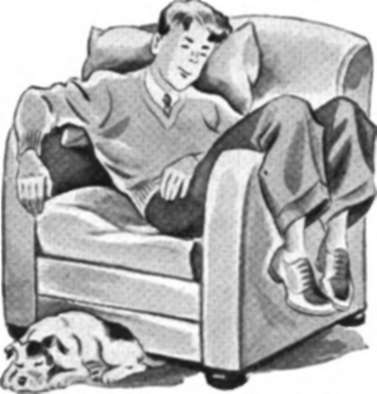
Try collapsing in an easy chair for relaxation.
It is not necessary, however, to set aside a special hour for everybody to relax at the same time. Each individual can plan his own way of living so that there is some time in the day when he can banish cares and become like a rag doll physically and mentally. This kind of relaxation can be developed in a very short time, and comes through practice. Just try sitting down in an easy chair sometime and melting into a lifeless lump. Relax completely, even to your tongue and the ends of your toes. You can literally feel the tight spots loosening up.
Restful Foods
In speaking of restful times, we mentioned food as something that helped one to relax. This idea should be pursued a little further to see just what kinds of food are suited to relaxation and how they can best be used. Eating is one of life's real pleasures. Enjoying food is an art that we should all cultivate. To be the most beneficial to us, eating should take place in pleasant surroundings. Arguments, unpleasant noises, unappetizing surroundings, and annoying people disturb the digestive process and make it much more difficult to relax. We should learn to talk about pleasant things in a pleasant way while eating. Of course, pleasant conversation is hard to manage if we do much of our eating by grabbing a hot dog at a stand or gulping down a sandwich at a counter.
Because of the plenty in which we live, many of us eat much more than we need to carry on our activities. The result is that we either become too fat, develop more energy than we know what to do with, or grow lethargic. A well-regulated diet is essential to relaxation. Scientists have found that there is a direct connection between what we eat and how we rest. Those who do not get enough calcium in their diet arc more restless than those who do, for example. If you eat such foods as cheese, milk, eggs, and oatmeal you will get calcium, and, according to the scientist, will be able to rest better.
Naturally when a person wants to relax he does not use stimulants such as coffee and spices. Especially in the evening one should watch his eating if he does not want to count sheep or pink elephants.
Continue to:


My Books

