


Variety In Hiking
Description
This section is from the book "Time Out for Living", by Ernest DeAlton Partridge and Catherine Mooney. Also available from Amazon: Time Out for Living.
Variety In Hiking
To one who is not familiar with the different types of hikes the sport of exploring the woods may seem limited in its appeal, but to experienced hikers and campers this is not the case. To them hiking offers endless new experiences. For a taste of these adventures, just review the following special kinds of hikes that have been used in various parts of the country.
Camera Ready
One of the most popular types of hike is the one in quest of good snapshots. With a pack full of good things to eat and an ample supply of film for the camera, it is great sport to head for the outdoors to see what you can capture. If you change the nature of the hike each time, this kind of hike can furnish many interesting adventures. One day it can be a search for beautiful trees, another for water scenes, and still another for sky pictures.
Compass
On a topographic map plot out a likely course for a hike, then set out to see how nearly you can follow the trail you agree upon. If you use a compass to guide you in following the map, this can be an exciting and profitable adventure.
Observation
With several companions, work out a scheme of points such as the following: 1 point for a crow, 1 point for a squirrel, 2 points for a hawk, 1 point for a white horse, etc. See who can gain the most points in the hike by sighting first each of the things included in the list. An easy way to keep track of the points is by a handful of small stones. Put them in your left pocket, and each time a point is earned transfer a stone from the left to the right pocket.
Flip A Coin
Divide your party into two groups, both starting from the same point. One group goes right, the other left. At each crossroad they stop and flip a coin to see which way to go. This they continue to do for a period of time that has been agreed upon beforehand, say an hour, when they turn back and return to the starting point as rapidly as possible, using the shortest route they know. The group which gets back first wins. This is a good activity for summer evenings.
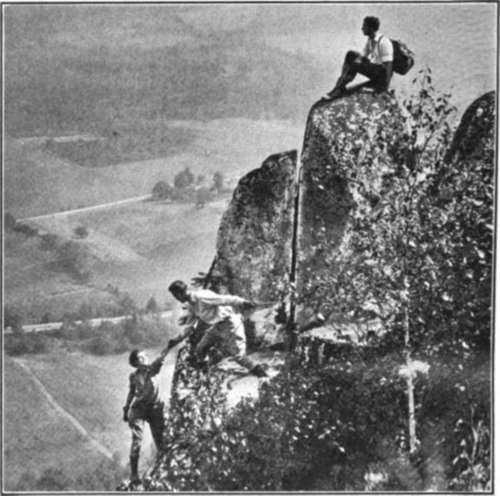
Only experienced hikers should go in for cliff scaling.
Mystery
There are several types of mystery hikes. One good one is to have two or three members of the group plan a hike, including the food and other details, not telling any other member about it. The group then sets out together following those who have planned the trip. On the way they try to guess where they are going and what will happen when they get there. A good variation of this is to blindfold those who do not know the destination and keep them blindfolded for some time, tracking back and forth to confuse them in direction. When the destination is reached take off the blindfolds and see if they can guess where they are. Obviously a mystery hike needs to be conducted in such a way as to prevent accidents of any kind.
Traveled roads, dangerous paths, completely unfamiliar territory, and long distances must be avoided.
Robinson Crusoe
More experienced hikers enjoy testing their ingenuity to see how they can find their own food and cook it without utensils. Leaving home with only a few necessities, such as salt and sugar, the hiker is to find his meal in the woods from berries, roots, fish, and other things. If the hikers are near a seashore, they can dig clams and bake them, or obtain some other kind of sea food. Only those who know the woods well will want to try a Robinson Crusoe hike.
Youth Hostels
Nearly forty years ago, a German teacher who was a lover of the outdoors began taking his students on short trips away from the smoke and dirt of large industrial cities and into the sun-bathed fields. These small groups of students had very little money and therefore could not afford expensive transportation. They used the cheapest form of transportation - their own legs. By carrying their own equipment in packs on their backs they found that much interesting territory could be explored at little cost.
A Youth Hostel In France
The most difficult problem that faced these groups of hiking explorers was a place to spend the night. As dusk began to descend, they were often far from home and in need of shelter. Usually this problem was solved by the co-operativeness of friendly farmers who offered their haymows for the night. Such hospitality was not always forthcoming, and Herr Richard Schirrmann, the school teacher mentioned above, realized that if the students were to go hiking about the country some better means of shelter would need to be found. Accordingly, he devoted much of his life to the development of houses where, for a very small fee, a young person could secure simple lodging and a place to cook his meals. Out of this simple beginning came one of the most interesting movements of modern times, the youth hostels. Today there are more than two thousand youth hostels in various countries of the world, serving a very great number of young people each year.
In Europe, youth hostels have been established in peasant houses, old castles, towers, ships, and schools; and many new buildings have been erected for hostels. The whole plan is to keep the cost of the lodging offered by the hostels very low, so that young people of limited means can use them. The expenses of upkeep and the pay of the house mother and father who live in the hostel are usually met by membership fees and a small charge for staying overnight. In America, the annual membership is one dollar and the overnight charge is twenty-five cents. The membership fee entitles the holder to a pass that permits him to use the hostels in foreign countries as well as his own.
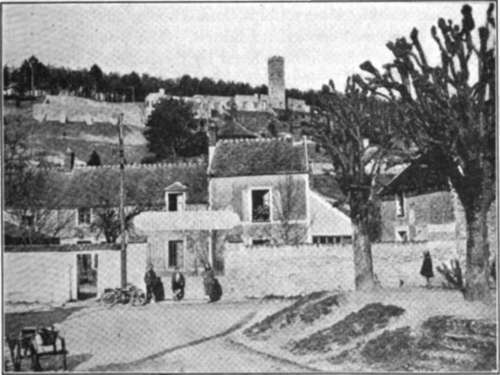
The plan is to have the hostels located at convenient distances apart, so that a good day's walk will bring the hiker into a shelter each night. The distance is about 15 miles. The hostel furnishes a bed and blankets for the guest, but each hiker carries his own bed-sack which contains two yard-wide sheets, sewed together across the bottom and two thirds of the way up the sides. This is to insure that the bedding is kept clean. Each person or group of persons does its own cooking. Usually food can be purchased for this purpose at the hostel, if the hikers do not happen to have it with them.
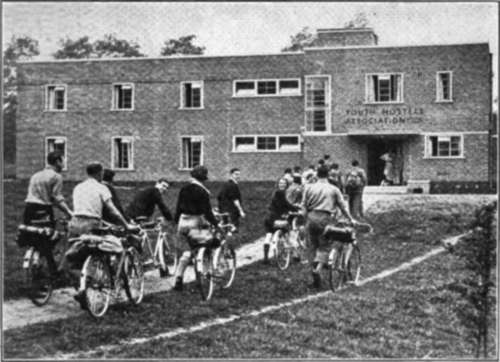
English cyclists arrive at a youth hostel.
Groups of hikers using the American youth hostels in New England have found that it is possible to travel for about seventy-five cents a day for all expenses. Certainly this is a reasonable way to travel when money is scarce.
Youth Hostels In America
Perhaps it will be well to quote briefly from the American Youth Hostel Handbook in regard to hosteling in this country:*
"Purpose. To help all, especially young people, to a greater knowledge, understanding, and love of the world by providing for them youth hostels, bicycle trails, and foot paths in America, and by assisting them in their travels both here and abroad.
"The American Youth Hostels, Inc. was founded by Isabel and Monroe Smith, National Directors, the first youth hostel being opened in East Northfield, Massachusetts, on December 27, 1934. The following figures show the developments of youth hosteling through 1939:
* These handbooks can be secured from American Youth Hostels, Inc., Northfield, Massachusetts, for 50 c each.
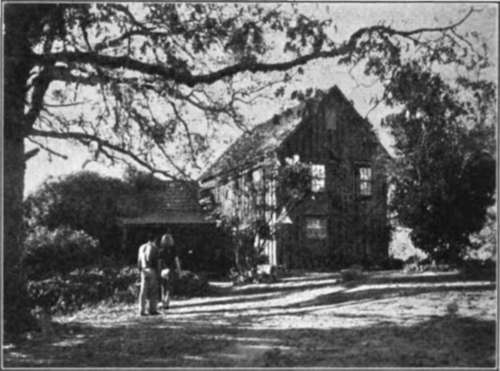
An American Youth Hostel.
year | number of hostels | a.y.h. passholders |
1934 | 1 | 150 |
1935 | 35 | 1,750 |
1936 | 76 | 4,797 |
1937 | 110 | 7,066 |
1938 | 184 | 8,860 |
1939 | 209 | 11,146 |
"An A.Y.H. pass costs $1 a year for those under 21, $2 for those 21 and over. This pass expires the last day of the current calendar year. New passes are procurable after October first and are valid until December 31 of the following year. By taking out a pass each year you are helping to build hostels.
"A.Y.H. KNAPSACK is included in the pass fee. It is a quarterly magazine which contains current hostel information and stories which act as a supplement to the Handbook, keeping the information about hostels up to date.
"Located on the average of 15 miles apart, the distance between hostels is considered as an average day's hike. Bicyclers usually skip one or two hostels, covering from 30 to 45 miles a day. Hostelers are advised to take it easy at first. At all times it is preferable to take enough time to see things and enjoy the countryside, rather than to turn the hostel trip into a longdistance endurance flight. Hikers should start early in the cool of the morning to allow time for rest in the heat of the day.
"The overnight fee in all American hostels is 25c. There is an additional charge of 5c in summer, 100 in winter, to cover fuel for cooking, light, electric pump, wood, coal, etc.
"Meals are usually prepared by the hosteler. Hostelers can live very well on a dollar a day budget, allowing 15c for breakfast, 25c for lunch, and 30c for supper, and they can live on less if they plan thoughtfully and are not wasteful.
"Year 'round hosteling: Winter hosteling is growing in popularity. Some hostels are closed in the winter because of inadequate heating facilities. Faltboating on the rivers is greatly increasing the spring hosteling.
"A white triangle marks A.Y.H. trails. With the co-operation of hostelers and local committees the trails leading to and from hostels are marked with white triangles which are either painted on trees or posts, or are made of metal which can be used by nailing it up."
Continue to:


My Books

