


Activities On The Out-Trip. Continued
Description
This section is from the book "Handbook For Scoutmasters. Volume 1 & 2", by Boy Scouts of America. Also available from Amazon: Handbook For Scoutmasters.
Activities On The Out-Trip. Continued
Other Suggestions For Games And Contests
Other activities that adapt themselves to use on the out-trip are:
1. Explorers (Purpose: The Development of Observation). See Sample Hike No. 8 near end of this Chat.
2. Apache Relay Race (Purpose: The Development of Physical Fitness)—Each Patrol is a band of Apache Warriors attempting to carry a message by means of a relay of runners over a stretch of approximately one mile. Each band is taken out by the Chief (the Patrol Leader) who places Scouts at convenient points along the one-mile route. When all are in position, a written message is handed to the first runner of each Patrol and the race started.
The first runner hands the message to the second, and the second runner to the third, and so on, until the last Scout in each Patrol delivers the message at its destination.
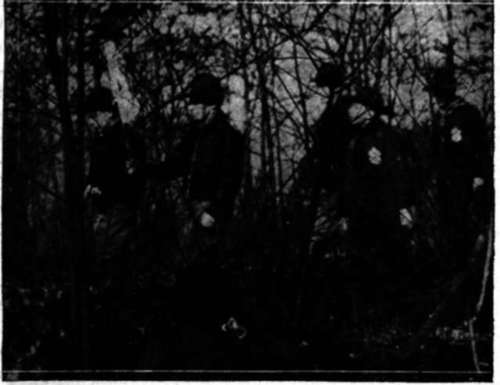
Indians say that moving objects are easily seen. Complete immobility often is perfect camouflage. Try it in stalking.
The race may be made more interesting by using a short verbal message, which invariably will be garbled beyond recognition before it is delivered by the last runner.
3. Sealed Orders (Mystery) Hike (Purpose: The Development of Scoutcraft Knowledge)—See Sample Hike No. 27.
4. Shadowing (Purpose: Training in Stalking)— One Patrol is told to shadow a party of "desperadoes" (another Patrol or the rest of the Troop) who are advancing through the country. The Patrol that is shadowing must follow on as closely as possible, with one or two Scouts ahead to signal when it is safe for the rest to advance. If the "desperadoes" see a Scout shadowing them, they may give chase; and if the Scout is overtaken, he becomes a prisoner and must march with the "desperadoes." (It is necessary to touch a shadower to make him prisoner). The "desperadoes" may divide themselves into two parties and join again further on, or some of them may stay behind in ambush. If the "desperadoes" cannot throw the shadowers off their tracks within a certain distance (IV2—2 miles), or capture more than half of the shadowers, the "desperadoes" are defeated. If the game is to continue, another Patrol takes the part of shadowers.
5. Ambushing (Purpose: Training in Stalking)—A group of Pioneers (two Patrols) advance along the trail, with Scouts walking in front of and behind them to prevent a surprise attack. The Indians (also two Patrols) follow them. They shadow the Pioneers as they advance, until a suitable part of the country is reached, when one of the Indian Patrols attempts to get ahead of the Pioneers by going around in a semicircle and joining the trail again further on. If the Indian Patrol succeeds in doing this, it hides in ambush and attacks the Pioneers when they arrive. For the ambush to be a success the other Indian Patrol should be able to attack at the same time and should therefore be close behind the Pioneers. If the Patrol making the semicircle is seen, all of the Indians in both Patrols may be captured by being pursued and touched by the Pioneers.
6. Far and Near (Purpose: The Development of Observation and Memory)—Before starting out, the Scouts have read to them twice a list of items to notice on the road. Then the Patrols set out, each with a Troop leader carrying a scoring card on which are the names of the Scouts in that Patrol. Whenever a
Scout notices one of the items required, he immediately notifies the leader, or, if it is an article, hands it to him, and receives the points specified on his score sheet. The highest individual score in a Patrol makes that Patrol the winner; or the individual scores in each Patrol may be added, in which case the Patrol having the highest total is the winner. Items may be footprint of an animal, a bird's nest, a burned match, a stone with a hole in it, a tree struck by lightning, an ant hill, etc.
7. First Aid Hike (Purpose: The Development of Scoutcraft Knowledge)—See Sample Hike No. 25.
8. Hare and Hounds (Purpose: The Development of Observation)—See Sample Hike No. 7.
Singing And Yelling
"The American Scout doesn't sing enough," was the comment of a foreign Brother Scout visiting in this country. When one is hiking with a group of Scouts, one is apt to feel that possibly he is right. We do not sing enough on the open road. Most often we just hike along, silently. And yet, the American boy likes to sing—and sings well, too, if given a bit of encouragement.
Make every effort to turn your Troop into a singing Troop. Singing is a magnificent morale builder. It creates enthusiasm and pep. It makes the distance shorter. It develops group spirit.
Look over the marching songs in Songs Scouts Sing, and select some of the more familiar ones. Get one of the Patrols to start singing, and very shortly a regular singing contest is on. Songs will be dug out from hidden corners in the boys' minds. Harmonizing will make its appearance. And the last couple of miles will be covered easily.
Yells, too, should be encouraged. Each Patrol will render its own, and will add to the Troop's repertoire of cheers for all occasions.
At The Destination
Finally the Troop arrives at the hike's destination, where the preparation of the meal will be undertaken and where further activities will take place.
Immediately upon arrival, the Patrol Leaders gather with the hike leader or leaders, make a quick survey of the grounds and choose their Patrol sites for fire-making and cooking. The Patrol Leaders call their Patrols to their respective sites, and arrange their haversacks and equipment in neat order—preferably in a "duffel-line." The Senior Patrol Leader or other leader should make a general inspection of the sites from time to time to see to it that the Patrols keep their spots free from paper, equipment and chips scattered around. If a rigid check along this line is made the first couple of times the Troop goes hiking, the Patrols will soon get into the habit of keeping their spots clean without any further reminders. The slogan should be: "You will have no mess to clean up later if you have made no mess in the first place."
The further procedure depends upon the type of activities scheduled.
Demonstration
If this is the first hike, for example, and fire building and cooking are the topics of the day, a demonstration of proper firemaking would be timely. This demonstration, put on by a couple of junior leaders, should involve clearing the ground, preparing tinder, breaking wood in proper pieces, laying the fire, and lighting it. It would also be worth while to show the use of dingle-stick and pot hook, or of a simple hunter's fire crane.

Let the Scouts try out their skill. Let it be their own fireplace. Some day they will have to go it alone. This is the preparation period.
The demonstration should be snappy and to the point. The boys are impatient to show what they can do. As a matter of fact, many leaders feel that the boys should have a chance to try the thing themselves before a demonstration is put on to show how effectively it can be done.
Other features of the day may definitely require preliminary demonstration:
Axemanship, for example. A good axeman should demonstrate the safety precautions and the technique before the Scouts start their work. If bridges are to be built, the proper lashes should be shown first. Judging and measuring methods, use of compass, making smudge fires for smoke signaling, staking off land and track casting should all be demonstrated prior to the boys' own experimentation.
Experimentation
The experimentation takes place within the Patrols, possibly in the form of Patrol contests with definite projects to be completed within a definite length of time, such as constructing a stone or a log fire place, lashing of four tressels for a signal tower, measuring heights and distances, etc. In each instance the Patrol Leader will report to the hike leader as soon as the project is completed for judging and comment.
Examination
The Scouts should know that every hike—with very few exceptions—will provide a period during which they may appear before a leader who will examine them in Scout Requirements.
In the early days of the Troop's life, such period might take in the whole Troop, involving the examination of those who are ready, and the further training of the others in the same subject.
When the Troop has become older, and the Scouts have advanced to various heights on the ladder of Scoutcraft achievement, the examining should be arranged so that it will not break up the regularly scheduled activities of the hike. The examiner—or examiners—will take the boys aside, independent of the rest of the Troop, and put them through their paces.
Games And Contests
In addition to those used on the out-trip, it may be advisable to include a few games and contests—on a Patrol basis—while at the destination.
These may be events over large territory in which each Patrol has its own objective and does not directly compete with the other Patrols, such as Sealed Orders, Explorers, Treasure Hunts, Hare and Hounds, or other games bringing in various Scoutcraft subjects such as Signaling, Scout Pace, Compass, Observation.
Or they may be competitive games such as Capture the Flag, Border Scouting, or some Wide Game.
If it is not desirable to scatter the Scouts over a wide area, races and relays will be in place, such as Antelope Race, Human Obstacle Race, Chariot Race, Skin the Snake, Knot-tying Relay, Knot Hoop Relay, Stick Relay and many others.
See index for these games.
Outdoor "Living"
A great deal of emphasis should be placed on the fact that "Hiking is Preparation for Camping" and that "Camping is Outdoor Living."
This, of course, means that the special items which are needed for successful camping should be emphasized and that the Patrols should get a real taste of orderliness, cleanliness and cooperation, and skill in camp cookery.
On the first hikes, individual or buddy cooking is in place. But after the boys have met their cooking requirements for Second and First Class ranks the Patrols should do their cooking by Patrols—that is, preparing a complete meal for the complete Patrol using the Patrol's cooking utensils. This necessitates the securing of some equipment and the development of a Patrol organization plan.
In this the Patrols will need special guidance. Suggest that they start with a primitive cooking outfit (such as two sets of nesting pots made from two No. 10 tin cans, two three-pound Crisco cans, two one-pound coffee cans and two frying pans from a five-and-ten-cent store) and get better pots as they earn the money with which to purchase them. The building of simple menus should be discussed at meetings of the Green Bar Patrol, and the Patrol Leaders should be shown how it simplifies matters when each boy brings from home the ordinary staples, such as sugar, flour, potatoes, onions, etc., to be pooled together into a Patrol larder, sometimes only necessitating the purchase of meat.
After a number of hikes with practice in Patrol cooking, the Patrols will have learned much about the culinary problems involved in camping.
Continue to:


My Books

