


Camp Fire And Ceremonies
Description
This section is from the book "Handbook For Scoutmasters. Volume 1 & 2", by Boy Scouts of America. Also available from Amazon: Handbook For Scoutmasters.
Camp Fire And Ceremonies
If the hike is held in the late afternoon and evening, it may be concluded with a short camp fire, containing a program as suggested in Chat 30.
This would provide an excellent occasion and an appropriate setting for the Tenderfoot Investiture Ceremony and for the presentation of badges to Scouts who have advanced to higher ranks.
Clean-Up
Before the Troop starts the return trip, the Patrols should be given adequate time for cleaning their respective sites, thoroughly. As the Patrols are satisfied that they have completed their job, the Patrol Leaders report to the hike leader. When all reports are in, the members of the Troop Leaders' Council are called together to make an inspection, the Scoutmaster commenting upon the findings.
The site should not be left until it is in the same condition in which it was found upon arrival—or preferably, better condition.
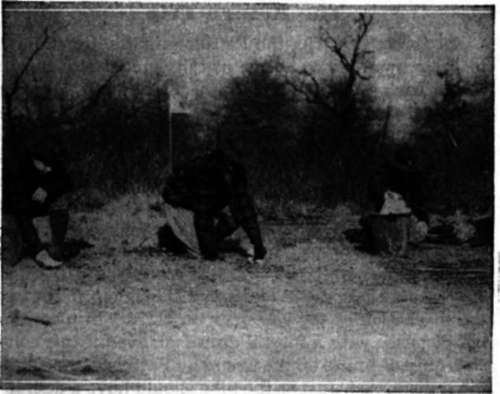
Make the policing of the cemp site a Patrol contest. Put the game element into all hum-drum tasks. They become fun, not drudgery.
Another important point: Don't start the return journey before the boys have cleaned themselves thoroughly. There is no reason why they should be permitted to arrive home looking like a bunch of hobos, but every reason why they should enter town as smart-looking, real Scouts. For this purpose instruct the Patrols in advance to bring a piece of soap and a few paper towels that can be discarded after use. Also, each Patrol Leader should give his fellows an inspection before dismissal, at which neckerchiefs, drooping stockings, and the like are made neat. A slicked-up return will make a good impression on the public in general and upon the parents in particular.
The Return Trip
For the return trip, the Patrols might better be left to their own devices. Any activity undertaken on a Troop basis is apt to prove an anticlimax. Now the boys are as eager to get home as, earlier, they were eager to get out.
The return should preferably be over a route different from the out-journey, and should be planned in such a way that the boys will arrive home at the time scheduled or before. Of course, suggestions given previously in regard to the out-trip hold good for the return trip as well.
Whether you decide to dismiss the Troop following the inspection of the site or upon arrival in town, do not dispense with a formal dismissal, even if this consists only of lining up the Troop by Patrols and declaring it dismissed. Just as the hike should have a definite beginning, it should have an equally definite ending.
After The Hike
After the hike, the leader in charge should prepare a short report of the advance plans and how they were carried out, including such ideas for improvement as may have suggested themselves. This will prove a valuable addition to the Troop's program file.
To follow up on the interest created on the hike, the "story" of it—"the truth and nothing but the truth"— should be told at the next meeting by a Scout or a leader. This will add to the store of memories, create a laugh or two and make those Scouts who did not participate eager to take part on the following hike.
At the same time the question may be sprung: "When and where shall we go next? Talk it over in your Patrol so that your Patrol Leader can present your ideas at our next Troop Leaders' Council!"
Continue to:


My Books

