


Chat 16. His Attendance And Tenure
Description
This section is from the book "Handbook For Scoutmasters. Volume 1 & 2", by Boy Scouts of America. Also available from Amazon: Handbook For Scoutmasters.
Chat 16. His Attendance And Tenure
THE aim of Scouting, as we know, is character-building and citizenship training.
But "Rome was not built in one day." Neither is character. Nor is training for citizenship accomplished overnight. Influencing human behavior is a task which requires a considerable period of time. So if the Troop is to perform its purpose and make Scouting a vital part of the life of the boy, it must be conducted in such a way that it will maintain his interest and hold him sufficiently long to instil in him the principles and spirit of Scouting.
How long a period is required? That, of course, depends upon the individual boy, his home and school and religious training, his special abilities and numerous other factors. Yet experience has shown that a minimum of four years tenure will enable most boys to realize the values of the Scout Program, to experience and to apply the Scout ideals.
It should be your aim then, to keep the majority of your Scouts for at least four years, under the influence of a genuine Scouting Program, thoroughly understood and correctly followed.
This Can Be Done, Itecause It Is Being Done
You cannot get the boy's assurance when he comes in that he will stay for four years. It would obviously be unfair to ask him for it.
But there is one thing which you can do: You can make his experience in the Troop so exciting, so close to his expectations of what Scouting is that he will stay, that he simply won't want to leave the Troop- not even after four years.
You won't need a fortune-teller to tell you if the possibility of a four-year tenure is present. A very simple item will indicate it to you. The boy's attendance at Troop and Patrol meetings and outdoor activities. That is your immediate index of what the future has in store.
His attendance shows his interests and his satisfaction-and those two things alone, are what will hold him in the Troop.
Checking Your Scouts' Attendance
To determine at any given time your chance of holding your boys, analyze the attendance of your Scouts.
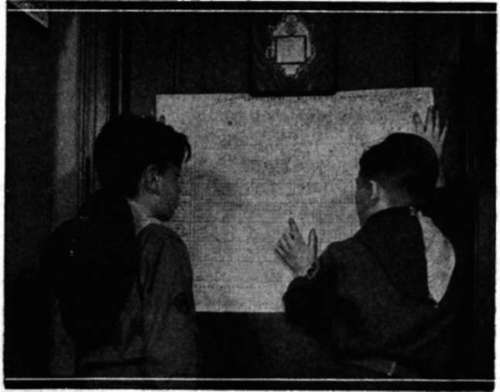
Growing in Scouting ability. Being able to care for one's self any where, and under any conditions. Advancement is recorded here.
If it is high, there is smooth sailing ahead. If it is poor, better take new compass bearings and soundings and rechart your course. In other words, check up on the following vital points and correct those that prove weak:
How Were The Boys Received?
Often the Scouts with poor attendance are the ones who never felt that they had joined anything. If a boy slips into Scouting casually, it is ten to one that he will attend casually also. That is why such great emphasis was placed in Chat 15 on the proper reception for the new boy, the correct type of friendly "interview" between the Scoutmaster and the boy, and upon an impressive investiture ceremony.
How Is The Program?
If a boy continuously fails to attend meetings, there is always present the rather disturbing surmise that he may be exercising good judgment. Put yourself in the Scout's place and give yourself a frank answer to this question: "What would I miss if I failed to show up?" Whenever boys are given something to come for, they usually come. A satisfied "customer" comes back again and again.
And what about hiking and camping? The boy joined Scouting because of its promise of adventure in the out-of-doors. Is he getting it? Or has he been disillusioned? In studying numerous Troops it has been found that the ones with the highest attendance and the longest tenure are those with a planned, vigorous outdoor program, with "something doing" continuously.
Are The Patrols Patrols?
Does the boy find in his Patrol the comradeship he has hoped for? Or does his Patrol consist of a number of fellows who are comparative "strangers" to each other, made into an artificial unit for convenience only, lacking the life and spirit of a true Patrol? A boy will not lightly break his relationship to a closely-knit gang in which he has entwined his whole-hearted loyalty.
Are The Boys Steadily Advancing?
If the boys have a desire to advance steadily and are given the chance to do so, you will find no difficulty in securing high attendance and long tenure. A study made some years ago revealed that the average tenure of the boy who did not advance beyond Tenderfoot was 1 year 5 months, while those that reached
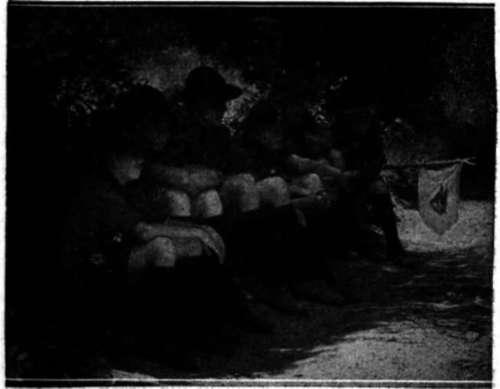
Resting in the shade this Patrol has been places and done things. Patrol spirit runs high. They follow their Totem flag.
Second Class remained 2 years 5 months, and those reaching First Class 3 years 4 months. Another study recently held showed that Scouts who had reached Eagle Rank showed a tenure in excess of 5 years. The point apparently is to make the boy, upon joining, enthusiastic about reaching the top of the ladder in Scouting.
The Individual Contact
And, finally: Do your boys find in you a man who tries to understand them, who draws out their most manly qualities and latent leadership abilities, who is sympathetically helping each Scout with his own problems, who is patient, yet firm, friendly and enthusiastic?
Remember that your greatest concern is the individual Scout, If the boy has truly accepted you as his leader, he will follow your foot steps through years of Scouting adventure.
Securing Attendance
Unquestionably the best ways to secure attendance are those mentioned above: to welcome a new Scout properly into a Troop with an active program carried on through real Patrols whose members are steadily advancing-while they see in you a real friend and companion.
But even then, there will always be boys who do not immediately catch the spirit.
Study carefully the attendance records of the Troop, check the names of boys who have shown irregular attendance, and discuss them in the Troop Leaders' Council, on the supposition that it is the Patrol Leader's duty to see to it that his Scouts attend. Find out, if possible, the reason for irregular attendance. Possibly the boy may have been sick or may have had some other good excuse-but failed to notify his Patrol Leader.
In all instances, it is up to the Patrol Leader to see that his Scouts are present or have informed him in advance that they will be absent. Attendance should be considered heavily in the Patrol's efficiency.
In case of a Scout who may seem to lack interest, the Patrol Leader should telephone or call upon the boy and remind him, or even go around to his house on Troop meeting night to call for him. At times the Senior Patrol Leader, or even in extreme cases, the Scoutmaster himself, may reinforce the reminder to those who are likely to fall down. A telephone or postcard message, "You know, I'm counting on you, old man," will do a lot to insure a careless Scout's presence, and may be the first step toward developing in him the traits of regularity and reliability.
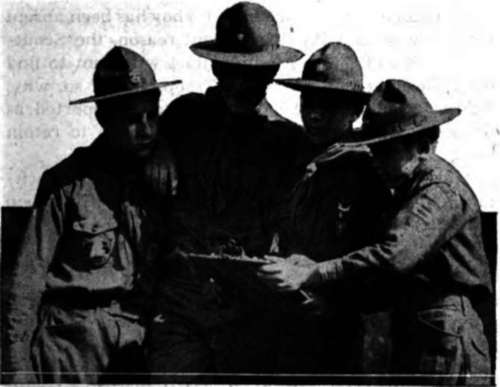
These Patrol Leaders, some with years of Service and leadership, know how to keep attendance high. They plan thrilling programs.
Continue to:


My Books

