


Chat 17. His Growth
Description
This section is from the book "Handbook For Scoutmasters. Volume 1 & 2", by Boy Scouts of America. Also available from Amazon: Handbook For Scoutmasters.
Chat 17. His Growth
WITH all our talk about tenure, it must be realized that tenure itself means nothing. It is what happens to the boy during that tenure, what he is becoming, that counts. Tenure is the means to an end and that end is the growth of the boy. The three-fold objective of that growth is expressed very clearly in the Scout Oath:
"... physically strong, mentally awake, and morally straight."
These together cannot fail to make a good citizen. The boy who, as a good Scout, lives the Oath and Law will grow.
Physically Strong
Physically strong is not meant to imply that it is necessary or even important for a Scout to develop his body after the model of a professional strong man with huge muscles developed to handle great weights, but rather that he should see to it that his body is kept fit at all times to meet the demands of life.
His body is and will continue to be at one and the same time, the home, the vehicle and the protector of his life and its vital forces; as long as life lasts that one body will continue to be his shelter. He cannot replace it with another one as he might an old car with a new one. Pretty big job for a few pounds of bone, muscle and blood, isn't it?
No boy of Scout age needs be told that a house needs regular inspection and occasional repair to keep it from going to pieces, that an automobile or bicycle needs service as well as guidance to keep it going.
When ne applies the same sort of thinking to himself he will have little difficulty in understanding why it is important that he keep physically fit.
Many a man has found his efforts to go ahead slowed down or stopped by a physical defect that could have been easily and inexpensively corrected in his youth.
Of course, another excellent reason for him to desire to keep fit is to satisfy his ambition to excel in games, or to fully enjoy sports which require physical strength and skill, and, almost without exception, the most success comes to him who is in the best physical condition.
The Medical Examination
The medical examination of a boy in the doctor's office and the inspection of a motor car by an expert mechanic in a service station have much in common- both test each part to find defects if they exist in order that such defects may be corrected.
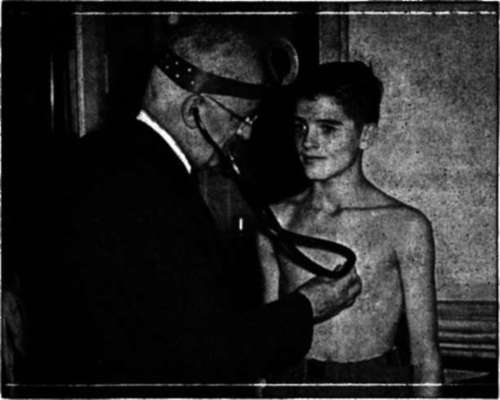
The good doctor listens with his stethoscope. "Heart action, normal." "Lungs, normal." A typical American Boy Scout.
It is important for two reasons for a boy to have a medical examination made when he first enters Scouting:
First, for his own protection in order that it may be determined whether or not he is suffering from an abnormal condition which might cause serious consequences if he were permitted to take part in such exercises as running, climbing or swimming. It is a fact that many drowning accidents actually result from defective hearts or some other disease which causes its victim to become unconscious in the water.
Second, in order that a boy and his parents may know of his condition-whether he may participate without restriction in all activities; whether his play should be limited to the less exhausting games and sports; or whether he has minor or major defects that need correction in order that he may grow up without such a handicap.
A medical examination is a great factor in protection, and in stimulating correction.
The Parents' Part
In planning these examinations, the Troop will need the cooperation of the parents. Unless they have an understanding of what the Troop is trying to do, they may not see the reason for the examination, or may be unwilling to incur the expense. On the other hand, their full cooperation will be forthcoming when they realize all that is involved.
The parents may want the physical examination to be made by their own physician, a procedure that should be encouraged. However, in many instances the Troop Committee may secure a physician to act as the Troops doctor, and conduct the examinations with the approval of the parents. Forms are available in the Local Council Office or from the National Office for this purpose. On this form the parents are asked to give the Health History of their son.
From these examinations and from the doctor's recommendations, the Scoutmaster will get a true picture of the boys' health, and be in a position to protect him when on a Troop activity. He will also be able to help the weak boy to build his strength, the normal boy to retain his, and the boy with physical defects to set them right.
Exercise
Every growing creature needs exercise, and fortunately for us nature has established in the growing boy a desire for action and fight, which provide that exercise.
As Gunnar Berg says: "Just observe a group of boys going about their own business, and what do you see? Action, lots of action. Much of it seemingly aimless, just running about, here, there and everywhere, up the trees, down by the river side, walking along the edge of the high fence, tumbling around, wrestling, jumping. A horrible waste of energy? Not at all. It is nature's way of taking care of the boy's needs. The boy's muscles cry aloud for motion, activity and the expenditure of energy. Only in this way can they reach the development and control that a man should ultimately have.
"The foundation for this muscular control is laid in the period of growing up. In Scouting we provide for this foundation through rough and ready games, hiking, camping, exploring, swimming. We even recognize and make use of that other urge of the boy: for fighting. Boys will fight and so will men. And it is not our intention to knock out the desire of the boy to indulge in such questionable activity.
"Far from it! To deprive the boy of his natural desire to stand up for his own right also deprives him of the necessary stamina to stand up and face the world of adult competition and strife; it makes him a weakling. Instead, Scouting encourages this urge but directs it away from the point of someone's jaw to socially useful goals. We preserve it in form, but guide its application."
In Scouting we use no formal physical exercise. The outdoor program of hiking and camping and their related activities suffices, if properly promoted and properly carried out.
Health Habits
Our greatest chance for helping the Scout to establish proper health habits is probably at camp. Here he is directly under our influence for twenty-four hours of every day.
The habits of his life may be strengthened or changed during those hours. Possibly he will realize for the first time the advantage of fresh air, personal cleanliness and sufficient sleep. If this is to be true, however, the camp and its leaders must be of high standards.
And in addition to the positive health habits, it is also important that by example we teach and help the Scout to avoid those things which undermine health and happiness. The old adage is still good: "Avoid things which cause headache or heartache." The Scoutmaster's example must help here.
Continue to:


My Books

