


Chat 2. The Game Of Scouting
Description
This section is from the book "Handbook For Scoutmasters. Volume 1 & 2", by Boy Scouts of America. Also available from Amazon: Handbook For Scoutmasters.
Chat 2. The Game Of Scouting
SINCE the day of the founding of the Boy Scouts of America in 1910 more than seven million boys and men of our country have been Scouts. Why? Because the boys wanted it! Because the founder of the Scout Movement had the genius to outline for youth the picture of the ideal boy, a picture which appealed to the imagination and captured the hearts of boyhood around the world.
The Panorama Of Scouting
To an outsider, Scouting must at first appear to be a very complex matter. If it were only possible to swing the gates of Scouting wide open to him and show him from a vantage point in one immense view the full panorama of the Scout Movement! Under the open sky he would see gathered hundreds of thousands of wide awake, red-blooded boys, busily occupied with self-appointed tasks, practices expected and required of real Scouts, ranging from the sending of signals with flags from hill-top to hill-top, to lighting a fire by primitive means-all living, breathing, absorbing Scouting.
The boys swarm around him, and as one of them runs by he asks him: "Tell me, what is Scouting?"
As the boy passes, his smile and his answer come back: "Scouting is fun!"
He bends over a boy who seems to have forgotten his surroundings, completely absorbed in preparing a simple outdoor meal, and asks the same question.
And the boy answers as he looks up wonderingly: "Scouting is adventure!"
A bunch of Scouts, led by one of their number, comes running and, as they draw near, their answer sings out: "Scouting is comradeship!"
Thus the boys define their own activity, their game.
And GAME-that is the word.
Scouting As A Game
To a boy Scouting is a game, a magnificent game, full of play and full of laughter, keeping him busy, keeping him happy.
That is the strength of Scouting! A boy becomes a Scout for the sheer fun there is in it.
The action in Scouting appeals to the boy's impulse to be doing something. The meetings, hikes and camps are essentially periods of activity. Even the code of Scout conduct is presented to him in terms of action-
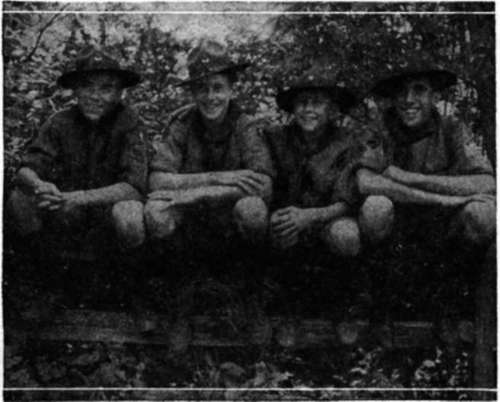
Resting on an old rail fence these four Scouts are enjoying themselves. Comradeship and fun are by-products of a hike.
"Be Prepared," "Do a Good Turn Daily." In fact, the basic principle in Scouting is "Learning by Doing." There is nothing negative in it. There is no "Go up in the attic and see what Johnny is doing and tell him he mustn't;!" There are no "Don'ts." Scouting does not say "Don't rob birds' nests," but "Find out about birds." It does not say "Don't cut down trees," but instead "Help save the trees." That is talking boy language-stimulating, not prohibiting.
There is adventure in Scouting. There is adventure in tackling a job alone-all by oneself, or with the gang. There is adventure in finding Good Turns to do every day. There is adventure in pioneering, exploring, out-door living.
There is companionship and fellowship in the Patrol, the natural unit in Scouting. There is always present an urge to achieve. A harder task, a higher rank always looms ahead; there is distinction to be gained.
The Man In The Boy
As Dean James E. Russell, the educator, says: "To the boy who will give himself to it, there is plenty of work that looks like play, standards of excellence which he can appreciate, rules of conduct which he must obey, positions of responsibility which he may occupy as soon as he qualifies himself-in a word, a program that appeals to a boy's instincts, and a method adapted to a boy's nature."
And he continues: "Every task in Scouting is a man's job cut down to a boy's size. The appeal to a boy's interest is not primarily because he is a boy, but particularly because he wants to be a man. Each one of these tasks holds the boy, not only because he is a boy and likes to do them, but also because they are tasks which grown men find useful. It is the man in the boy that is emphasized, and the type of manhood idealized is that which strives to stand for the right against the wrong, for truth against falsehood, to help the weak and oppressed, and to love and seek the best things of life."
Scouting In A Nutshell
Here, then, is Scouting in a nutshell: A game for boys under the leadership of boys with the wise guidance and counsel of a grown-up who has still the enthusiasm of youth in him. A purposeful game, but a game just the same, a game that develops character by practice, that trains for citizenship-through experience in the out-of-doors.
Chat 3. The Elements Of Scouting
CHARACTER and citizenship-these are our aims. But they are not peculiar to Scouting alone. So what are the essential elements which contrast Scouting with any other program for boys?
The answer is best provided in the words of the Chief Scout Executive, Dr. James E. West, who for more than a quarter of a century has guided the destinies of the Boy Scouts of America:
Continue to:


My Books

