


Policies. Part 5
Description
This section is from the book "Handbook For Scoutmasters. Volume 1 & 2", by Boy Scouts of America. Also available from Amazon: Handbook For Scoutmasters.
Policies. Part 5
Labor Movement And The Boy Scouts Of America
The American Federation of Labor, at the Annual Meeting held in Rochester, November, 1912, made an exhaustive report upon the Boy Scouts of America. The report deals with the history of the Movement, and its objectives and the program through which these objectives are to be attained. The report closed with the endorsement of the Organization by the American Federation of Labor.
The policy of the National Council is consistently and invariably one of non-interference, or non-competition. Boy Scouts, as such, and in Uniform, must not enter into industrial competition which the world's regular workers very properly regard as "unfair." It is the obligation of every Scout official to maintain this policy, and to see to it that no individual Scout involves the Boy Scouts as an organization in industrial competition.
Loyalty
By the provisions of Article XII of the Constitution, only men who are citizens of the United States, or those who have legally declared their intention to become citizens of the United States, or citizens of countries or territories under the control of the United States, may be commissioned for any form of leadership in the Boy Scout Movement. In the case of minors, born on foreign soil, only those may be accepted for membership as Boy Scouts who take an Oath of Allegiance to The Flag and the Government of the United States. But this is not enough. There must be active loyalty on the part of the Boy Scout membership. A suspicion of disloyalty must not remain unchallenged. The Boy Scout Movement is founded upon the principle of absolute loyalty. It is intolerable that a man commissioned by the National Office should make an utterance or give instruction which the Scouts interpret as unpatriotic. Every such case should be promptly and thoroughly investigated by the proper authorities, and unless perfect loyalty of the Scout Leader is established, a recommendation to the National Council for the revocation of his commission should be made.
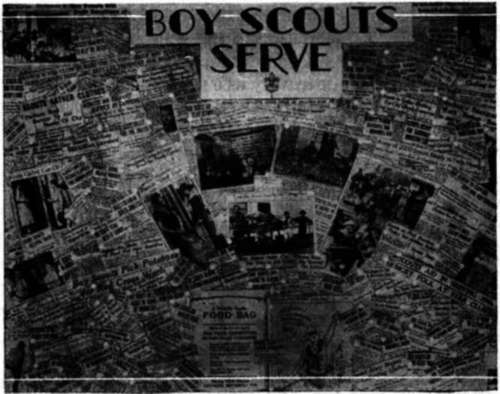
Scouts show their loyalty to their country by active work for its welfare-by service to others.
At no time in our history as a nation has there been a greater need for one hundred per cent Americanism than today. The Boy Scout Movement is unequivocal in its position upon this point, and will accept, or continue in membership, only those who are unreservedly loyal to our Government.
Participation In Public Functions And Parades
The By-Laws of the Boy Scouts of America state: Article XVI, Section 3-The officers and leaders of the Boy Scouts of America shall, when practicable, cooperate in connection with civic or other public gatherings of a non-partisan and non-political character in a way which gives Scouts an opportunity to render service in harmony with their training as Scouts, instead of merely taking part in parades or making a show of themselves in their Uniforms,
Political Questions
The Constitution of the Boy Scouts of America states:
Article III, Section 2-The Boy Scouts of America shall not, through its governing body or through any of its officers, its Chartered Councils or members, involve the Boy Scout Movement in any question of a political character, but each official and member shall have freedom of thought and action as an individual.
Professional Scouters Not Eligible To National Council
Members of National Council must not be Professionally Engaged in Scouting. By-Laws, Article I, Section 1, Clause 4.
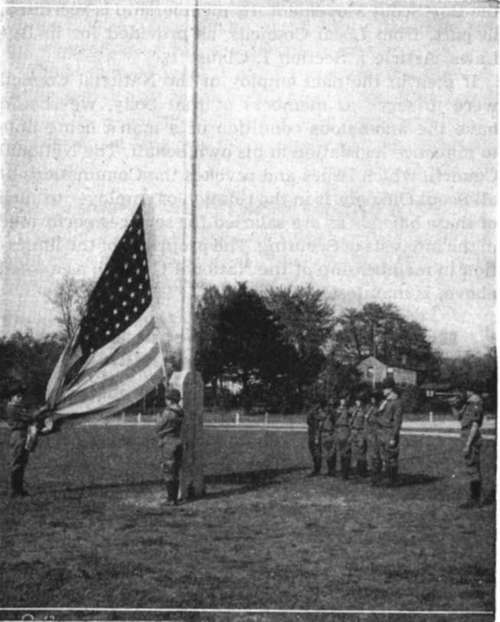
The Stars and Stripes rise as the sun rises, and are lowered as the sun sets. Scouts learn respect to The Flag and loyalty to their country.
The object of this provision of the By-Laws is obvious. The National Council, through its authorized agent, the Executive Board, is the executive organ of the Boy Scout Movement. Its membership is recruited, in part, from Local Councils, as provided for in By-Laws, Article I, Section 1, Clause 1.
If men in the paid employ of the National Council were to serve as members of that body, we should have the anomalous condition of a man's being able to influence legislation in his own behalf. The National Council, which issues and revokes the Commissions of all Scout Officials, is in the relation of employer to such of these officials as are salaried for services performed in the interests of Scouting. The propriety of the limitation in membership of the National Council, as quoted above, is manifest.
Registration Fees Of Scout Troops Organized In Institutions
Troops have been organized in orphanages and other institutions where the boys have no way of raising money to meet their annual membership-some have proposed that the registration fee be paid by a donor. The National Council is opposed to the principle involved in this plan. The plan advocated in such a case is, that the sum of money which would have been forthcoming for the payment of the dues be useU as a fund from which prospective Scouts be paid for services rendered. Such a plan makes it possible for a boy to earn his way in Scouting, and in so doing, increase his sense of self-respect and independence.
Scout Commissioners Not Paid
The Scout Commissioners of various ranks serve without compensation.
Scoutmaster Gives Voluntary Service
Of over 230,000 men serving boys through various capacities in the Scout Movement less than 1,000 are under salary. These devote their entire time to creating conditions which will facilitate service.
These include local Scout Executives and their assistants and also Field Scout Executives. The Scoutmaster is a volunteer worker who finds part of his recreation in this patriotic service of companionship with boys.
Scouters And Their Commissions
Article XII of the By-Laws deals with the leadership of the Boy Scouts of America, and from it the following provisions are quoted:
Commissioned Scouters
Section 1, Clause 1-In accordance with Article XII of the Constitution, the National Council may issue commissions to men to serve as Scoutmasters, Skippers, Lone Scout Friends and Counselors, Cubmasters, Lone Cub Friends and Counselors, Assistant Scoutmasters, Mates, Assistant Cubmasters, Scout Commissioners, Field Scout Commissioners, District Scout Commissioners, Neighborhood Scout Commissioners, Scout Executives, Assistant Scout Executives, Field Scout Executives, District Scout Executives, Camp Directors and Assistants, Educational Directors and Assistants, Chaplains, Regional Scout Executives, Deputy Regional Scout Executives, Special National Field Scout Commissioners and National Scout Executives. The above officials with the exception of Assistant Scoutmasters, Mates, and Assistant Cubmasters, must be at least twenty-one years of age.
Definition of "Scouters" and "Cubbers"
Section 1, Clause 2-"Scouters" is the collective designation for all registered Scout Officials and Adult Members (Active and Associate) other than Boy Scouts, classified as Council (Local and National) Scouters and Troop Scouters.
"Cubbers" is the collective designation for registered Pack Committeemen, Cubmasters and Assistant Cubmasters.
National Council Approval
Section 1, Clause 3-All recommendations from Local Councils or Troops not under Council, for commissions or certificates of membership are subject to the approval of the National Council.
Continue to:


My Books

