


Constitution Of The Boy Scouts Of America
Description
This section is from the book "Handbook For Scoutmasters. Volume 1 & 2", by Boy Scouts of America. Also available from Amazon: Handbook For Scoutmasters.
Constitution Of The Boy Scouts Of America
A committee was next appointed to draft a constitution to conform to the Federal Charter. The Constitution, drafted by William D. Murray, E. P. Bicknell, C. P. Neill, Paul Sleman and James E. West, was presented to the Executive Board on February 19, 1917, and adopted.
It has been referred to by competent authorities as an outstanding document providing for democracy without loss of the power to safeguard what is done for boys.
Because of the seven years of experience and service it was possible to incorporate into the Constitution- and the By-Laws-those principles of organization and policy which were considered of fundamental importance by those who have been responsible for the development of the Movement. Among these principles is the insistence that no one can receive a commission for leadership in the Movement who does not declare his belief in a God and demonstrate that he is an American citizen or has legally taken steps to become one.
The World War And The Scouts
On April 6, 1917, the United States entered the World War. Within twenty-four hours Scouts throughout the country were being mobilized for service to the Government. They sold Liberty Loan Bonds and War stamps to a value of more than two hundred million dollars. They located twenty million board feet of walnut for use in the trenches, collected a hundred carloads of fruit pits for gas masks, distributed Government literature, and rendered ceaseless service in a number of other ways, including food and fuel conservation, emergency coast service, planting and harvesting of thousands of Boy Scout gardens and working as dispatch bearers for the Government.
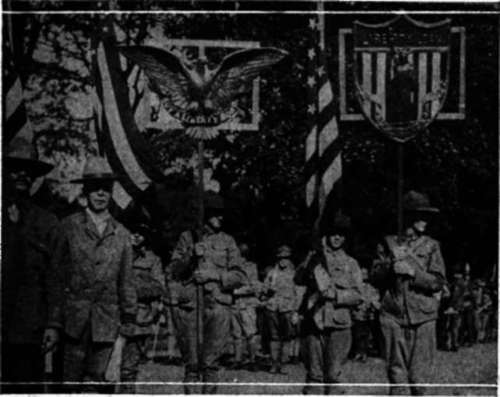
Within twenty-four hours following United States' entering the World War Scouts throughout America were mobilized for service.
For their efforts they received the commendation of the American people and the praise of President Wilson who, in a special proclamation stated:
"The Boy Scouts have not only demonstrated their worth to the Nation, but have also materially contributed to a deeper appreciation by the American people, of the higher conception of patriotism and good citizenship."
This Presidential proclamation was the call for the celebration of a special Boy Scout Week, June 8-14, 1919, during which the American Public was asked to recognize the contribution which Scouting was making to the Nation through its youth.
Continued Service
The war was over, but the work of the Scouts for the country was not. They continued by aiding the Department of Labor in its Americanization program, by rendering Nation-wide first-aid service in the influenza epidemic and in numerous other ways.
Regional Organization
In 1920 came the significant Regional Organization by which the country was divided, for effective organization and service into twelve Regions, following somewhat the geographical lines of the Federal Reserve Bank System area. The plan was adopted in order to secure a more complete coverage and to establish firmer cooperation between the Local Councils which were being created throughout the United States.
In order further to make effective the work of the local Scout Executives, a special training conference was held the same year at Bear Mountain, N. Y. The conference was so productive that it was decided to hold others at regular intervals of two years. These conferences were held in Blue Ridge, N. C, 1922; Estes Park, Col., 1924; Hot Springs, Ark., 1926; and on the campus of Cornell University at Ithaca, N. Y., 1928. They stopped with the onset of the depression, to be resumed in 1936, at French Lick, Ind., with the return of more nearly normal times.
World Contacts
It was not only nationally but also internationally that great steps were taken in 1920. That year is significant for the first of a series of international Scout gatherings, so-called World Jamborees, which have helped to firmly establish the Scout World Brotherhood.
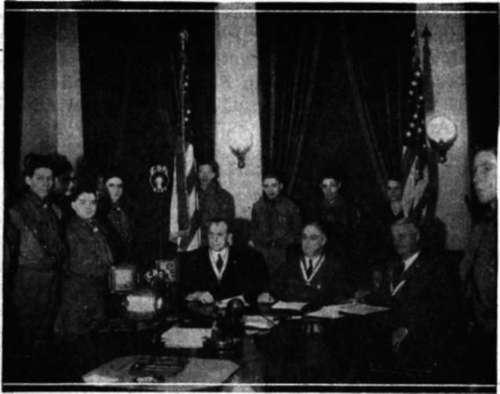
President Roosevelt, President Head and Dr. West at a Broadcast inaugurating a Good Turn on a National scale (Feb. 1934).
The first World Jamboree took place in London, England, and was attended by 1,500 Scouts from 37 countries, including 356 American Scouts and Scouters.
The second World Jamboree followed four years later at Copenhagen, Denmark. Six thousand Scouts gathered in a large camp outside the Danish capital. The Boy Scouts of America was represented by fifty-six picked Scouts, forming a special Jamboree Troop.
Arrowe Park, England, was the scene of the Third and largest World Jamboree, in which fifty thousand Scouts, representing 73 lands, camped together. The American delegation at this occasion numbered 1,300.
The Fourth World Jamboree was held at Godollo, Hungary, in 1933, with 21,000 Scouts participating, with an American contingent of 402 Scouts and Leaders, and the Fifth was in Bloemendaal, Holland, in 1937, with an attendance of 26,000 Scouts, including 814 Americans.
Honorary Presidents
President Harding accepted the Honorary Presidency of the Boy Scouts of America in 1921, following President Wilson.
One of the contributing causes to the success of the Movement has been the intelligent, wholehearted way in which the Chief Executives of the United States--Taft, Wilson, Harding, Coolidge, Hoover and Roosevelt, have taken an active part in the work of the Movement.
Scout Service
Throughout the second decade of our Movement great progress was made and numerous examples of the service that Scouts can render in emergencies and disasters were demonstrated-in the Knickerbocker theatre disaster in Washington, D. C; the floods in Pueblo, Col., San Antonio, Texas, and in Arkansas; the Illinois tornado; tornadoes in St. Louis and Omaha; the Florida hurricane; the Louisiana fire and the California earthquake.
Changes In Presidency
Colin H. Livingstone retired as President of the Boy Scouts of America in 1925, after fifteen years of outstanding service, and James J. Storrow was elected as his successor. At the first Executive Board meeting over which he presided, he began to develop opportunities for training courses for the professional leaders of the
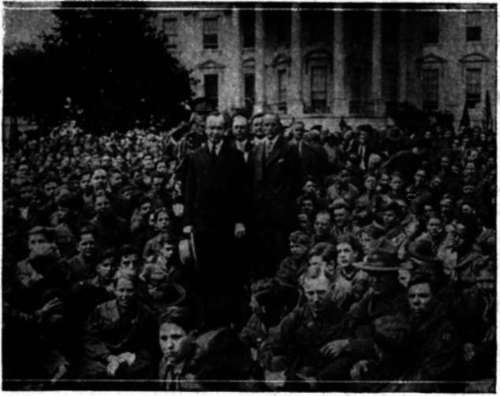
President Coolidge with Scouts on the White House lawn. The President of the 0. S. a. is the Honorary President of the b. S. a.
Movement. He lived just long enough to make this training a reality, the First National Training School opening at Bear Mountain Inn, N. Y., October 24,1925, with forty-three men in attendance.
Upon Storrow's death in 1926 Milton A. McRae, Vice President, was elected to fill his term. At the annual meeting which soon followed, Walter W. Head was elected President, a post he has held ever since with the exception of two months in 1931, to the great benefit of the Movement.
At this same meeting, the newly established Award for Distinguished Service to Boyhood, the Silver Buffalo, was presented for the first time to a number of nationally and internationally famous workers for boys. The first was given to the late Baden-Powell, the
Chief Scout of the World, who attended the meeting in person, while the second went to the Unknown Scout whose Good Turn brought Scouting to America.
Continue to:


My Books

