


American Scout Oath And Law
Description
This section is from the book "Handbook For Scoutmasters. Volume 1 & 2", by Boy Scouts of America. Also available from Amazon: Handbook For Scoutmasters.
American Scout Oath And Law
In framing the American Scout Oath and Law an effort was made to reword the English originals into a form that could be readily grasped by boys and become a part of their daily thinking in work and play.
The most significant revision of the Scout Oath was the inclusion of the third part, "To keep myself physically strong, mentally awake, and morally straight"- body, mind and spirit.
A notable change from the original Scout Law was the addition of three more points: A Scout is Brave, A Scout is Clean, and a Scout is Reverent. The Boy Scouts of America is proud of being distinctive among the Scout Movements around the world because of the fundamental twelfth point of the Scout Law emphasizing the importance of reverence in training of the boy. Great credit is due to the Chief Scout Executive for the inclusion of this twelfth point which also established a policy which became of great importance to the development of the Boy Scouts of America.
The American Scout Oath and Law were adopted in May, 1911. As evidence of the thoroughness of this and other efforts to Americanize the Boy Scout Movement, it is interesting to note that after the Committee had spent nearly four months in conference and study, its recommendations were submitted to the college presidents of the country with the specific request that either the president individually or a designated group of his specialists share in the responsibility of passing upon the suggested revision. As a result of this wide consultation, the Scout Oath and Law took the form, which they have kept to this day. (See pages 36 and 37).
First American Handbook For Boys
In the early part of 1911 the manuscript for the first American Handbook for Boys was developed under the direction of an Editorial Board consisting of William D. Murray, George D. Pratt, Frank Presbrey and A. A. Jameson.
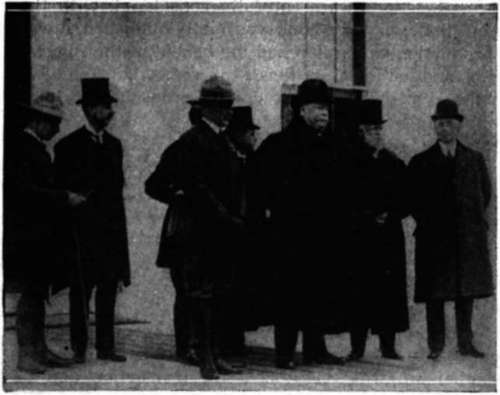
Baden-Powell at the White House for first Scout review. President Taft, Lord Bryce and Colin H. Livingstone are with him in front row.
After the manuscript was completed, the Editorial Board and the Chief Scout Executive felt it was too serious an undertaking for the Boy Scouts of America to inject itself into an educational procedure for the boys of America, without sharing the responsibility with others.
Therefore a limited proof edition of five thousand copies was printed, and these copies were sent to all the Scoutmasters of the day, all Scout Commissioners, all Boy Club leaders, all Boys' Work Directors of the Y.M.C.A., and many superintendents of schools, for suggestions. Thirty days were allowed for this purpose.
The suggestions were carefully considered, with the result that, when the book was finally published, it was a production which had had the benefit of the suggestions and editorial criticism of somewhat like five thousand people-a most unique procedure in book publishing.
The first edition appeared on August 31st, 1911, and so great was the demand that 156,750 were sold in the first year. Since then it has run through total printings of over five and a half million copies. The fifth million copy was presented to President Roosevelt at a special ceremony on April 13, 1935.
Boys' Life
From the very beginning of the Movement in this country, the need for a periodical publication for its membership was recognized, for instruction and to provide good reading.
In 1912 a Committee, consisting of Frank Presbrey, William D. Murray, and Daniel Carter Beard, was appointed to consider the matter of a magazine for boys. It was discovered that Joe Lane, a young man of eighteen in Providence, R. I., was publishing a magazine called "BOYS' LIFE," referred to by the editor as "the semi-official publication of the Boy Scouts of America."
The name of the magazine and its list of 6,100 subscribers were valuable assets, and after considerable negotiation, the purchase of the magazine was authorized by the Executive Board on the condition that it paid for itself. The first issue published by the Boy Scouts of America appeared in July, 1913.
Out of that meager beginning has grown a magazine which is now published monthly in 300,000 copies and has become a great and vital factor in the program of the Boy Scouts of America, guided by the Chief Scout Executive himself as Editor-in-Chief.
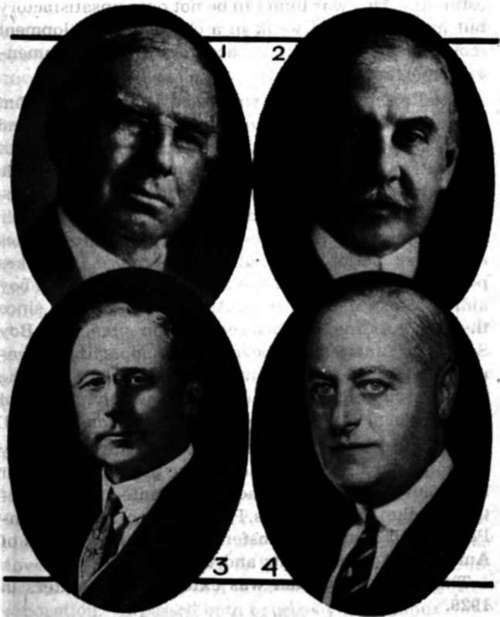
Former Presidents, Boy Scouts of America: (I) Colin H. Livingstone, (2) James J. Storrow, (3) Milton A. McCrae, (4) Mortimer L Schiff.
Registration
In 1913 the registration plan was developed. Prior to this time all of its statistical data had been based upon estimates. This was found to be not only unsatisfactory but misleading and weak in a character development movement where truth and accuracy are of fundamental importance.
The Registration Plan was created for an important educational purpose, namely, of instilling in the mind of the Boy Scout in a very definite manner a clear cut realization that he is connected with a nation-wide movement which is supported by the national organization, as evidenced by the certificate given him over the signatures of the President of the United States and other national officials. Furthermore, it makes possible an extension of the Scout principle of the boy aiding to pay his own way. As a matter of fact, since the inauguration of this registration plan, the Boy Scouts of America has been a self-supporting movement for all of its ordinary operating expenses. The money secured by contributions from individuals and Local Councils has been devoted to extension and field.
The registration plan also helps to insure that only boys in good standing as Scouts are permitted to wear the Scout Badge, which had been granted full protection by the United States Patent Office after Baden-Powell had formally transferred to the Boy Scouts of America all of his rights and title.
The registration plan was extended to Scouters in 1929.
Federal Charter
Then, on June 15, 1916, a Federal Charter was granted to our Movement by Congress.
Many different things led up to this honor.
We were six years old and had had time to show the public what Scouting really is. While the difficulties had been numerous, we had achieved almost complete success in building up one Movement for America and maintaining its unity. Our registration system and the procedure for granting charters and commissions annually, which afforded a very definite protection against undesirable men as leaders of boys, were strong points. Of course, the program itself is in tune with the nature of boyhood, and growing numbers of men were giving time as volunteers.
Members of Congress knew also about the Scout Good Turns, what Scouts had done in the Ohio Floods of 1913, at the Gettysburg Reunion, at the inauguration of President Woodrow Wilson, the Woman's Suffrage Parade and the Reunion of the Grand Army of the Republic, and our cooperation with the Red Cross and many others. They had heard the commendations we had received from Federal and State officials for the work of Scouts.
The bill providing for the Federal Charter, known as H.R. 755, was introduced by Representative Charles C. Carlin, of Virginia, and was referred to the Judiciary Committee. It was favorably reported on February 7, 1916. In its report the Committee said, among other things, "The importance and magnitude of its (the Movement's) work is such as to entitle it to recognition and its work and insignia to protection by Federal incorporation." It passed both houses by unanimous consent-the House on March 6th and the Senate on May 31st-the last day of the session.
In the presence of Colin H. Livingstone and James E. West and some Scouts, President Wilson signed the bill on June 15, 1916.
The Charter provided the Movement with protection from people or organizations who might try to profit by the good repute and popularity of the Scout Movement by imitating its name for commercial or other purposes, and gave the Boy Scouts of America the sole right to use its uniform and distinctive insignia.
Continue to:


My Books

