


Part IX. History And Policies. Chat 24. History Highlights Of The Boy Scouts Of America
Description
This section is from the book "Handbook For Scoutmasters. Volume 1 & 2", by Boy Scouts of America. Also available from Amazon: Handbook For Scoutmasters.
Part IX. History And Policies. Chat 24. History Highlights Of The Boy Scouts Of America
A leader in a movement of the size and scope of the Boy Scouts of America would be greatly handicapped in his work unless he were familiar with the main facts about its development and growth and the background of its traditions and organization. Especially is this so because from the very outset the Movement has been, as it is today, almost entirely dependent upon volunteer leadership for its success, for formulating its endeavors, for creating its traditions. The history of its past is the story of the work of those who have gone before you-while the history of the future will be written by your efforts and the efforts of your Brother Scouters.
It is, of course, not possible to set forth all of the facts connected with the development of the Boy Scouts of America in the few pages available in such a book as this. Neither is it necessary, since the story is told in the History of the Boy Scouts of America, by William D. Murray, that grand pioneer of American Scouting. We shall therefore attempt to give only a few of the highlights from the official history and refer you to that volume for the more complete treatment.
February 8, 1910
The Boy Scouts of America was incorporated under the laws of the District of Columbia, on February 8, 1910, by W. D. Boyce, Edward S. Stewart and Stanley Willis. Mr. Boyce, whose interest was occasioned by the performance of a "Daily Good Turn" by a London lad, as described in Chat 1, employed the attorneys and brought together the men who participated in this initial step.
Prior to this time a number of groups of Boy Scouts had been organized in various parts of the United States using the English literature and equipment. The publicity given to the incorporation of the Boy Scouts of America in the daily press and magazines soon made necessary the opening of a national office, which was established at 124 East 28th Street, New York, N. Y., through the courtesy of the International Committee of the Young Men's Christian Association. Edgar M. Robinson, the Senior Secretary of the Boys' Work department of the International Committee, as well as other members of his staff and boys' work secretaries throughout the country, gave considerable time and effort in furnishing leadership.
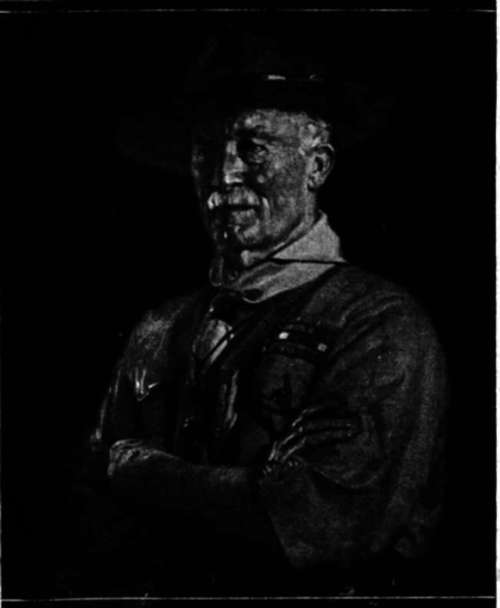
Lord Baden-Powell, Chief Scout of the World, whose book "Scouting for Boys," embodying the Boy Scout scheme, was published in 1908.
Committee On Permanent Organization
Early in the summer of 1910 it was deemed wise to secure a more representative and substantial backing. A conference was called of representatives from 37 different organizations having a definite interest in boy life. At this conference Mr. Colin H. Livingstone acted as Chairman. As a result of this meeting a Committee on Permanent Organization was appointed, consisting of Ernest Thompson Seton, Chairman; Lee F. Hanmer, Secretary; George D. Pratt, Treasurer; Dr. Luther H. Gulick, Jacob A. Riis, Edgar M. Robinson, Colin H. Livingstone, Daniel Carter Beard, Adjutant General William Verbeck and Col. Peter S. Bomus.
The original incorporators under the laws of the District of Columbia turned over to this newly organized committee all of their rights and responsibilities under the original incorporation, and men of national reputation and experience in work for boys were invited to associate themselves with the Movement as members of a National Council, which, through an Executive Board, was given full power and authority to direct the Movement. Through the courtesy of the Russell Sage Foundation, Lee F. Hanmer was detailed to aid in the development. John L. Alexander of the Y.M.C.A. was employed as Managing Secretary to give his full time in looking after the correspondence and developing pamphlets and necessary emergency literature. Preston G. Orwig was employed as Field Secretary for extension work.
Baden-Powell's Visit
Fortunately for the Movement, the infant organization was honored by a visit from Lieutenant-General Sir Robert S. S. Baden-Powell (later Lord Baden-Powell). A dinner was arranged at the Waldorf-Astoria in New York City on September 23, 1910. The presence of Baden-Powell and the publicity gained did much to focus the attention of the American people on the Boy Scouts of America as the real organization of the Boy Scout Movement in this country.
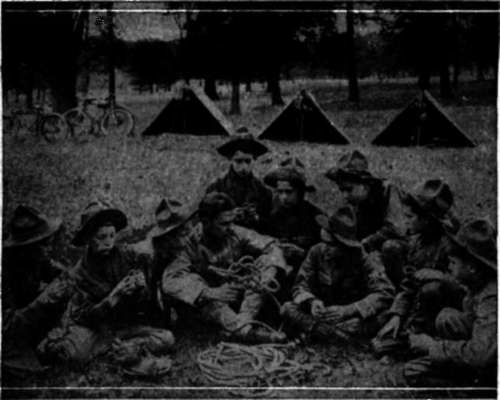
The broad-brimmed hat was a feature of the Uniform from the earliest days when boys set out on the Scouting trail.
A United Effort
This was especially important since the enthusiasm of the general public in accepting the Scouting idea had led to the forming of a number of movements unrelated to each other, such as the "Boy Scouts of the United States," with Col. Peter S. Bomus as Chief Scout; the "National Scouts of America," under Adjutant-General William Verbeck; the "American Boy Scout," afterwards changed to the "United States Boy Scout," sponsored by William R. Hearst; the "Peace Scouts of California," the "Y.M.C.A. Scouts."
By November 1910, all of these, except the group financed by William R. Hearst, had united in the Boy Scouts of America. Later (in 1917) the Hearst group consented to the entry of a judgment in the New York Supreme Court, dissolving the "United States Boy Scout."
The Movement's First Literature
The demand for information from all parts of the country compelled the hasty production of literature giving an outline of the Movement. Six bulletins were written and an American version of Baden-Powell's "Scouting for Boys" prepared under the direction of Ernest Thompson Seton.
Early Leaders
During September and October, 1910, the Committee on Organization was busy forming a National Council. A number of leading citizens were approached with an invitation to become members.
The position which the Movement had attained in the few months of its existence is reflected in the answers to this invitation. Prominent men, already committed to heavy obligations for public service, gladly accepted.
President Taf t consented to serve as Honorary President of the Movement, and former President Theodore Roosevelt as Honorary Vice-President and Chief Scout Citizen. Gifford Pinchot, became Chief Scout Woodsman. Ernest Thompson Seton was elected Chief Scout, which office he held until 1915. Daniel Carter Beard, Adj.-Gen. William Verbeck, and Col. Peter S. Bomus were elected National Scout Commissioners, in which position "Dan" Beard has continued to serve, inspiring each Scout and Scouter in the Movement with his pioneer spirit and his love for the out-of-doors. Other men of national reputation accepted membership on the National Council. The following men were elected as representatives of the first Executive Board, with
Mr. Livingstone as Chairman: W. D. Boyce
Mortimer L. Schiff
W. D. Murray
Seth S. Terry
Colin H. Livingstone
Lucien T. Warner
George D. Pratt
Lee F. Hanmer
Frank Presbrey
E. M. Robinson
And the following ex-officio members: Daniel Carter Beard Adj.-Gen. Wm. Verbeck
Ernest Thompson Seton Col. Peter S. Bomus
Of these men, Colin H. Livingstone, Dan Beard and William D. Murray are still members (1938) of the Executive Board.
James E. West
The need for a permanent Executive Officer was felt more and more. After a careful search, a young Washington attorney, James E. West, was recommended for this post, and an invitation was extended to him. After a meeting with the Executive Committee, West agreed to assume leadership responsibility for a period not to exceed six months, with the understanding that he would set up an organization, make a thorough survey of what, if any, changes should be made to adapt the Movement to meet American boy needs, produce necessary literature and put the Movement on a sound organizational basis.
Either he or the Executive Committee was free to terminate the arrangement within the six months, but -the six months never ended. The man chosen was the man for the job-the leader who was to carry the Boy Scouts of America forward from a small organization to a great national Movement. As the British Movement owes so much to the genius who created it, so we in America have had, and still have, a genius, and we are indebted to James E. West-first Executive Secretary, but soon after Chief Scout Executive-for the long and creative leadership he has given to the Boy Scouts of America.
It was a great day in our history, when on January 2, 1911, he opened the office in the Fifth Avenue Building, New York City, with a staff of seven people.
First National Council Meeting
The first meeting of the National Council was held February 14 and 15 in Washington, D. C. At this meeting Colin H. Livingstone was elected the first President of the Boy Scouts of America. The members assembled in the East room of the White House and were addressed by President Taft. It was the unanimous opinion of those present that different committees should consider all phases of the Movement as it had been developed in different countries and thus determine what revisions would be helpful to thoroughly adapt Scouting to the needs of the American boy.
These committees were the Committee on Standardization of the Scout Oath and Law, Tenderfoot, Second Class and First Class Requirements, with Professor Jeremiah W. Jenks, then of Cornell University, as Chairman; Committee on Permanent Organization and Field Supervision, H. S. Braucher, Secretary of the Playground and Recreation Association, Chairman; Committee on Badges, Awards and Equipment, Dr. George J. Fisher, then Director of Physical Education of the International Committee of the Y.M.C.A., Chairman; and Committee on Finance, with Mortimer L. Schiff, Chairman.
It was agreed that the report of these committees should be acted upon by the Executive Board as representing the National Council and included in an American Handbook for Boys.
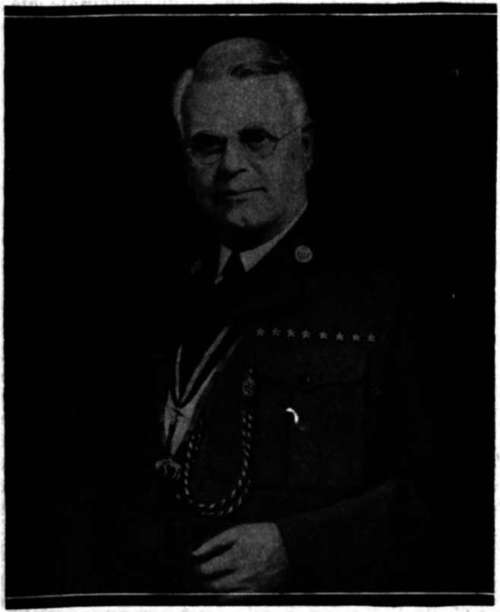
DR. JAMES E. WEST. Chief Seoul Executive and Editor of Boys' Life
The committees worked earnestly and devoted much time and thought to the consideration of meeting their duties.
Continue to:


My Books

