


Part VIII. Growth Of The Scoutmaster. Chat 23. Scoutmastership Training
Description
This section is from the book "Handbook For Scoutmasters. Volume 1 & 2", by Boy Scouts of America. Also available from Amazon: Handbook For Scoutmasters.
Part VIII. Growth Of The Scoutmaster. Chat 23. Scoutmastership Training
THE Scoutmaster grows with his boys. As they advance, you will advance. As they grow in leadership so will you. Not in the same manner by any means, but just as surely. And as you grow an urge will come upon you to grow faster. You want to be further ahead. You want to reach out and gather the experiences of others that you may bring them into the Troop and aid your boys, you want to have new Scoutcraft skills and new visions to place before them.
This is the surest sign that you are alive to the needs of your boys.
It happens occasionally that a Scoutmaster-especially a new one without previous Scouting experience -will isolate himself from other leaders and other Troops. Feeling uncertain, he does not want anyone outside the Troop to see his uncertainty. He reasons: "Some day, when I have a really good Troop I'll show them." He forgets that the way to build a good Troop is to see how good Troops are run, to harvest the experiences of others. He is also forgetting that those others are his brother Scouts-that there is in them the desire to help, not the desire to criticize and belittle.
The more a Scoutmaster gets out of his shell and seeks the aid of others the quicker he grows, the more successful he will be in running his Troop or Tribe or Neighborhood Patrol, and the easier will be his work.
The Printed Page
The earliest training a Scouter is apt to get is from the printed, page. As a matter of fact, no Scoutmaster can get along without continuous reference to the Official Handbooks of the Boy Scouts of America. His minimum library should surely contain:
(1) Handbook for Boys-which contains the technique of Scoutcraft in terms that the twelve-year-old boy can understand and enjoy;
(2) Handbook for Patrol Leaders-which gives to the boy leader an understanding of his job and a multitude of suggestions for carrying it out;
(3) This Handbook for Scoutmasters-which shows how the Patrols are coordinated into the Troop and describes ways and means of making effective in the lives of the boys the ideals of Scouting.
(4) "Scouting" magazine-the official monthly publication for Scouters-which is sent to all Scout leaders. In its pages are found program material for meetings, hikes and camps, games and stunts, articles by successful Scoutmasters on their methods in running their Troops, besides news of the National and International Scout Brotherhood and all official announcements of the National Council and decisions of the Executive Board.

The Round Table-Scoutmaster meets Scoutmaster and they exchange workable, usable, practical ideas. They learn by doing.
The official monthly magazine for Scouts, BOYS' LIFE, provides the Scoutmaster with inspiration, stories for retelling around the camp fire or in the meeting room, suggestions for handicraft projects and activities that may be carried out in the Patrols or in the Troop.
Whenever the need arises for information or suggestions on specific Troop activities, the Scoutmaster will find them in the pamphlets of the Service Library, published by the Boy Scouts of America. References to many of these pamphlets have been made in the previous pages. For a complete description of the contents of all of them, request the Literature Catalog from the National Supply Service.
The Merit Badge Library contains individual pamphlets on the various Merit Badge subjects. They may be secured as the boys come to the point when they want to set out on the trail toward higher advancement.
But a Scoutmaster should not confine his reading to books on Scouting alone. On the contrary, it is important that he read other books which, as Gilcraft says, "will widen his outlook and give him an understanding of the world in which he is training his boys to become citizens. It has to be realized that in order to show a boy how to take his proper place in life, the leader has to know something about life himself."
Personal Contacts
When all is said and done it is through personal contacts with other leaders that you will get your best and most rounded training.
The very set-up of the Local Council provides for training facilities for all the leaders within it. As a matter of fact, the Council is specifically charged with the responsibility of making training available. It does this through its Council leadership and by encouraging get-togethers of Scouters within its domain.
The Local Council office is the Scouter's service station, and the Scout Executive is ready and willing tc assist with problems. To him you can go for help toward solving your problems. And if you cannot go to the office, the Local Council will send a representative to you, through its field service of Field Executives.

Scoutmaster Training Courses may start formally. They become groups of enthusiastic men doing Scout activities and Patrol stunts.
Field Commissioners, District or Neighborhood Commissioners.
Through Council activities you will be thrown in contact with other Scoutmasters and will get the chance to talk over with them various problems, exchange ideas and arrange for visits to their Troops to see how they are run.
Informal Training
Scouters of the same Council, district or neighborhood often get together for Round Table Discussions, during which they listen to a presentation on a phase of Scouting by one of their number and afterwards analyze it and consider its pros and cons to the mutual benefit and enjoyment of all.
At times, the Local Council calls in its Scouters for Training Conventions or Training Conferences relative to the running of their Troops, with a program of special talks, demonstrations, fellowship and fun, through which the Scouters are enabled to serve more effectively the boyhood of their community.
Special Training
The Council runs periodic Training Courses along definitely established lines on a Council-wide or District basis. These contain all the subjects a Scoutmaster is apt to come up against as he runs his Troop.
Such Training Courses are, in the words of Baden-Powell, "helpful in showing Scouters the shorter cuts to success as evolved by experienced trainers of Scout-craft-and in saving them unnecessary labor. At the same time these courses can also be of infinite use in assisting new hands to pick up the threads quickly and effectively."
They all contain a minimum of talk and a maximum of action. Those attending are organized into a Troop, with Patrols carrying on games and projects, the aim of the courses being "to help boys to become men by helping men to become boys."
Camp Training
Of all training practices, the training that you will receive by camping with your boys for days at a time in a real Scout camp, under the supervision of the Local Council, is at the same time the most effective and the most beneficial. In all other training you are with men, imitating the activities of boys in an effort to learn them. In camp you learn them directly with boys, by guiding them after you yourself have been guided. Here the activities take on their real per spective, here you see the true application of the Scouting principle of training-"Learning by Doing"-and at the same time provide your boys with a camping experience under their own Scoutmaster.
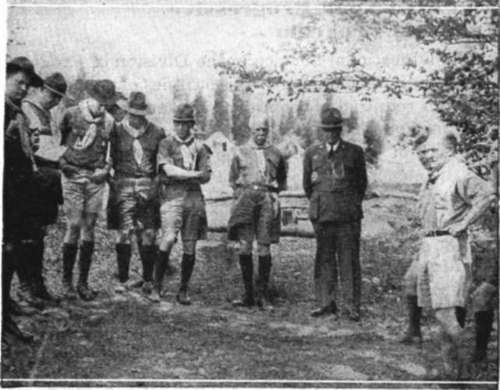
A group of leaders at the Rover Camp. J. S. Wilson, Gilwell Camp Chief, and Chief Scout Executive Dr. James E. West, at tracking pit.
Training Awards
Scoutmasters take training for the sake of their boys, often consuming much of their valuable time to do so. Our organization, through its Local Councils, shows its appreciation of the Scoutmaster's efforts toward raising the standards of Scouting by presenting him with special certificates for participation in approved courses. The Scoutmaster's Key, the highest award for Scoutmasters, is awarded upon his completion of the Five-Year Progressive Training Program.
The Five Year Progressive Training Program
The Educational Service in the Division of Program at the National Office provides outlines of courses that are both required and optional as training toward the Scoutmaster's Key. These course outlines stress the necessity of understanding the objectives of Scouting and the elements of the Scout Program through which we seek to attain those objectives in the lives of boys. They also stress methods that may be used in presenting the program, both in its general scope and as related to specific activity features. And in addition they give to the Scouter a knowledge of source material which will enable him and his Troop to carry forward over a period of years.
The Award Of The Scoutmaster's Key
Upon completion of the Five-Year Progressive Training requirements and certification by the Local Council Court of Honor to this effect, as well as five years of satisfactory service, a Scoutmaster is eligible to receive the SCOUTMASTER's KEY. (Years of service as an Assistant Scoutmaster will not be credited.) A minimum of three years service as a Scoutmaster and the balance in some form of Commissioner service is acceptable.
For Scouters who are not Scoutmasters, but who complete the required Five-Year Progressive Training Program, and who have met the requirement of five years of satisfactory service, a Scouter's Key is available to be awarded upon the recommendation of the Local Council and certification by its Court of Honor.
Continue to:


My Books

