


Chat 44. Air Scouting
Description
This section is from the book "Handbook For Scoutmasters. Volume 1 & 2", by Boy Scouts of America. Also available from Amazon: Handbook For Scoutmasters.
Chat 44. Air Scouting
TODAY's world is an air world. Thousands of Scouts are deeply interested in aviation. At Council Circuses, Scouts have shown their skill in making and flying model airplanes. From time to time, "air meets" have been held in Scout Camps. Year after year Scouts have qualified for the Aviation Merit Badge since 1912.
Air Seoul; Candidate Awards
The Civil Aeronautics Administration started its air training program at the college level. Now, the Air Scout Program reduces aero-dynamic principles to projects that a Scout can do. Salted through the program are many opportunities to make airplane models of new and distinctive design. Others may read about the "flying wing" but the Air Scout may make and experiment with it as a model. To meet the demand by Scouts for aviation training there is now available to the Scout, within his Troop, the Air Scout Program. This program offers attractive and useful aviation activities, short of actual flight, which bring together the leader and the Scout to aid the development of the boy into a "man of character trained for participating citizenship," while exploring aviation.
If, under fifteen years of age, the Scout may qualify as an Air Scout Candidate by meeting certain requirements as follows:
Tenderfoot Air Scout Candidate. The Tenderfoot Scout, to become an Air Scout Candidate, must: 1. Present an acceptable model airplane he has built himself, suitable for flying or for exhibition, and, 2. Submit a list of ten safety practices related to aviation.
Second Class Air Scout Candidate. A Second Class Scout may qualify for the miniature Double-bladed Propeller Insignia of the Second Class Air Scout Candidate by completing: 1. The Two Tenderfoot Air Scout Candidate Requirements; 2. Aviation Merit Badge; 3. Airplane Structure Merit Badge; 4. Weather Merit Badge.
First Class Air Scout Candidate. A First Class Scout may qualify for the miniature Triple-bladed Propeller Insignia of the First Class Air Scout Candidate by meeting the following: 1. The four Second Class Air Scout Candidate Requirements; 2. Aerodynamics Merit Badge; 3. Airplane Design Merit Badge; 4. Mechanical Drawing or Electricity Merit Badge; 5. Signaling or Radio Merit Badge.
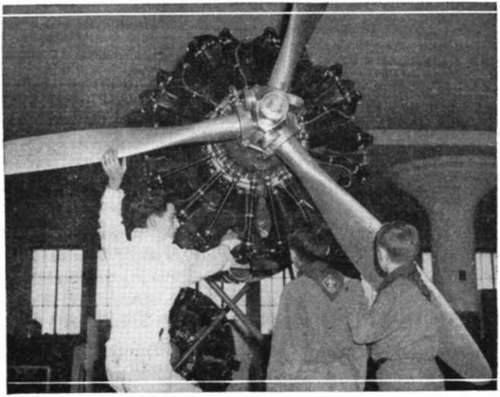
Americans understand machinery. Most basic modern patents are American. Scouts will excel in Air Scouting.
The wise Scoutmaster will encourage his Scouts to follow Air Scouting, not just for the sake of the present but, also to stimulate their interest in Air Scouting as a Senior Scout activity. You will note that the Air Scout Candidate ranks are based on the Merit Badges enabling the Scoutmaster to use the Merit Badge Counselor for the technical aviation knowledge.
Air Scouting — A Senior Activity
Where Scouts have had their interest in aviation fed in the Troop they can go on into Senior Air Scouting when they become fifteen.
Getting Started
Air Scouting can be conducted in a number of ways. Any Scout may as an individual pursue aviation through Air Scouting. This might be the case in a comparatively young Troop with only one eligible boy of Senior status. On the other hand, with several air-minded Seniors, the Scoutmaster, an Assistant Scoutmaster, or some aviation expert interested in youth, may undertake the formation of the Scouts into a special group—an Air Scout Patrol or Crew— for the purpose of pursuing their common interests.
Further, an already established Explorer Patrol or Sea Scout Patrol may decide to specialize in aviation in addition to their activities in the woods or on the sea.
Apprentice Air Scout
To become an Air Scout a Scout must meet the entrance requirements as an Apprentice Air Scout:
1. Be fifteen years of age.
2. Know and put into practice in his daily life the Scout Oath and Law.
3. Outline 10 basic rules of air safety.
4. Show his interest in aviation by at least one model airplane he has made.
5. Know the customary forms of respect to The Flag.
6. Present the written consent of his parents. Present evidence that he has passed a physical examination.
Previous Scout experience is, of course, desirable, but it is not required. In other words, a boy fifteen years of age who has not been a Scout may become a member of the Air Scout section of our Movement by meeting the Apprentice Air Scout Requirements.
After having met the requirements, the Scout is registered as an Air Scout, paying the regular Scout registration fee of fifty cents, and is privileged to wear, over his right pocket, an embroidered slip with the legend: "Air Scouts of America." If the candidate is already registered, no additional registration fee is required.
Air Scout Program
The program of the Air Scout specifically covers the following:
1. Specialized Advancements; 2. Projects in Aviation; 3. Visits to Airports; 4. Service to Others.
In addition, a group of Air Scouts might want to arrange for special outdoor activities, as also for social gatherings along the line of those participated in by Explorers and Sea Scouts.
Air Scout Ranks
Three ranks are available to the Air Scout: Air Scout Observer, Air Scout Craftsman, Air Scout Ace.
In this specialized advancement, a broad field of study opens itself to the Scout. With specially developed requirements and Merit Badges it moves on from the history of aviation, through the science of aviation; airplane design and building; airplane identification; the fundamentals of the aviation engine; the theory of navigation; air safety rules; weather, meteorology, astronomy and related subjects.
Projects
The work on Air Scout advancement involves many projects in aviation, ranging from the making of rubber-band and gas engine flying models, experiments with model parachutes, to testing of airplane design in a home-made wind tunnel.
Visits
As part of the required training, Air Scouts visit available local airports and schools to get first-hand information on the working operations of aviation. Such visits may be for general information, or for the purpose of observing construction details, practice in taking down an engine, landing control.
Service To Others
In all Scout endeavors service to others is an important factor. In Air Scouting this might involve the training in the Troop of Scouts not already fifteen years of age in the requirements for Air Scout Candidate, and serving as Junior Leaders specializing in instruction related to Air Scouting. Air Scouts may also undertake special service to the community, such as air labeling it; giving assistance to the local airport; messenger service and so on.
Epilogue
Looking Ahead
"The story is told."
The panorama of Scouting has been unrolled before you, with its activities, its fellowship, its fun.
Has the multitude of details left you breathless? Have you felt that you will never be able to master the mass of them?
Don't worry! The climb to the top need not be taken in one step. The rules of the Game you will learn as you play. The technical knowledge you will absorb with your boys as you hike the Scouting trail together.
Are you afraid that you will lose the way?
Never fear! The hill may seem steep and the forest dark and the road may be winding and long. But with strength of purpose and following the true course of your compass, you shall eventually succeed in leading your boys to the goal you have set.
And that goal is citizenship—and that compass is the Scout Oath and the Scout Law.
The End
Continue to:


My Books

