


Chat 6. The Rise Of The Troop
Description
This section is from the book "Handbook For Scoutmasters. Volume 1 & 2", by Boy Scouts of America. Also available from Amazon: Handbook For Scoutmasters.
Chat 6. The Rise Of The Troop
THUS, after thorough pre-natal care, the "child" enters into the world. But it is not enough that the "child" is healthy at birth-it must be kept healthy, and furthermore, it must immediately start the right habits of living. It has been found with human children that habits established in the early months of one's existence may follow him through life.
The same with a Troop. It is in its "toddling period." It should start to develop its habits of right Scout living.
This is a dangerous period and, unless it is approached vigorously, may prove fatal.
The Importance Of A Definite Program
A definite program first. A program which challenges the respect of the boy, his imagination, his capabilities, a program of romance and adventure. It was to get this that he joined. Give it to him-plan for it. Include not only your own activities but also cooperation in Local Council plans. Make yours a Troop that knows where it is going; with a program for the year -for each month of it. (See Chat in Volume II on "Planning a Balanced Program.")
Get Out-Or Go Under!
Get that Troop of your out-of-doors! At once! Doctor's orders. Hike outdoors, play outdoors, eat outdoors, sleep outdoors. No parlor Troop ever survived its first few months. Get the Troop to camp as a Troop and it will begin to find itself right then and there. (See Part in Volume II on "Outdoor Activities.")
Cooperation
If there is an older, "going" Troop in the neighborhood, tie up with it. One of the greatest helps and inspirations for a new Troop is for its leaders-from Patrol Leaders up to Scoutmaster-to visit and watch occasionally the work of a real live outfit. "We'll be as good as those birds some day" your boys will say. Throw the Troop into contact with Scout life. "Playing" with another Troop and whole-hearted participation in Council events and activities is a real factor in the growth and vision of a Troop.
A Vigorous Use Of The Patrol Method
Really live Patrols are the foundation of Troop success. Get the Troop Leaders' Council well organized, set out on a thorough training of the Patrol Leaders, expect much of them; many successful independent Patrol meetings, hikes, camps and many projects being carried to completion. (See Part IV.)
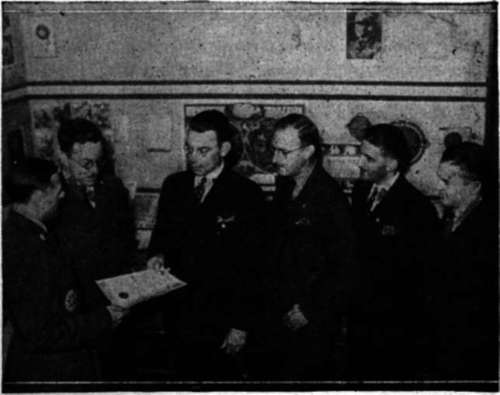
Here are the Scoutmaster's friends-the Troop Committee and the local Scout Executive. They all help him.
The Scout Uniform
As soon as possible, if you have not already done so, get a Uniform yourself and encourage your boys to get their own complete Uniforms. The wearing of the Uniform isn't compulsory, but to have your Troop fully outfitted at the earliest suitable time should be a definite objective because it will help you so much in the effectiveness of your job as a Scoutmaster. (See Chat 18.)
Recruiting
Recruiting must be continued-not fast, but naturally through the Patrols. But then-if the program of the Troop is good this point will take care of itself. The boys come where the good program is. To paraphrase slightly: "Let a Scout Troop run a real program and even though it hides itself in the deepest woods, the boys will wear a path to its door-a path? -a boulevard!" (See Part V.)
Advancement
Get the boys to advance by giving them every natural opportunity to do so, by building a program of activities that lead progressively toward greater skills and higher ranks. If the outdoor program of the Troop is built on the right foundation it will automatically provide a thorough advancement. Let the aim be "Each boy a First Class Scout" with emphasis on First Class. (See Part XIII, Vol. II.)
The Parents' Interest
Get and keep the parents' interest. For their sake, for their boys' sake, for the Troop's sake. The more they know about what Bill is getting into, the more they are apt to help Bill to be a permanent Scout. (See Chat 21.)
Rudget System
Start a budget system in the Troop to provide it with funds for equipment, badges, registration fees and BOYS' LIFE magazine. (See Chat 19.)
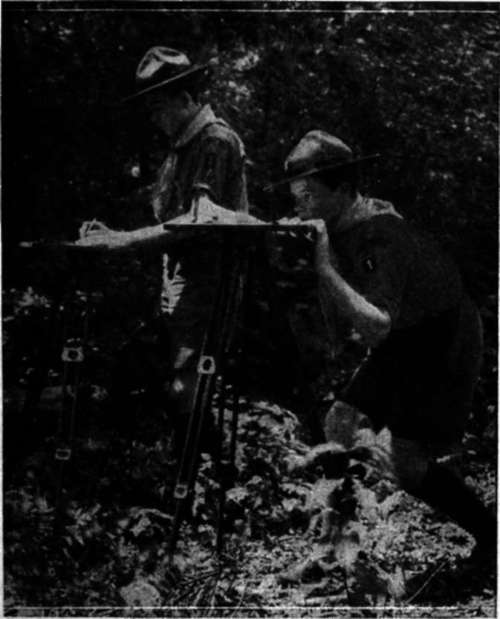
Surveying, using a real compass and plane table; going definite places makes a compass a useful bit of equipment.
Scoutmaster's Advancement
And last, but not least-advance yourself by book study, by association with other leaders, by participation in available training courses. Be forever on the lookout for ideas and stunts that may help you in your work to make the Troop a success. (See Chat 23.)
Summary Of Objectives For A Troop's First Year
At the end of the first year a Troop should reasonably have attained these objectives:
Organization
Responsible Patrol Leaders and Assistants for all Patrols.
A fully functioning Troop Leaders' Council composed of all Troop and Patrol officers and meeting regularly.
A Scribe who knows his job and is operating a satisfactory record system.
A Senior Patrol Leader in full standing.
At least one Assistant Scoutmaster qualified to relieve the Scoutmaster.
Scoutmaster and Assistants having taken the Leaders' Training Course of the Local Council.
A Troop Committee-active and helpful.
A Troop Budget Plan firmly established.
Parents' interest secured through the founding of a Parents' Auxiliary.
Program
Snappy, up to the minute weekly or fortnightly Troop Meetings with the "punch" in them that will hold boys.
At least monthly Troop Hikes and Overnight Camps.
Multitudinous Patrol Meetings and Hikes.
Satisfactory Advancement of Scouts to Second and First Glass Rank.
Impressive Ceremonies from time to time.
At least one week's camp during the summer.
At least one duly recognized Troop Good Turn.
Participation in Local Council activities.
An appreciable effect from the emphasis on Scout Ideals.
Prompt attention to the re-registration of your Troop-with full strength, which means an enrollment of as many boys as the Troop can serve (up to 32 Scouts in four Patrols with proper junior and adult leaders).
Equipment
An almost completely uniformed Troop (both Scouts and leaders).
A decorated Troop meeting room.
At least the equipment listed below:
For The Troop
Flags (American Flag and Troop flag). Record Book. Wall Chart of advancement record. Bulletin Board. General Scribe's supplies. Bugle. Material for Troop Ceremonies. Materials for use in Scoutcraft work-e.g., First aid practice kit, signal flags, ropes, etc. Camping equipment (limited).
For Each Patrol
Patrol Flag. Patrol Record Book. Handbooks for Boys and Handbook for Patrol Leaders. Scoutcraft materials-e.g., Compass, Tracking Irons, etc.
All the above points are described in greater detail elsewhere in this volume. Be sure to make use of this material.
Measuring The Troop's Worth
And then, for measuring the Troop's worth turn to the Scout Oath. It stands unchanged. As long as your boys try to live it your Troop is bound to progress and prosper. It's not what your boys wear on their Scout shirts, but the way they feel inside, that makes them real Scouts. It is not so much the face it shows to the public, but the living within it that proves the Scout Troop.
The Troop Finds Itself
The permanent Troop has begun to find itself. It struts and swaggers a little. It begins to develop Troop Traditions ("That's the way we do it in Troop 3!") It sees that Troop publicity appears in the papers and publications. It takes upon itself Troop Good Turns and service projects. The Patrol Method is in full swing. The Troop Committee is being called on to do things. Parents are not only interested, they are participating in Troop affairs. A normal balance of age and rank is maintained. Scout advancement is continuous, older boys are being used to lead. The Troop attends summer camp as a Troop with its Scoutmaster in charge.
Is it going to live? You bet! It is on its way to becoming the finest Troop in America-no, wrong!-in the whole, wide world.
Continue to:


My Books

