


The Troop Installation
Description
This section is from the book "Handbook For Scoutmasters. Volume 1 & 2", by Boy Scouts of America. Also available from Amazon: Handbook For Scoutmasters.
The Troop Installation
And then, finally, comes the moment when the group emerges as a full-fledged Scout Troop. The Charter is ready for a ceremonious presentation.
Make this occasion as spectacular as possible.
There are good reasons for having a public installation. In the first place it gives the Troop a solid start in the minds of the sponsoring institution, making it realize that the Scout Troop is a functioning body important in the community. It gives to the new unit the stamp of public approval. It gives to the parents, to the Committee, to the leaders of the institution, and to the boys, the thought that Scouting is a serious thing, a Movement with a definite purpose. It cements solidly the cooperation between Troop and Local Council.
Securing The Attendance
Careful steps are necessary to insure the attendance of parents, the Troop Committee, and the head and representatives of the sponsoring institution. A strong personal invitation written or verbal from the Scoutmaster or the Chairman of the Troop Committee should be extended to the parents of every boy and to all others who should be present. This invitation should make the importance of the occasion clear, and should be followed up in the manner best calculated to get results. Either a District or Neighborhood Commissioner or other Scout official will, of course, be on hand to represent the Local Council and to conduct the installation ceremony. Arrangements for this will have been made through the office of the Local Council.
Suggested Program For Installation
And now for a suggested program.
1. Introductions-First of all, have the necessary introductions to the parents. The head of the institution, after a word of welcome, should explain that the Troop is being formed on authority of the governing body of the institution and then introduce the Chairman of the Troop Committee, who in turn will introduce the future Scoutmaster. The Scoutmaster should say a few words about what the boys have accomplished in working for their Tenderfoot Rank and should announce that they are now ready to become Scouts. The Chairman of the Committee will then introduce the District Commissioner or other Council Representative who will invest the Troop.
2. The Installation Proper-After asking the members of the Troop Committee to stand, the District Commissioner will read the section of the National Council By-Laws (Article XI, Section 1, Clause 5) outlining their particular responsibilities. Then he will ask them: "Will you undertake to discharge these duties faithfully and to the best of your ability?" They answer, "We do."
The District Commissioner then asks the prospective Scoutmaster to stand and says further to the Troop Committee: "It is your wish that Mr. Blank should serve as Scoutmaster of this Troop?" The Committee having answered in the affirmative, the District Commissioner should say to the Scoutmaster:
"Do you subscribe to the policies set forth in the Constitution of the National Council, Boy Scouts of America, and will you serve faithfully and to the best of your abilityas Scoutmaster of this Troop?" (If there are any Assistant Scoutmasters, they should also be called upon to answer.)
After answering in the affirmative, the Scoutmaster (and the Assistants) repeat the Scout Oath after the District Commissioner. The Commissioner welcomes them all with the Scout handshake into the Boy Scouts of America and declares the Troop duly installed. (If possible, he should deliver the Troop charter and membership certificates at this time, and he may make a brief talk as well.)
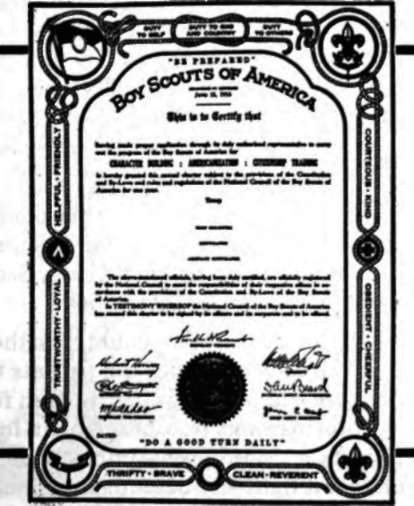
Hera is the Troop Charter. The presentation can be made a fine get-together of Parents, Scouts and Troop Committeemen.
3. Investing the Patrol Leaders-After his investiture the Scoutmaster explains the duties of the Patrol Leader and his importance in the Troop's life, and invests his Patrol Leaders, presenting them with their badges of office. (See Chat 12.)
4. Tenderfoot Investiture - The Scoutmaster then proceeds with a Tenderfoot Investiture Ceremony. (See Index.) If he prefers a very simple ceremony, he can ask the boys who have met the Tenderfoot Requirements to come forward, and after they are in a line in front of the parents he can ask them if they understand the Scout Oath and are ready publicly to assume its obligations. He may then have them repeat after him the Scout Oath, phrase by phrase, and then present their Tenderfoot Badges and membership certificates unless the latter have already been issued to them. The Chairman of the Troop Committee should shake hands with each boy (using the Scout handclasp) as his Badge is presented.
5. Scoutcraft Demonstration-At this point, inject bay action into the evening's program if found desirable. Have a demonstration of knot-tying, Scout Drill or some other Scout activities by the boys.
6. Closing-The Scoutmaster should give the closing talk, asking for the cooperation of the parents to insure unfailing attendance at meetings, permission for hikes, securing of Uniforms, and encouragement for Patrol activities. This talk is of great importance; do not hurry it, and do not fight shy of it for imagined lack of oratorical talent. Simple and friendly statement of your position is what the occasion requires. You should make it very clear, without the slightest feeling of embarrassment, that you are undertaking a service which will be a tax upon your time and ability; that in fairness to you the parents must allow and encourage the boys to attend the meetings regularly and otherwise carry out their Scouting obligations; that the values of Scouting may not be apparent at once but will gradually increase; that Scouting, like everything else a boy goes into, will involve some expense and some adjustment of family arrangements.
You'll never have a better chance to say these things; you can say them more effectively than anyone else can even if its the first public speech of your life. Don't waste this opportunity with any vague generalities; say the things suggested above, say them vigorously, with an air of friendly confidence in the outcome.
Continue to:


My Books

