


Composition Of The Patrols
Description
This section is from the book "Handbook For Scoutmasters. Volume 1 & 2", by Boy Scouts of America. Also available from Amazon: Handbook For Scoutmasters.
Composition Of The Patrols
There is the possibility that the boys, before voting, should have suggested to them how Patrols may be composed for the greatest amount of efficiency and cooperation.
As far as possible, it is desirable that boys from the same general neighborhood form a Patrol together. This will facilitate the holding of Patrol meetings and will make easier the accomplishment of many other projects. Friends, and in most instances brothers, should be encouraged to enter the same Patrol.
At times it is advantageous to have boys of the same school together. As is obvious, this simplifies Patrol gatherings greatly and makes possible numerous special activities.
This brings up the question whether it is advisable to have the boys of the Patrol all of the same age. It would seem that this might be the ideal condition, but experience proves otherwise, for often a Patrol so organized turns into an independent clique, with clique spirit instead of Patrol Spirit, and all members of such a Patrol are likely to graduate from Scouting at one time. Save in exceptional instances, the best Patrol consists of boys of varying ages. This make-up simplifies the job of the Patrol Leader and tends to insure the permanency of the Patrol. It also presents opportunities for the older Scouts to train and help the younger ones, at times at the cost of sacrificing some of their own wishes for the sake of the Patrol as a whole, a point which adds to the growth of the proper spirit.
Size Of The Patrol
Another important factor in the "ganginess" of the Scout Patrol is its size. The fact that a Standard Troop is often defined as consisting of thirty-two members in four Patrols does not necessarily mean that a Patrol with less than eight members is incomplete and inefficient. Six will work well. A Patrol may even do efficient work with but four members. Usually a Patrol with a thoroughly trained leader will grow naturally to seven or eight; but a Patrol of eight should be regarded as a maximum but not necessarily ideal.
The Patrol, then, may consist of any number between four and eight boys, including the Patrol Leader and his Assistant. This number has many advantages: (1) it approximates the natural gang formation; (2) a boy can more effectively and easily handle them; (3) it gives a Troop a number of Patrols and therefore increases chances of leadership and chances for developing responsibility.
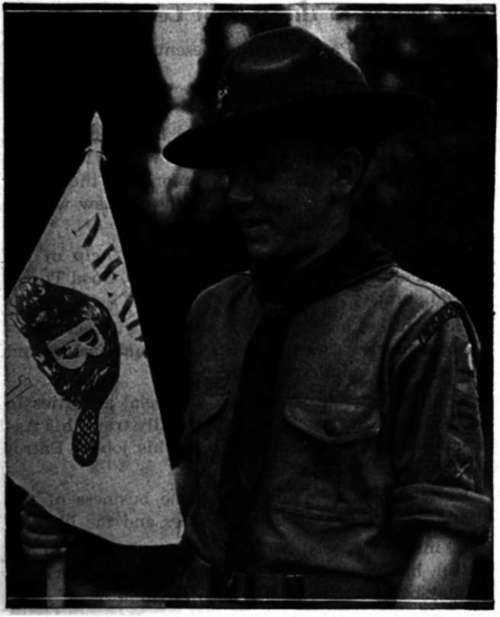
The Patrol Leader. He leads with a "Let's try this stunt," not as a boss who gives orders. He knows his fellows individually.
The Patrol Leader And His Job
The important second step is to secure the right leaders for the Patrols, after considering the duties of these future boy leaders, and the qualifications boys look for in those they are willing to follow.
The Duties Of The Patrol Leader
The office of Patrol Leader presents two sides, each with its specific duties:
(1) He is the Leader of his Patrol.
As such, he leads his Patrol by his initiative and personal example, in Scout Spirit as well as in Scoutcraft knowledge, establishing the morale of the Patrol on such a plane that the Scout Oath and Law will be realized in action.
He provides for and plans, with the help of his Scouts, Patrol activities-meetings, hikes, Good Turns, special stunts.
He furnishes inspiration for his Scouts to secure advancement, trains them in the Scout Requirements and conducts,preliminary reviews.
He deputizes the leadership of special activities to the Scouts of his Patrol, and specifically trains his Assistant Patrol Leader to take over his job of Patrol Leadership in his absence.
He is responsible for the routine business of the Patrol, its attendance, records, dues and the like.
He makes a special effort to know each Scout of the Patrol, his home, his parents, his school or work, so he may be able to help each one individually.
(2) He is a Leader in the Troop.
As such, he helps to plan, in the Troop Leaders' Council, the activities of the Troop.
He gears the activities of his Patrol in with those of the Troop into a unified program for his Scouts.
He undertakes and carries through with his Patrol special activities as may be assigned by the Troop Leaders' Council.
He promotes and secures the whole-hearted participation of his Patrol in all Troop events.
He is responsible to the Troop Leaders' Council for his leadership of the Patrol.
This may look like a formidable list, yet the Scout of real leadership ability and enthusiasm will have little difficulty in measuring up to the duties which are expected of him, especially if he is wise in encouraging his Scouts to participate with him in planning the Patrol activities and in making them successful.
The point is to find these prospective leaders-to find them and to train them.
Finding The Patrol Leaders
The leaders are there-right within your Troop. The way to find them is by looking for the attributes which are common in the boy leader.
Personality and Popularity. Naturally, it is of prime importance that the boy possess some of the characteristics which indicate him as a natural leader-contagious enthusiasm, a measure of executive ability, a little knack of organizing, dependability.
Physique and Health. If he is strong and healthy, interested in sports and an "all around boy," so much the better. Boys respect athletic prowess and physical courage.
Age. Few boys are apt to follow willingly another boy materially younger than themselves, unless they recognize particular skills in him.
Tenure in Scouting. Only a reasonable tenure in Scouting can develop in a boy the loyalty to the Scoutmaster, to the Troop, and, first of all, to the principles of Scouting which will make him fit for Scout leadership.
Intelligence and Scoutcraft Knowledge. A Patrol Leader should have the brains and push to set the pace in advancing in Scouting. If he is outdistanced by his Scouts, he is in grave danger of losing their respect.
Initiative and Energy. You cannot have a leader that has to be pushed. He must be equipped with a self-starter, with initiative that will get things going in the Patrol, and he must have the energy to carry through what he has started.
Common Sense and Self-Control. He should feel instinctively when "rough house" and when seriousness is in place. He should set a proper example to the others, without being "preachy." He must take no unnecessary chances. Good judgment and self-control will take care of most situations which may arise in a Patrol's life. They will help the boy leader to look philosophically on slight hurts, misunderstandings and jealousies, and together with a nice sense of humor will deflect any shocks which might hurt a more sensitive personality.
Helpfulness. He must have a sense of helpfulness toward each Scout in his Patrol, the Patrol as a whole and his Troop.
So much for the qualification. And yet-and this is where the difficulty comes in-a boy may have several of these various points in his favor and not be fit for leadership, while, on the other hand, a boy may seemingly lack most of them and be decidedly a leader, strengthening his own weak points through his leading.
As E. DeAlton Partridge says in Leadership Among Adolescent Boys: "Some individuals, because of their personality and ability, seem to dominate any group in which they find themselves. Many persons think of a leader as one differing from others in certain important characteristics. But instead he may differ only in the amount of certain qualities. It is more than mere popularity which makes for leadership. The fool or the wisecracker may be popular but he will not be the one to influence people to make decisions in accordance with his guidance. The leader shifts to a position of responsibility because of the confidence he manages to instill in others over a period of time and in a variety of situations."
Leadership, then, is the ability and disposition to inspire confidence in others, over a period of time, and to cause them to act and think in the way the leader desires them to act and to think. The quality of leadership is partly born in a person but is also largely determined by training and development. The only way a boy can develop leadership is by practicing it. It is usually true that leaders exceed those in their group in almost every characteristic. But it is just as true that leadership is partly a product of the group in which it operates. The group's expectation stimulates the leader.
Determining Leadership Ability
There have been examples of unreliable boys who, faced with the responsibility of Patrol Leadership, have become more agreeable and willing, more unaffected and finally more dependable by far than other boys with better reputations; of boys rated as "bad" who have proved themselves eventually of finer calibre than others popularly recommended as "good boys."
Certain types of boys-vigorous physically, full of "pep"-come forward as "natural leaders." Yet a "natural leader" may be shallow in intelligence and weak in moral fibre, while another lad, sounder mentally and morally but less forward and pushing, may have latent within him the highest qualities of leadership.
If, for example, when looking around in the Troop and finding things going mighty well or pretty much "busted up," your first reaction is "Well, Jim has been active again!" Jim is apparently the leader you are looking for. And then, perhaps, when a sudden crisis or acute problem arises in the Troop, Jim flusters, while another Scout whom you had hardly noticed steps forward quietly and unobtrusively takes over the situation as a calm leader.
A boy's reaction to a problem is an important indication of his abilities.
It is also necessary to determine whether the leadership manifested by a certain boy is on the basis of his age margin alone. Often the small boy coming in as a Tenderfoot, still having the high-pitched voice, is ready at once to become the vassal of a boy three years older who talks in the bass register, whether that boy has any other points in his favor or not.
In a Patrol, the members of which average between the ages of thirteen and fifteen, the leader need not always be the oldest.
Ability, intelligence, initiative, rather than age, are the bases upon which selection should rest.
As it appears, every single case must be decided upon its own merits in selecting Scouts for Patrol Leadership.
The Senior Patrol Leader. In a thousand ways his enthusiasm and intimate knowledge help to inspire the Patrol Leaders.
Continue to:


My Books

