


How To Select Patrol Leaders
Description
This section is from the book "Handbook For Scoutmasters. Volume 1 & 2", by Boy Scouts of America. Also available from Amazon: Handbook For Scoutmasters.
How To Select Patrol Leaders
The question then arises: "Should the Patrol Leader be elected by the Patrol or selected by the Scoutmaster?" The answer is an emphatic-and apparently paradoxical-"Yes!" As a matter of fact, he should be eithei elected by the Patrol or selected by the Scoutmaster, or maybe preferably both-according to the Troop's age and its peculiarities.
Since the Scoutmaster has the ultimate responsibility, he naturally should decide upon the method to be followed. It is obvious that under different conditions it may be necessary to use different methods. A new Scoutmaster starting out with new boys with no previous Scout experience might want to select the leader himself, while a Scoutmaster, himself a Scout and with several years' work with boys to his credit, oecause of his experience or viewpoint, would follow an entirely different course.
Under the ideal Patrol Method, the Patrol Leader is selected by the expressed wishes of the members of the Patrol he is to lead. There is seldom any danger that the boys will choose the wrong boy for their leader. If they have had a chance to come to know each other through association in the Troop, their choice is usually the boy peculiarly fitted to their needs. The chosen leader may not always be the one the Scoutmaster might have most preferred, but the wise Scoutmaster should not override the Patrol's choice, except in a serious emergency, in which case he exercises his power of veto. It may be preferable to let the Patrol suffer for a short while the handicap of an unwisely chosen leader and thus learn by its own mistakes.
The Scoutmaster's Part
If a very definitely unfortunate selection seems imminent to the Scoutmaster, through his more mature knowledge of the Scout in question, he may decide to call the Patrol together and give it a talk on the necessary qualifications of a Patrol Leader. This talk may even be so designed as to narrow the choice to the boy the Scoutmaster would like to see chosen. Almost invariably the boys will follow suggestions thus diplomatically given-and will feel that they, after all, did the choosing.
A modified election scheme is the method by which two or three boys in each Patrol are nominated by the Scoutmaster or the Troop Leaders' Council and one is elected by a vote of the Patrol.
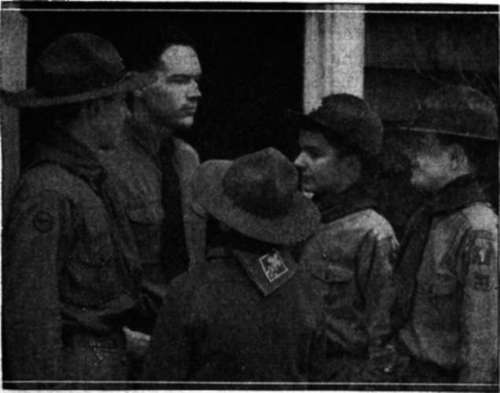
The Scoutmaster meets with his Patrol Leaders, under the ideal Patrol Method selected by the boys they are to lead.
In some Patrols every boy writes out the names of the fellows he thinks are the three best leaders in his group. The results are not made known directly to the Scouts but practically every boy in the Patrol has some kind of rating placed upon him as a leader. At the Troop Leaders' Council meeting, with all the senior and junior leaders present, the ratings are gone over and it is decided just who will be the best leader for the group. In this way both Scouters and Scouts have a share in deciding who the Patrol Leaders shall be and the possibility of embarrassing situations is eliminated.
In all instances, the appointment of the Patrol Leader should not immediately follow his election or selection. It should be definitely understood that he has to prove his mettle before the appointment is forthcoming. For this reason it is advisable to institute what might be called a "period of probation" during which the Scout is given the chance to prove that he is worthy of the high office of Patrol Leader. This period may be of one month or six weeks' duration, and should seldom be longer.
The Appointment Of The Patrol Leader
In a new Troop, the Scoutmaster will himself, of course, decide when the appointment should be made. In an old Troop, when a new Patrol Leader has been elected, his ability should be discussed at the Troop Leaders' Council and his appointment affirmed there.
When the proper time comes, the new Patrol Leader's appointment should be announced before the Troop with an appropriate ceremony, along the following general lines:
1. The Troop is formed in a circle with the members of the Troop Leaders' Council in the center.
2. The Scoutmaster tells the Troop in a few words of the importance of good Patrol Leadership and announces the appointment of Scout Blank as the new Patrol Leader of the So-and-So Patrol.
3. Scout Blank is called forward. He places his left hand on the pole of the Troop flag, above that of the Scoutmaster, salutes, and gives the Patrol Leader's Promise: "I promise to do my best to be worthy of my office as Patrol Leader, for the sake of my fellow Scouts, my Patrol and my Troop."
4. The Scoutmaster pins the Patrol Leader's Badge on the boy's left sleeve, presents to him a Handbook for Patrol Leaders, and the youngest member of the Patrol presents him with the Patrol flag.
5. A Junior Leader leads the Troop in a cheer for the new Patrol Leader, who thereupon steps back into his Patrol, where he is greeted by another cheer from his own Scouts.
The Selection Of The Assistant Patrol Leader
The first job that confronts the Patrol Leader is the selection of an Assistant-in conference with the Scoutmaster-from among the Scouts of the Patrol. It is imperative that this choice be left in the Patrol Leader's own hands to ensure that the Assistant be one that has his complete confidence. On the other hand, the Patrol Leader should be made to realize the importance of his decision so that his choice will be governed by "Who will make the best Assistant for the Patrol?" To guide him in his selection, he should be referred to the section on the Assistant Patrol Leader's qualifications, as presented in the Handbook for Patrol Leaders,
When the Patrol Leader has made his selection, the Scoutmaster makes the appointment, preferably before the whole Troop, and, if found desirable, with a ceremony similar to that of the Patrol Leader.
Term Of Office
As a general rule, a Patrol Leader may be kept in office as long as he gets results. Nevertheless, it is advisable to make public to the Troop the fact that the term of office is for a predetermined length of time, such as one year, and that after that the Patrol Leader may be eligible for reelection. This will simplify the matter greatly in instances where a Patrol Leader has performed poorly and might have to be asked to step down in order to permit more efficient leadership to take his place.
If conditions arise which necessitate a change in Patrol Leaders before the end of the year, such as would occur in the case of resignation, transfer or removal, the office should be filled at once, preferably by having the Patrol elect the successor, or possibly by the advancement of the Assistant Patrol Leader. The new leader will then remain in office for the remainder of the year, when he may be available for reelection to a "second term."
It is well to keep in mind that as many boys as possible should have an opportunity to gain leadership experience. For that reason no single individual should be allowed to "monopolize" the Patrol Leadership over a long period of time to the exclusion of other capable and worthy Scouts. But when a Patrol Leader moves out of that position, the Scoutmaster should see to it that some other opportunity opens up for him so that he may continue his interest.
Personality Problems
When Patrol Leaders are wisely chosen they seldom represent a problem to the Scoutmaster. Yet, occasions may occur when a Patrol Leader goes "rampant," loses his sense of proportions and seems to disregard his responsibilities entirely. This may be the case with the new Patrol Leader in whom consciousness of his official importance is undeveloped.
All such instances should be handled in private conversation between the Scoutmaster and the boy leader, with the "treatment" taking the form of kindly, but none the less positive advice. The boy should be made to realize that as a Patrol Leader he must be a model for the other members of his Patrol, and that his failure to live up to the Scout ideals is a more serious offence than the failure of a Scout in the ranks.
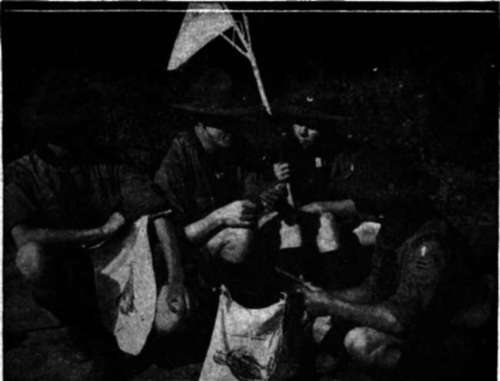
Gathering around their Scoutmaster to plan details of the evening camp fire. Will the Eagles or Bob-Whites have the honor of serving?
Occasionally a Patrol Leader becomes indifferent to the progress of his Patrol and fails to demonstrate sufficient interest in the welfare of his boys. Such cases may be solved-(1) by arousing the Patrol Leader's ambition through stimulating inter-Patrol games and contests, (2) by making him and his Patrol temporarily onlookers instead of participants in some of the more interesting activities of the Troop, (3) or (and this should be the last resort) by removing the Patrol Leader from his office.
In the handling of all such problems it is imperative that discretion be exercised constantly so that the Patrol Leader will have no opportunity to feel that he is being unfairly discriminated against or that any animosity exists.
The Scoutmaster's Most Important Task
With the Patrol Leaders chosen, the Scoutmaster's most important and hardest task starts: The training of them in Patrol work and in Scoutcraft and the using of them for Patrol and Troop Leadership. He must inspire and teach and lead them to the end that they will be real Scouts, themselves, so that they in turn will be able to inspire, teach and lead the members of their Patrols to be real Scouts.
Continue to:


My Books

