


Chat 12. The Patrols And Their Leaders
Description
This section is from the book "Handbook For Scoutmasters. Volume 1 & 2", by Boy Scouts of America. Also available from Amazon: Handbook For Scoutmasters.
Chat 12. The Patrols And Their Leaders
THE important thing for the Scout Troop, then, is to get itself established along the lines of the Patrol Method and to proceed from here in making the Scout Program effective in the lives of the boys.
Steps To Be Taken
To accomplish this there are five definite points that need to be covered:
(1) The Formation of the Patrols
(2) The Selection and Appointment of the Patrol Leaders
(3) The Organization of the Troop Leaders' Council
(4) The Start of the Patrol Leaders' Training
(5) Opportunity for the Patrol Leaders to Lead
Formation Of The Patrols
The formation of the Patrols depends upon whether it is a case of starting a new Troop or reorganizing an old one.
In A New Troop
In a new Troop the forming of the Patrols is the natural continuation of the work begun that first day when the first few boys were gathered to hear of the start of a new Troop in town.
From the earliest meeting (see Chat 5) these boys were led to think in terms of Patrols. They were told to look around them and to decide for themselves with whom of the other boys they would like to be associated in a Patrol, and what specific boy might be a good leader of their group. All of the formative meetings were necessarily, because of the number of boys, run as Patrol meetings with the Scoutmaster-to-be the Patrol Leader. The features of the meetings were such as would readily apply in the ordinary Patrol. The spirit of the gatherings was akin to Patrol Spirit.
As this preliminary group grows in number to, say, ten, twelve, or fourteen boys, the time comes when it is ready to take the shape of a Scout Troop of two Patrols. (If fifteen to twenty boys, three Patrols may be formed. With more than twenty boys the formation of four Patrols is desirable.)
The most natural way to establish these Patrols is by introducing at a meeting a few two-team games
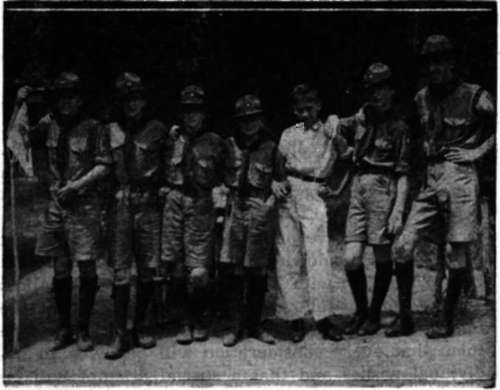
They want him in their Patrol. He belongs with them. They'll soon help him to become a Tenderfoot. He will grow.
(or three or four-team games, according to the size of the group) and let the boys themselves team up without any suggestions from you. If the teams are uneven, you will propose the transfer of some of the boys from one group to another. Then play the first game, and, when it is over, try another after suggesting to the boys that they may want to change around in the teams. No indication should be given that these games are of an experimental nature for the purpose of establishing Patrols. At the following meeting repeat the same process. Then as you come toward the end of this meeting, announce that the Troop is to form its Patrols. In this manner the boys will have had an opportunity to react upon each other, to know each other better, and will have a sounder way of judging how their Patrols might shape up.
Two ways suggest themselves of now forming the Patrols:
The simpler one is merely to ask the boys to divide into two groups in two corners of the meeting room. In many instances this will work out satisfactorily. A few boys may be left out in the preliminary rush but will be absorbed readily. If there is any doubt in your mind as to the feasibility of this method, use secret ballots. Give out papers and pencils and ask the boys to write down the names of those they would like to team up with in a Patrol. Collect the ballots and inform the fellows that the membership of the Patrols will be announced at the next meeting. Assure them that every consideration will be given to individual wishes and that a special attempt will be made to have the Patrol set-up suit everybody.
Then, during the week, work over the ballot sheets, arranging the boys by Patrols, using your own best judgment in cases where wishes are not clearly expressed or where boys seem to have been left out of the running.
At the next meeting the Patrols are announced. You will find that the arrangement will be readily accepted. Whereupon the Patrols are ready to choose their leaders, their name, yell, etc.
In An Old Troop
When an old Troop decides that it has not been working effectively on the Patrol Method and desires to have it definitely established, the procedure is a little more complicated, since here it is not so much a matter of forming Patrols as of re-forming them.
The subject of reorganization should first be broached at a gathering of all the leaders of the Troop.
Here the idea of creating a "republic" might be presented with an accompanying suggestion that a "referendum" of the "people" be held in order to find out their preferences. The Patrol Leaders should be asked to cooperate by "surrendering their portfolios" (resigning their positions, but not surrendering the right of reelection).
At the next Troop meeting the Patrols are announced dissolved, and each Scout is requested to fill out a secret ballot sheet with his preference for team mates in a new Patrol, indicating at the same time his first and second choice for Patrol Leader.
As in the case of the new Troop, the ballots are collected by the Scoutmaster, and the Scouts are grouped by Patrols by him in accordance with their own wishes. A "Senate" of the "republic" is formed from the new Patrol Leaders, while the Scoutmaster naturally holds the position of self-styled "president."
Continue to:


My Books

