


Keeping The Interest Alive
Description
This section is from the book "Handbook For Scoutmasters. Volume 1 & 2", by Boy Scouts of America. Also available from Amazon: Handbook For Scoutmasters.
Keeping The Interest Alive
When established, the interest must be sustained by devising things which the parents or the Parents' Auxiliary may do for or with the Troop.
The Troop needs transportation to a rally or to camp, and immediately a transportation committee is formed by the fathers' branch to take care of this problem. The Troop needs tents, and the mothers' branch sets out to. earn the necessary funds first through food sales, card parties, suppers, and then goes in for a new-fashioned tenting bee. The fathers get to work to secure special instructors on various subjects, and the mothers make bandages, signal flags and what-not, to make the instructions effective.
Then again, the Troop invites the parents for special council fires during its summer camp and puts on for them a real Scout Program. The fathers are invited for a special Fathers' and Sons' Hike to the Troop's favorite overnight camp site, where a pot full of beans has been "doing" overnight, and where special games and contests, from horse-shoe pitching to relay races, may be held. An annual banquet may be held for all the parents-possibly in connection with the Troop Anniversary-with the fathers taking care of the attendance, the boys the program, and the mothers the eats. And, of course, the parents will want to attend the Troop Courts of Honor at which their sons are to attain higher ranks in Scouting; and the parents of a new Scout will want to be present at his Tenderfoot Investiture.
All of these activities bring the boy, the parents and the Troop closer together.
The Good Turn In The Home
The parents can do much for Scouting, but Scouting must reciprocate by doing much for the parents.
The daily Good Turn, by force of circumstance, is usually performed in or about the home. But his regular home duties are not to be thought of as being the boy's Good Turn. It must be something extra, something done consciously. If it is forgotten or neglected, the parents may tactfully make suggestions that will increase the effectiveness of the Scout Program in their son's life.
But most of all, the Troop should repay the parents' interest and aid by helping their boys grow into the type of young Americans who will be a pride to their hearts.
Scouting And The Schools*
Just as parents are concerned with the growth of their son, the school is interested in the development of the "whole man." The opinion of outstanding educators is, in the words of Dr. Lotus D. Coffman: "The school gives the boy life-tools, but he needs practice in living outside the class room." Numerous school men affirm that Scouting helps to provide this practice. They recognize in our Movement an educational agency of real value, supplementing the schools in training for citizenship and providing worth while free-time activities that help to make the whole environment conducive to the all-round development of youth in the community.
Parent-Teacher Associations are becoming an increasingly effective medium of contact between Scouting and the schools as Sponsoring Institutions of Troops, and perform a real service in relating the schools more closely to the home and the community through Scouting.
Those who have developed specific plans for school-Scout Cooperation have found advantages to the school, the Troop and the boys reached by both.
How The School May Help The Troop
There are many opportunities for school men and women to help Troops by aiding the boys to a more satisfying Scouting experience. Any Scoutmaster, whether his Troop is sponsored by a school or some other institution or group, is apt to find that the cooperation of school men and women is easily forthcoming. All he has to do is to approach the proper people to secure their whole-hearted support.
*Based upon: Ray O. Wyland, Scouting in the Schools.
Some of the services which schools have given to Troops are as follows:
Making available the names of twelve-year-old boys, and encouraging boys to register or continue in Scouting.
Placing at the Troop's disposal school rooms for Scout purposes, such as Troop meetings, parents' gatherings, Courts of Honor, exhibits, entertainments.
Providing volunteers to serve in Scouting, as Troop Committee members, Merit Badge Counselors and the like.
Giving Scouts the opportunity to demonstrate their activities to the student assemblies and Parent-Teacher meetings.
Including in the school libraries complete sets of the Handbooks of the Boy Scouts of America and the various Merit Badge pamphlets.
Checking the Scouts' records of service for that requirement toward the higher ranks in Scouting and for the Scholarship Merit Badge.
Cooperating with the Troop in making Boy Scout Week a spectacular event in the community.
How The Troop May Help The School
The most valuable service the Troop may render to the school is to encourage its Scouts to make the influence of their ideals and loyalties felt in a generally improved morale and finer relationships among the students of the school.
But in addition, Scouts are able to help the school in many other and more tangible ways, by:
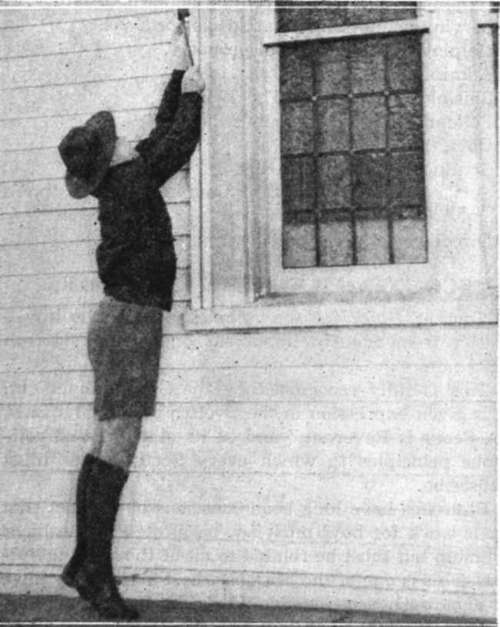
The Church often needs a bit of friendly attention. Repair things that get broken. Go on from there to greater helpfulness.
Volunteering quickly in response to the ordinary calls for service in the school rooms.
Giving loyal support to all school projects.
Handling crowds at school functions and serving as ushers.
Helping in accident prevention and scnool safety. Serving as messengers at special sessions. Helping to protect school property. Administering first aid. Raising and lowering The Flag. Policing the school grounds. Doing hall duty. Conducting class field trips.
Serving in the school library and in the school lunch room.
Directing activities of playground.
Continue to:


My Books

