


Organization In Rural Areas. Continued
Description
This section is from the book "Handbook For Scoutmasters. Volume 1 & 2", by Boy Scouts of America. Also available from Amazon: Handbook For Scoutmasters.
Organization In Rural Areas. Continued
Organizing The Tribe
A Tribe is different from a Troop or Patrol in that its membership is first secured on an individual basis. Boys register as Lone Scouts, and after five or more have registered, they are brought together and organized with a view of giving them a chance for group action on a monthly basis with adult leadership, and with group opportunities to get training in Scoutcraft from each other and from special instructors who come to meetings on invitation.
The Tribe may, as mentioned, be sponsored by the Local Council through its Rural or District Committee, or a separate institution may sponsor it and choose a Committee for it. In a number of Councils, a rural Troop, located in a town or village, sponsors a District Tribe of Lone Scouts, and Troop members are responsible for recruiting farm boys of the trade area around the town, giving instruction and making possible a fine relationship between the boys of the country and those of the town. In this case, there should be free exchange of courtesies; farm boys of the Tribe may entertain the Troop; the Troop may entertain the country boys in the town. These occasional hikes working both ways will keep up continuous interest and establish a mutual friendship and respect among the boys.
Tribes reregister every year. They may have Patrols, just as do Troops, but these Patrols should not be confused with separate Neighborhood Patrols which are independent of all organized Scout units.
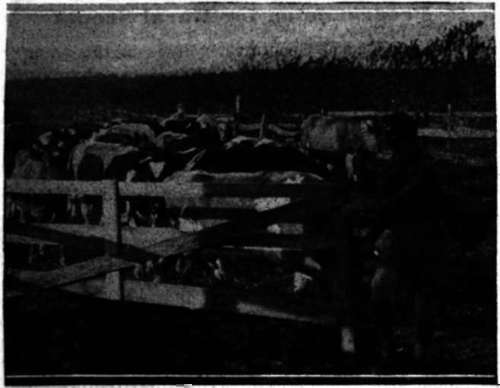
It's milking time. The setting sun strikes level across the fields. Lone Scouts herd the cows into the barnyard.
Activities Of The Tribe
The Tribe usually meets once a month. But no effort should be made to hold Tribe meetings at the same place all the time, because a Tribe is a federation of boys from many neighborhoods. Places may be selected that will be helpful to seasonal Tribe activities and convenient for the boys served.
Tribes may locate and build Tribe huts, dens or camps and may hold an occasional over-night or short-term camp, special meeting or a pow-wow at these places. In the winter, meetings may be held at Grange halls, school houses, churches, farm homes, clubhouses, community buildings-in fact wherever comfort and sufficient space make possible successful activity.
Programming For Rural Scouts
Since the rural Scoutmaster lives in the country and is a part of it, he knows its problems intimately from within and the special needs of the boys of his community.
He will realize that the Scouting ideals and the Scouting program in all their aspects, as presented throughout this Handbook for Scoutmasters, are applicable to rural territory. The program emphasis should be changed to fit certain situations, and to make sure that boys get Scouting at its best near their homes.
Variety In The Program
It is possible that, for example, the programs of the Neighborhood Patrol and the Tribe may require more variety than the programs of a city Troop, in order to hold the interest of the rural boys. And, of course, they will require different emphasis for different types of rural areas-the fruit belt, the dairy regions, the grazing lands, and others.
In general, the popular rural program may be less physical and more social and mental. The rural boy already does much outdoor walking so that hikes for him should be aimed at recreation and mental exhilaration, such as that provided by trips to cities, to museums, to nearby places of special interest.
In most cases trips to the water-the beach, the lake, the river-will still have their strong appeal.
To provide camping, the Scoutmaster may find that several obstacles must be conquered, not the least being the fact that the early summer camping season is the season also of much farm work.
The Advancement Program
Because it is often necessary to have long interims between meetings, a large portion of each meeting program may be used to introduce the subjects of the Scout Requirements and of Merit Badges, and to stimulate the boys' enthusiasm for advancement which may fill much of their time, and on which they may work alone or with a buddy or with a Friend and Counselor.
Merit Badges of particular interest to the rural boy in Scouting are provided. The Scoutmaster may find details of these and of many other distinctly rural program features in the Handbook for Boys.
To put over this program effectively, the Scoutmaster may secure the aid of County Agents and State agricultural experts. The Merit Badge pamphlets published by the Boy Scouts of America contain a wealth of information, and further pamphlets and bulletins may be had free of charge or at a nominal cost from your State College or other Extension Departments or the United States Government. (Write to the U. S. Department of Agriculture, Washington, D. C, for a list of publications on the subject desired.)
The Social Program
The rural group has a great advantage over the city Troop in the fact that parents' support may be more readily available for participation in special Scout events. In the city with its bustle, the many diversions cause family life to be less unified than in the country. The members of the rural family more often spend their evenings at home together, unless special activities cause them to go out together.
The rural Scoutmaster has a real opportunity to enrich the life of the community, by accepting a large share in community responsibility for assembling people. The boys will enjoy it, and so will their parents.
The rural group may thus have many more public activities than the city Troop, many more public evenings of Scout games in which old and young may participate, evenings of first aid or other instruction, and many more "feeds"-hamburger roasts, covered dish suppers, barbecues, doughnut parties. It is even possible that certain of the values of the old singing school, the literary society, the barn dance, the husking bee may be given to the community through a Scout meeting open to an invited and interested public.
The Leader
Upon the rural Scoutmaster rest the responsibilities of being a real leader, of developing local cooperation, of serving and enriching the life of his community and of pointing the way to his boys toward realizing plans for useful living.
Continue to:


My Books

