


Part XI. Outdoor Activities. Chat 28. Hiking
Description
This section is from the book "Handbook For Scoutmasters. Volume 1 & 2", by Boy Scouts of America. Also available from Amazon: Handbook For Scoutmasters.
Part XI. Outdoor Activities. Chat 28. Hiking
Outing is three-fourths of "SCOUTING." Out-door adventure is the feature which, more than any other, makes boys flock into our Movement. City boys welcome an opportunity to have contacts with nature; rural boys are anxious to have the out-of-doors interpreted through Scouting.
So, the boy becomes a Scout. Does the smell of wood smoke tickle his nostrils from the moment he enters? Does he perceive an undercurrent of open air sweeping through all of Scouting's activities, even those between the four walls of the meeting room? Is there always present the promise of wilderness ahead? Most important: Is that promise fulfilled? Is the boy given the chance he came for, to experience the real thing?
If your answer is "Yes," you will have no need to worry about holding the boy. You simply won't be able to keep him away whenever Scouting calls.
The Outdoors In Your Program
Check back over the suggested outlines for Troop meetings in the previous Chat. Analyze them carefully and you will discover in each the anticipation of the outdoor experience to come, of camp fires, of activities under the open sky.
In other words, the Troop meetings are leading up to the climax of each month: the outdoor adventure. The Troop program consists of outings supported by Troop meetings, rather than of Troop meetings with occasional outings thrown in as supplementary features.
In the early part of a Troop's life these outings will take the form of numerous hikes (day outings that do not involve overnight stays) during which the boys and the Patrols become skilled in hikecraft. As the Scouts grow more experienced, the hikes become more ambitious, more adventurous, more strenuous, and eventually—as equipment is developed by the Patrols and made by the boys—evolve into overnight affairs, into short-term and long-term camping. Even then, the Scouts do not graduate from hiking. A balanced mixture of hikes and camping expeditions will form their complete year-round, rain-or-shine outdoor program.
Who Plans The Troop Hikes?
In considering the year's program, the Troop Leaders' Council will have decided upon a general hiking schedule, even to the extent of placing a special emphasis on the hikes of any given month. As the month approaches, this emphasis is further increased—or changed, if conditions necessitate this—and definite planning is undertaken.
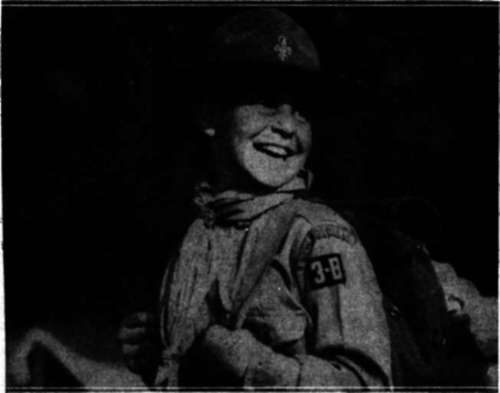
A balanced mixture of hikes and camping expeditions will form a complete year-round, rain-or-shine outdoor program.
You may find that the Troop Leaders' Council is too large a body to undertake the detail planning of Troop hikes. It may spend so much time in deliberations and weighing the pros and cons of various hike spots that it will be difficult to reach any quick decisions. In that case, it will be far better for the Troop Leaders' Council to establish a Hike Committee (of possibly three members) who, under the guidance of an Assistant Scoutmaster, will work out all plans and necessary announcements. This committee may be selected to serve for a certain length of time, such as three months, or may be a temporary one chosen prior to the hike in question. After the committee has planned the hike, its recommendations are submitted to the Troop Leaders' Council and are reviewed and approved there.
Another method is to have the Patrols of the Troop take turns in developing ideas for Troop hikes, and after approval carry them through.
Except for surprise hikes—Treasure Hunts, Obstacle Hikes and the like—all hike plans should be submitted to and accepted by the Troor) Leaders' Council.
The Job Of The Hike Committee
The job of the Hike Committee (or whatever group of Scouts is selected by the Troop, Tribe, or Neighborhood Patrol to perform the functions just discussed) consists of:
1. Planning the hike.
3. Making the necessary announcements.
4. Executing the hike.
Continue to:


My Books

