


1. Planning The Hike. Continued
Description
This section is from the book "Handbook For Scoutmasters. Volume 1 & 2", by Boy Scouts of America. Also available from Amazon: Handbook For Scoutmasters.
1. Planning The Hike. Continued
Working Out The Schedule
In working out the plans, an approximate hour-by-hour schedule should be developed. It should, for example, be decided whether a game is to be of one hour or two hour duration; whether it is to stop and be followed by a general assembly at 4:30 or at 5:30. Similarly, the Patrols should be given a definite hour at which they are expected to start their fire building and cooking and an equally definite hour at which to have their clean-up completed.
Such a schedule—announced in advance—is absolutely necessary for the success of the hike. If the Patrols are permitted to straggle along, taking their own good time, you can't expect to accomplish the activities which were planned. But not only that: the lack of energy and foresight of one Patrol in getting its work done in a reasonable time is apt to penalize the rest of the Troop by necessitating the throwing out of a looked-forward-to Patrol contest or game. A definite schedule fairly well kept will prevent this from happening and will help to establish standards of precision and orderliness in the Patrols.
The schedule may take the following form: Hike to Schiff Hills—September 18th.
2:30—Troop meets at Ralston Post Office.
Check up. Patrol Leaders account for their Patrols. 2:40—Game on the out-journey: Hare and
Hounds.

Their home town left behind, maps become the keys and helpers as Scouts push into unknown country and explore farther afield.
3:30—The tracks end at a place suitable for training in Scoutcraft: Fire Building, Signaling, Scout Pace, Knife and Hatchet Work, etc.
4:30—Activity game: Capture the Flag.
5:30—Building of Patrol fires. Supper: Ka-bob, baked potatoes, and sandwiches brought from home.
6:45—Clean-up. Patrols practice for the following period.
7:15—Troop camp fire. Songs, challenges, stunts, story-telling.
8:00—Extinguish camp fire. Start home journey.
9:00—Dismissal in town.
Where?
The "Where?" must fit the "What?" No use of sending the Scouts into deep woods if flag signaling is the theme of the hike, nor to take them into the open fields if pioneering is the order of the day.
In planning a hike, a topographic map of the locality—preferably with the scale 1 inch to 1 mile—will be found of great help. Many suitable spots and routes will immediately suggest themselves, places which may be known to most of the Hike Committee members but which somehow have to be brought into the light of their new use to be considered.
Of course, for a young Scout the hikes should be short—not more than two to three miles out and the same distance back. (In heavily populated districts where distances are great it may be necessary to get to an appropriate point for a hike by using a trolley car or a bus. In metropolitan districts such procedure is certainly required.)
As the Scouts get hike-minded and hike-trained, the distances may be increased. This may be done directly through a definite training toward the fourteen mile goal of the First Class journey, or indirectly by providing exciting Treasure Hunts or other games over extensive territory.
In all consideration of the "Where?" two points are imperative:
Keep away from main traffic arteries, using bypaths and country trails only.
Make the destination of the hike a spot which will truly fit the purpose of the hike.
When?
The "When?" depends primarily upon the leadership and when boys can best be spared from home, church, school or farm obligations. In some instances, only week-ends and special holidays enter into consideration.
Usually, a Saturday hike will be an afternoon and evening hike, starting when the leaders get home from business, possibly around 2:30 P.M., although in old Troops with trained boy leaders, the Patrols may combine a Saturday morning Patrol hike with the afternoon activity of the Troop as a whole. The Saturday hike may be comparatively short, of three to four hours' duration, getting the Scouts home in time for supper, or it may involve an outdoor supper and a short camp fire period around an open fire.
As far as Sunday hikes are concerned, every Scoutmaster should conform to the resolution adopted by the National Council of the Boy Scouts of America (March, 1922):
"WHEREAS, the Boy Scouts of America is specifically pledged to encourage reverence and faithfulness to religious obligations;
"AND WHEREAS, the attention of the National Council has been called to the fact that in some cases
Scouts have been permitted to neglect church attendance while at week-end camps or on week-end hikes, "BE IT RESOLVED, that the National Council records its disapproval of programs for week-end hikes or camps which preclude the attendance of Scouts from religious services, or which cause loss of credits for the individual or Patrol or Troop, if the Scout elects to remain at home to attend church."
This does not mean that a Scoutmaster should not plan a Sunday hike, but it does definitely mean that he should only do so with the approval of the parents of the individual boys and of the clergy of the churches involved, and only after having determined that the boys will have a chance to participate in their religious observances.
On special holidays such as Lincoln's and Washington's Birthdays, Columbus Day, etc., the Troop has the opportunity of making its hikes all-day affairs.
How?
The "How?" concerning arrangements for participation in a hike should be left squarely on the shoulders of the Patrols and their Patrol Leaders.
In most instances each Patrol will meet by itself and proceed toward the mutual Troop starting point, there to join the others for the outing at the stipulated time. This method is preferable to having the whole Troop mobilize and go in a body. It saves time; the boys get out of town readily and quietly, without overloading trolley cars or buses to the discomfort of other passengers; and also, it further establishes Patrol consciousness on the part of the Scouts and gives the Patrol Leaders an opportunity to exercise their responsibilities. The Patrols' attendance and punctuality in arriving at the starting point will count toward its standing in the Troop.

The crisp air of late fall hiking brings them to their noon day meal, hungry and anxious to try out their new cooking skill.
Commissary
Each Patrol should be expected to work out its own food plans, after it has been decided whether the hike should involve individual cooking, Patrol cooking, or whether the boys should simply carry with them a few sandwiches from home.
If Patrol cooking is the order of the day, the Patrol Leaders should submit menus and costs in advance to the leaders of the hike who will assist them in keeping down the expenditures through a double-check on quantities and prices.
Clothing and Equipment
For clothing the Scout Uniform will be worn and particular attention will be given to proper footgear —shoes and stockings. Suggested personal, Patrol and Troop equipment is listed on the opposite page. The necessary equipment will depend upon the type of the hike, but no hike should ever be undertaken without adequate First Aid supplies to care for any emergency need.
"Be Prepared."
2. Investigating The Route
If the hike is planned to cover unfamiliar territory, it will be necessary to investigate the route beforehand to ensure the success of the trip. It may be found, for example, that following the route as mapped may involve trespass on private property or that certain changes in the landscape since the issuance of the map, such as woodland cut down, a bridge demolished, new highways constructed, may interfere with the progress of the hike.
Also in many instances permission will have to be secured from landowners for use of their land, for lighting fires, or cutting dead timber for use in bridge construction, or simply for trespass privileges. When permission is secured in advance and the Scouts carry out their training and treat their privileges in a Scoutlike manner, it is usually easy to get permission for another time.
Other reasons for investigating the route are that for a Treasure Hunt clues must be developed to fit local conditions and for an Obstacle Hike suitable positions must be found for the placing of the obstacles.
Hike Equipment. Personal Equipment
Necessary: Scout Uniform
Raincoat or Poncho (if rain threatens) Suitable Stockings and Hike Shoes Pocket First Aid Kit (properly loaded) Eats
Cup Matches Knife String (strong cord)
If Wanted: Haversack
Canteen (if you aren't sure of drinking water) Cooking Utensils—Plate, Fork, Knife, Spoon Notebook and Pencil Watch Compass Handbook for Boys
Camera Flashlight
Patrol Equipment
As Needed:
Maps Belt First Aid Kit
Axe Trench Shovel (for fire building)
Rope Cooking Utensils
Soap Signaling Flags
Paper Towels (for hands and dishes)
Troop Equipment
Necessary:
Troop First Aid Pouch
As Needed:
"Treasure" for Treasure Hunt Identification Books for Nature Study Tracking Irons or Trail Making Material
Who Does The Investigating?
If the hike is in charge of a Hike Committee, this committee may do the investigating a week prior to the event, modifying its original plan to fit the situation as found. Or a Patrol in charge of a forthcoming Troop hike will use a Patrol hike for the investigation. Or in a young Troop, a hike of the Green Bar Patrol under the leadership of the Scoutmaster will make the preliminary survey to ascertain that the hike can be carried out, at the same time giving the Scoutmaster an opportunity to train the Patrol Leaders in hike leadership.
3. Making The Announcements
The preliminary announcement of the hike is made to the Troop or Tribe or Neighborhood Patrol at a regular meeting a month in advance, appropriately at the meeting immediately following the previous hike. An established Troop with a monthly mimeographed Troop paper or program bulletin will naturally have the announcement appear there with the necessary instructions.
While the date and time of a hike should be announced well in advance so that the Scouts may have it reserved for the activity, it is not necessary to present the complete announcements as to meeting place, equipment and food, until the last regular meeting prior to the hike. The important thing, of course, is that the Patrol Leaders know every detail of the hike in advance of their Scouts so that they may be able to answer all forthcoming questions.
Definite Time Schedule Important
It is quite evident that a definite time must be given for the start of the hike. But it is equally important that the time for the return be made clear in advance. Every effort should be made to keep the schedule decided upon. It is poor Scouting and poor leadership to have Joe's mother wait for Joe for hours after he was supposed to have returned home. The result will often be that Joe will not be permitted to go "the next time." But of course, unforeseen events may occur to prevent the Troop from returning at the scheduled time. For this reason it is recommended that the Scoutmaster arrange to have someone—a Troop Committee member or a parent—at a telephone back in town during the hike. If the Troop is delayed the Scoutmaster will telephone and leave the message, so that worried mothers may phone the number of which they are previously informed, and be reassured as to the safety of their boys.

Let your Patrols Leaders work out the details. Their own Handbook will give them the elements of successful Patrol hike leadership.
In all announcements the hike should be surrounded with the aura of romance which it deserves. Do not announce the event as just "another hike." Give it a name: "Buckskin Hike," "Kit Carson Hike," "North Pole Hike," or whatever suits the occasion. Read again the suggestions in Chat 26 in regard to putting adventure into all of the Scouting program. And by using suggestions in the concluding pages of this Chat, make the romance stand out, base the hike on some type of romantic experience, historical background or other special emphasis. Use imagination. Grip the Scouts' interest with adventure. Build self-reliance, inventiveness, into all hikes.
Have the announcements clear, short and to the point and be sure that all the boys have everything straight—when to meet, where to meet, what to bring.
4. Executing The Hike
The final responsibility of the Hike Committee or Patrol in charge of a particular hike is to see to it that the hike proceeds as scheduled and that each Scout is kept happily busy so that the purposes of the hike may be fulfilled. The following suggestions will prove helpful.
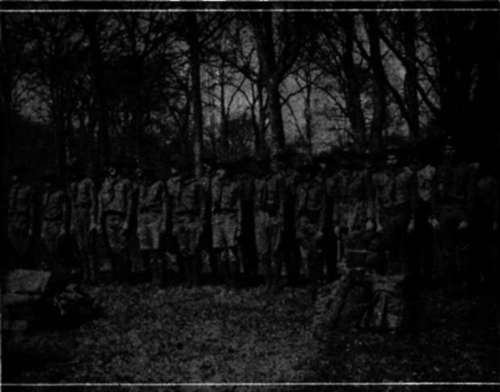
The Troop is assembled. Patrol Leaders have reported. Now the hike can start.
Continue to:


My Books

