


The Ingredients Of A Successful Hike. Before The Hike
Description
This section is from the book "Handbook For Scoutmasters. Volume 1 & 2", by Boy Scouts of America. Also available from Amazon: Handbook For Scoutmasters.
The Ingredients Of A Successful Hike. Before The Hike
As far as the Patrols are concerned, the hike will begin as the boys meet at the Patrol dens or at special meeting places decided upon by the Patrols themselves, and set out for the mutual gathering point of the Troop. The Patrol Leaders should have been instructed in advance on the proper way of proceeding and should be expected to follow the suggestions given in the Handbook for Patrol Leaders, dealing with the start of a hike, Scout courtesy, highway safety, etc.
An adult leader should be at the gathering point well in advance of the scheduled time to receive the Patrols as they arrive and help the Patrol Leaders make their final preparations.
Troop Assembly
At the exact hour decided upon for the start of the Troop hike, a signal is made for Troop assembly by the Senior Patrol Leader, the Junior Assistant Scoutmaster, or an Assistant Scoutmaster, and the Patrol Leaders lead their boys into the formation indicated.
While the boys stand at ease, each Patrol Leader makes a short report on the number present and absent, giving the reasons for possible absences when asked for in advance. Upon completion of the Patrol reports, the Scouts come to attention, the leader turns to the Scoutmaster, salutes and reports "The Troop is formed." The Scoutmaster acknowledges the salute and turns the Scouts over to the hike leader (the Scout or Scouter in charge), who gives the final instructions. And the Scouts set out.
At first, you may feel like dispensing with the suggested, rather formal start of the hike. But don't. A Troop activity should not be started in a casual manner, such as "Well, I guess we won't wait any longer. Let's get going." This may quickly result in the boys themselves being "casual" about their attendance. Be business-like about it. Make the Scouts realize that punctuality and alertness are expected and they will deliver every time.
The Out-Trip
While, obviously, the ideal hike immediately sends the Scouts off into the woods by Patrols on the trail of real Scoutcraft adventure, conditions may make it necessary to follow a highway for some distance before the wood trail may be reached.
Moving safely on a highway, even when alone, is serious business, but when many boys are trying to get somewhere, it takes constant vigilance, as well as an orderly but simple method of formation to avoid accidents.
Suggested Skeleton. Troop Hike Program
Period | Activity |
Before the Hike | The Patrols meet in their respective dens or at a central meeting point. The Patrols travel to Troop gathering place. Final checking by Patrol Leaders. |
Troop Assembly | Patrol Reports. Inspection. Announcements. |
Out-Trip | Formations. Instruction. Games. Contests. Songs and Yells. |
At Destination | Scoutcraft presentation. Experimentation. Review in Scout Requirements. Games—Scoutcraft. Games—Recreational. Contests. Outdoor "Living." Outdoor Ceremonies. Camp Fire. |
Return Trip | As Out-Trip. |
Troop Dismissal | Announcements. Dismissal. |
Remember that this is definitely a skeleton only, and that it is the emphasis, imagination and spirit employed in planning and execution, which turn it into a hike program.
Safety On The Road
The most important point in highway hiking safety is to walk on the left side of the road, facing the oncoming traffic. This is the rule throughout the country, and the law in many States. By staying on the left side the hiker can see an approaching vehicle, and be more readily seen by the driver, and being able to see the approaching vehicle, the hiker can move further to the left and even get off the highway altogether, if necessary. On the other hand, if a hiker walks on the right side of the highway, it is the driver only who can avoid a possible accident, for the hiker cannot see the car unless he turns around, and often, on crowded or crooked roads, he will not be able to hear a car approaching. Highways today are built for vehicular traffic and not for pedestrians. When they are used for hiking, the safety of the hiker is pretty much his own responsibility.
Hike Formations
Therefore, when the Troop follows a highway, a simple formation should be insisted upon. It is advisable to have the Scouts proceed by Patrols rather than in a single group. Each Patrol will then move forward in single file on the left side of the road. The Patrol Leader should be 25 feet ahead of the first Scout, ready to warn about oncoming traffic, and the rear guard, the Assistant Patrol Leader, should be 25 feet behind the last Scout. The various Patrols should keep about 100 feet apart.
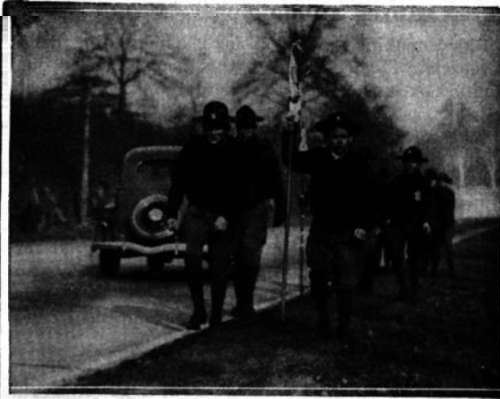
Getting out into the country often means using the crowded roads and highways. Walk against traffic. Keep off the road.
If the hike involves walking on a highway at night, a similar formation should be used. Each Scout should wear white bands or handkerchiefs tied on the ankles just above the shoe tops. White is noticeable at night from an automobile, whereas the Uniform would be hard to distinguish. The leader should wear similar markers and also a broad white band around his waist, and should walk 75 feet in advance and carry a light. The rear guard should wear a white band or handkerchief across his back and walk 75 feet in the rear of the column with a light.
It is illegal and unreasonably hazardous to cross railroad trestles or to hike on railroad tracks and this should not be permitted either by day or night.
Hitch Hiking Taboo
Ride thumbing or hitch hiking is a nauseating, dangerous and illegal pestilence that has settled on our country like a scourge, with the growth in the use of motor cars. Police ledgers are so plentifully sprinkled with records of assault, robbery and murder, which occurred to the sympathetic motorist who had given a lift to itinerant travelers, that cautious car owners, with good reason, regard wayside ride beggars as potential crooks.
Not infrequently either, has the solicitor paid for this unwise practice with life or mangled body. No matter how liberally we may try to look at it, ride begging has nothing worth while to commend it, and it most certainly has no part in Scouting.
There may be occasions now and then, and far apart, when a Scout in an emergency needs a lift along the way so seriously that, stating his plight frankly, he will be justified in requesting the courtesy.
But merely to cover ground, make an objective in a given time, save himself work, or for any reason other than that of real necessity, no Scout should ever resort to this practice nor should any Scout Leader countenance it.
Hike Health
If a long hike is planned, the health of those who are to go should be checked with their parents. Particularly is this important in cold weather. A sore throat or a cold should automatically eliminate any Scout, both for the protection of that boy and of his companions. It seems almost unnecessary to say that Scouts whose physical examination record has shown that they have organic defects should, if taken along, be permitted to do only the amount of work recommended by their doctor. With perfectly healthy Scouts precaution should be taken to make certain that no one becomes exhausted. The boy may return home tired, but certainly not worn out.
A hike is not a race. A steady pace that can be kept throughout is desirable. Rests should be short and frequent rather than long and far between. Let the slowest set the pace.
Continue to:


My Books

