


Planning A Balanced Program. Part 2
Description
This section is from the book "Handbook For Scoutmasters. Volume 1 & 2", by Boy Scouts of America. Also available from Amazon: Handbook For Scoutmasters.
Planning A Balanced Program. Part 2
Who Should Plan The Program?
Who should plan the program? Before we answer that question it may be more important to state who should not make it. It should not be made by adults. It should not be made by the Scoutmaster acting alone, or by the Scoutmaster and Assistant Scoutmasters acting together. If adults alone make the program you cannot expect willing or intelligent boy-participation. It smacks too much of grown-ups coming to the boys and saying, "Here are the things we want done." We must give the Scouts themselves a large share in shaping the program. We must set up a situation which causes every boy in the Troop to feel that he has a part in making it.
We can accomplish this in various ways.
We can encourage Patrol discussion as to what should go into the Troop program so that each Scout gets a chance in his Patrol to express his likes and dislikes freely, feeling that his Patrol Leader will carry the discussion into the Troop Leaders' Council and there represent him. Another method is to ascertain boy desires and wishes through a periodic survey, using a questionnaire with such questions as "What do you like best in the Troop meeting?"—"What do you like least?"—"What games should we play most?", etc. After the questionnaires are tabulated they form an excellent basis for improving the Troop's program.
Whichever method you decide to use, the job of establishing the Troop program lies with the Troop Leaders' Council. It is here that the needs of the Troop are discussed and ascertained and the yearly program is developed in skeleton form before the "meat" is put on. The Troop Leaders' Council determines the general nature of the Troop's activities, serves as a clearing house for important suggestions, then brings in the
Troop for decision on specific activities, all under the supervision and guidance of the Scoutmaster, who, of course, gives the final approval for what goes into the program, seeing to it that the objectives are thoroughly covered.
Preliminary Steps In Program Making
One important thought must be kept in mind in program making—a rather obvious one, yet often disregarded: The Program must fit the Troop. No program was ever developed which fitted other Troops than the one for which it was originally designed—for the simple reason that no two Troops have the same problems to cope with, the same kind of leaders, the same kind of boys, or even the same meeting facilities.
This principle applies, of course, to a Lone Scout Tribe or Neighborhood Patrol; and throughout the pages that follow, although the word "Troop" will be used freely to designate the unit of organization, Scoutmasters of Lone Scout Tribes and Neighborhood Patrols will recognize that the principles of programming and activities, and many of the activities themselves, are applicable to their own particular situations—the distinctive features of which were discussed in Chat 8.
A Troop with a membership entirely of working boys might have to have a less active program than one composed of school boys. A Troop containing many older Scouts would not want to engage in the same program of activities as one consisting solely of new Scouts. A large meeting room would make possible activities which could not be featured in a smaller place. Financial circumstances might help or interfere with an extensive hiking and camping schedule, and so on.
Apparently, then, the first step is: CONSIDER THE
TROOP. Call in the Troop Leaders' Council and place these two questions on the docket: "Where are we?" and "Where do we want to go?"
From the discussions of and the answers to these questions will evolve a definite picture of the Troop's strong and weak points, its present status and its impending needs, a basis for an intelligent charting of its future.
Also it is important that you review the Local Council's program so that your Scouts may gain the greatest benefits possible from participation in Council-wide and District activities involving cooperation with other Troops.
Planning A Year's Program
The next step is the development of a year's program in skeleton form.
Going through the list of Troop activities (presented earlier in this Chat) and adding such other suggestions as may have been advanced by the Scouts themselves, make a temporary list of desirable activities for your own Scouts, considering the points which a survey may have brought out.
If, for example, the Troop Leaders' Council discovers that the interest of the parents has been poor, the securing of their interest and cooperation becomes a definite Troop objective which must be provided for in the program, through the inclusion of Parents' Nights, Fathers' and Sons' Hike and the like. Similarly the Troop Leaders' Council may decide upon a more elaborate outdoor program than before with exciting monthly expeditions, a closer contact with other Troops with regular inter-Troop get-togethers or greater provision for friendly Patrol rivalry through quarterly or monthly inter-Patrol contests. Perhaps the Troop is weak in numbers and the Troop Leaders' Council will decide for a part of the year to concentrate on recruiting to full strength, or possibly the Troop consists mostly of Second Class and First Class Scouts, in which case it may prefer to feature advanced Scout work for the Troop as a whole. If poorly uniformed, 100% uniforming becomes the slogan and objective of the Troop and is emphasized in the program.
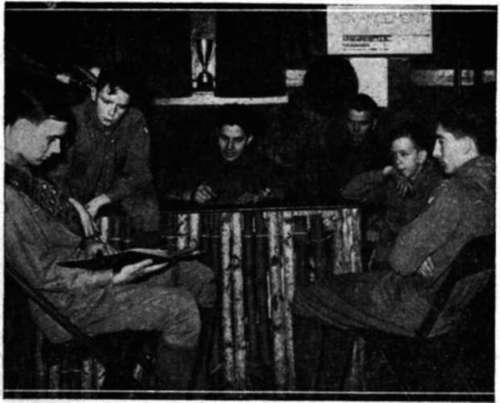
Some day they will be grown-up leaders and plan programs for coming generations. Give them opportunities while they are growing.
In this connection it may be valuable to consider specific examples of yearly objectives in the three different stages of a Troop's career:
The new Troop or the Troop which is just growing up should plan a series of big events at intervals possibly quarterly during the year which will stimulate the Troop and the Patrols, such as a Parents' Night, a big inter-Patrol contest, a rally with a neighboring Troop, a big Good Turn, a Troop birthday party, and certainly the summer camp.
The Troop which has found itself should plan a year's program with a high spot for every month on which it can focus its attention and which will provide a healthy stimulus to all Patrols.
The old-time "crack" Troop must set itself some honest-to-goodness big job to do—something which will grip the attention and interest of every leader and Scout and challenge them to real work—such as securing a real Troop headquarters with Patrol dens, establishing a Senior Patrol, an Indiancraft unit, a Scout handicraft shop, holding an Old-Timers' reunion and banquet, developing a flock of Eagle Scouts, or helping a weaker Troop on its feet
Continue to:


My Books

