


Policies. Part 3
Description
This section is from the book "Handbook For Scoutmasters. Volume 1 & 2", by Boy Scouts of America. Also available from Amazon: Handbook For Scoutmasters.
Policies. Part 3
Buildings For Scouts
The policy of the Boy Scouts of America is opposed to the erection of buildings for Scout headquarters. To raise a considerable sum of money for the erection of Scout headquarters, involves many questions beside the important ones of permanency and proper administration of funds. A central meeting place for all the Troops of a district involves travelling long distances by individual Scouts, which from every point of view is undesirable. Moreover the advantage accruing to the community from having the Troop active in the immediate locality of the homes of its members is lost when Troops gather from widely scattered areas for meetings in a central place. In a few instances where attempts have been made to have cabins or buildings suitable for a Troop headquarters, problems have arisen seriously affecting the best interests of the Troop. It is held by the National Office that the best interests of the boy in Scouting are conserved by the organization of Troops in connection with existing institutions. In other words, the effort should be to get existing institutions to adopt the Boy Scout Program as immediately serviceable to their needs, rather than to organize Scouting as an indepedent movement.
This policy should not be confused with the question of the ownership of permanent camp sites and camp cabins by Local Councils. Wherever a Local Council can acquire a permanent camp site for its Troops, and by the erection of a cabin, secure to the Scouts the advantage of some out-of-door life throughout the year, it is most desirable that this be done, as the camp site and cabin are promotive of one of the major objectives of Scouting, namely, the establishing of vigorous physical health through out-of-door activities, and the increase of knowledge of plants and animals through observations and association.
The Church And The Boy Scout Movement
The relationship of the Boy Scout Movement to the church is one of non-interference in doctrinal instruction. The Boy Scout Program conflicts with no religious doctrine; on the contrary Scouting can be adopted as an auxiliary by any religious denomination, as an extension of its boys' work plan.

Religion is recognized by the Boy Scouts as fundamental. Churches find that cooperation with the Scout Troops is mutually helpful.
Moreover the Boy Scouts recognize the religious impulse as fundamental.
It is significant that our records show that more than half of all Scout Troops are organized and operated under auspices of some religious institution. The Scout idea is a movement rather than an organization, and it is the primary idea of the national officers, and of all who are interested in the promotion of Scouting, to have it available as a movement to supplement the work of the church or other existing organizations, rather than an agency which might lessen their influence. The Boy Scouts of America recognizes the church as one of the most important agencies for work with boys, and it is believed that proper leadership in organizing Troops in churches will give a widened opportunity to serve boy life and prove of great value as a basis of religious education by the church.
Commercialism
The use of the Scout Uniform and organization for commercial purposes is not permitted. The By-Laws of of the Boy Scouts of America state:
Article XVI, Section 1-No member of the Boy Scouts of America, Scout Troop* or Cub Pack, chartered Council, or any officer or representative of the Boy Scouts of America shall have the right to enter into a contract or relationship of a commercial character involving the Boy Scouts of America unless duly authorized by the National Executive Board, and then only in connection with the carrying out of the purposes of the Boy Scout Movement.
Nor shall any Local Council or Scout Troop* or Cub Pack enter into a contract or business relationship with a business or commercial agency or corporation, or individual which may be construed as using the Boy Scout Movement for commercial purposes, such as an effort to capitalize public interest in the Boy Scout Movement rather than depending upon the merits of the business proposition. This shall not be interpreted, however, as interfering with any Scout earning money for his own Scout equipment or for his Troop, provided the money is earned through services actually rendered, and is not dependent upon capitalizing interest in the Boy Scouts of America.
* Troop, Ship, Tribe, Neighborhood Patrol.
This clause is a challenge for every Scout official, every individual Scout; the former to test each proposal which comes up in the course of financing the Troop to make sure that it involves no trace of commercialism, the latter, that in exercising his conceded right as an individual to earn money for himself, or for his Troop for Scout purposes, he may do so without violating the Scout Insignia or Uniform. It must be clearly understood that a Scout engaged in individual selling activities may not use the Uniform or good name of the organization as a basis of his effort.
This policy is the outgrowth of experience in interpreting the real motives underlying a great variety of proposals submitted to the National Office. In many of these the "commercial" intent was so veiled as almost to escape detection. In others the advantages to the organization or to the individual Scout (financial or otherwise) were so alluring as to blind any but the severest analyst of the terms of the proposal.
Experience has proved that too great caution cannot be exercised in such matters. Proposals for advertising space in the official magazines, proposals for the sale of articles known to be desired by Boy Scouts, proposals for the use of Boy Scouts individually or in Patrols or Troops, are often couched in terms so subtle as to conceal their true import. Proposals of this sort come into the National Office daily, and their rejection often involves the forfeiture of large financial advantages, nevertheless they are invariably discredited as being contrary to the policy of the Boy Scouts of America.
Scoutmasters And Scout Officials Will Receive Many proposals which have every appearance of being devoid of "Commercialism," and it will be only after the most careful scrutiny of the conditions that a determination can be made. What at first sight seems to be free from any purpose to use the Boy Scout name or prestige to advance a business proposition, will often, on further study, reveal this as its underlying motive. Too great care cannot be exercised by all upon whom rests the responsibility for fulfilling both the letter and the spirit of this clause of the Constitution and By-Laws of the Boy Scouts of America.
Solicitation Of Money, Or Sale Of Tags And Ticket Sales
The By-Laws of the Boy Scouts of America state: Article XVI, Section 2, Clause 1-Boy Scouts, collectively or individually, shall not be used in the solicitation of money or the sale of tags, or other similar methods of solicitation of money in connection with efforts to raise money incidental to the expenses of Scouting, provided, however, this shall not prohibit Local Councils from sanctioning the sale of tickets for the public display of Scout activities such as Merit Badge Shows, Rallies, Demonstrations, etc., when the nature of the program or function offers a value commensurate with the purchase price of tickets offered for sale, and the sale of tickets is not used as an indirect method of defeating the purpose of this By-Law; and provided further that Scouts' participation in the sale of tickets for such affairs shall be confined to their parents and immediate friends, and not involve methods similar to those used in the sale of tags or other general solicitation. The Scout Uniform must not be capitalized in such sale of tickets (see Article IX, Section 4).
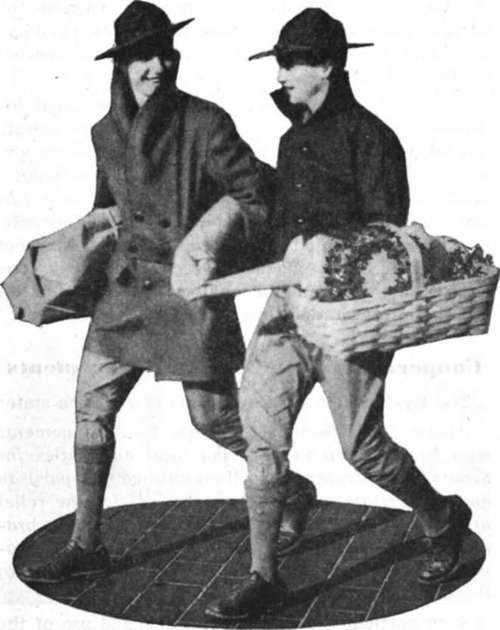
Helping other people, at all times. On a distinctly non-commercial basis, Scouts wear their Uniforms proudly and serve in many ways.
The purpose of this clause is to prevent capitalization of the Scout Movement or the Scout Uniform. It is manifestly unfair to the Scout to permit his participation in any enterprise involving the handling of money, under conditions which do not provide for a strict accounting, and it is for his protection against the adverse criticism to which such participation renders him liable, that the safeguard of this clause is inserted in the By-Laws.
It is realized that there are some exceptional instances where it is proper to have Scouts cooperate and participate with others in disposing of tickets, and therefore it has not been found advisable to make a drastic rule absolutely forbidding use of Scouts in this way. The only thing that can be fairly and safely done is to place the burden squarely upon the conscience of the ranking Scout officials of each community concerned, having in mind the language of the article itself and the interpretation thus given.
Continue to:


My Books

