


Second Class Requirements. Part 3
Description
This section is from the book "Handbook For Scoutmasters. Volume 1 & 2", by Boy Scouts of America. Also available from Amazon: Handbook For Scoutmasters.
Second Class Requirements. Part 3
Preparation
On a hike, demonstrate the making of the Trail Marks. Have each Patrol lay a trail for another Patrol to follow. Start a Troop hike with a trail laid in advance, sending Patrols off with five-minute intervals. Incorporate trailing in a Treasure Hunt. Play "Explorers," "Far and Near," "Hare and Hounds." Finally introduce the study of actual tracks of humans and animals. For further training in observation, use "Kim's Game" as a Patrol Contest; also, other observation games as described in Chat 31.
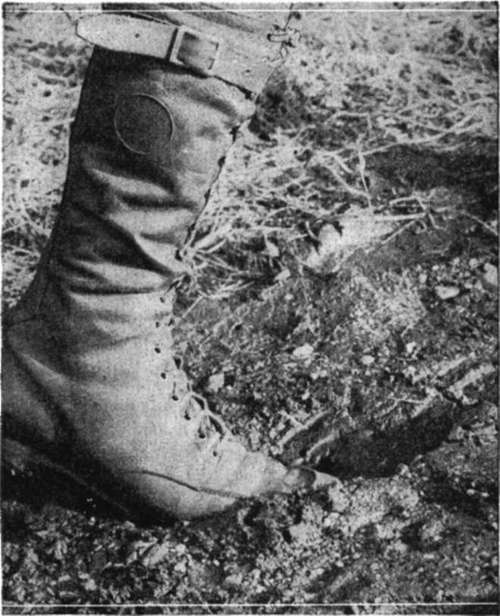
Footprints in the sand or slush or mud or leaf mould tell stories of the trail. Note the dog tracks parallel to the shoe.
Examination
Trailing: The counselor goes out with an assistant and lays the trail, making more or less of a circle. The marks should be placed at least thirty feet apart. The half-mile distance may be approximated. The counselor remains at the end of the trail. The counselor will question the Scout as to the route followed and the number of trail marks noted.
Window observation: The counselor selects a street where several store windows are near together. The Scout is permitted to look at four of them for a minute each. Then the counselor selects the window which the boy must describe. The Scout is required to gain at least fifteen points, on the following basis: One point is given for each article correctly written down and orally described, and one point subtracted for each article mentioned which was not in the window.
Review
"What was your experience in trailing? What kind of a trail was it? Where was it made? How does your training in observation help you in your everyday life? (By careful observation, accidents are prevented, knowledge acquired. One may be asked to locate a building, a street, or event, required to be a witness in a law suit following an accident, etc.)" Etc.
Second Class Requirement No. 5
Go a mile in twelve minutes at Scout's Pace —about fifty steps running and fifty walking, alternately; or lay out, measure by the stride method and stake a four-acre tract of land.
Object
To enable a Scout to cover a long distance quickly without getting tired and to measure with considerable accuracy distance by time or time by distance covered. It also suggests other uses for the "human yardstick," provides physical development, and encourages "stick-to-it-iveness" through the mastery of a difficult task.
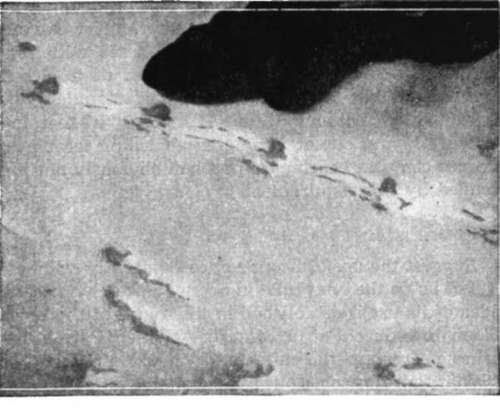
Here the new fallen snow is criss-crossed with tiny foot prints. It's fun to follow the tracks and read their animal adventures.
Interpretation
Scout's Pace: The Scout must cover a measured mile in not less than 11 minutes, 45 seconds, and not more than 12 minutes, 15 seconds, alternately walking and running—or rather, trotting. Scout should be familiar with the length in inches of his walking stride, double step and his running stride.
Laying out Land (An alternative of particular interest to rural boys): Lay out a square, each side approximately 417.5 feet long, thus enclosing the 174,240 square feet which make up four acres. The Scout should measure the sides with the known distance of his walking stride, within 10% error. (If we were to require the boy to lay out four acres with less error, it would mean the construction of a closed traverse circuit, in its simpler form a rectangle, with base line "n" feet and altitude V feet, involving laying out of 90 degree angles or taking 90 degree compass bearings, a problem obviously not intended by this requirement.)
Preparation
Suggest the use of Scout's Pace repeatedly on hikes ("Let us do the next mile in Scout's Pace!") until the idea of its use is established in the minds of the boys. Then introduce Patrol contests—"Which Patrol finishes nearest to the mile mark in 12 minutes?" or "What Patrol reaches our hike goal, five miles distant, closest to one hour?" Include Scout's Pace in Treasure Hunts, Message Relays, etc.
If a boy is interested in the laying out of a four-acre tract, secure for him the assistance of his father or a rural neighbor who knows how.
Examination
Scout's Pace: The simplest way is to have the Scout go a half mile and return. The distance may be measured with an automobile trip-meter or ascertained on a map. The Scout is not permitted the use of any timing device. A first attempt should never be examined. The Scout should be considered as having met his requirement only after at least three successful attempts prior to the examination.
Laying out Land: Indicate approximate position of tract. Check with yard stick, tape measure or measured string to ascertain how accurate you have been.
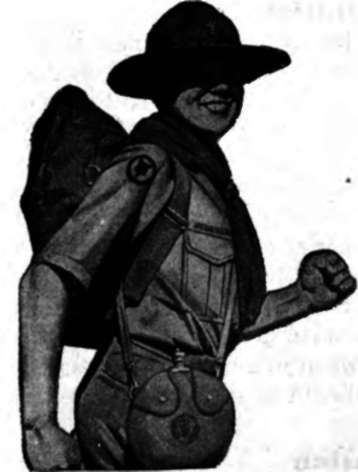
Scout's Pace is like the old-fashioned dog trot. It eats up the miles with least effort. This walking, running pace gets Scouts places.
Review
**Where did you do your Scout's Pace? Did you do the mile in exactly twelve minutes? How many times did you have to try it?" or "Where did you lay out the tract of land? What method did you use?" Etc.
Second Class Requirement No. 6
Use properly knife and hatchet.
Object
To prepare the Scout in campcraft, encourage him in handicraft and teach him safety with sharp-edged tools.
Interpretation
Knife: The Scout should know and apply the rules for using the knife as described in the Handbook for Boys, and should prove his ability to whittle a fuzz-stick and a paper knife in a workmanlike manner.
Hatchet: By hatchet is meant a Boy Scout (Hand) Axe. The boy should know and apply the rules for using it, and should demonstrate (without violating accepted rules of conservation) how to cut down saplings and small trees, up to two inches in diameter, trim them and cut them in pieces as required for the production of camp gadgets. He should also be able to cut down-wood of similar thickness into suitable fire wood. He should be reminded to preserve the properties of others.
Preparation
There is little difficulty in interesting Scouts in this subject. They will be all too eager to use knife and hatchet. The important point is to demonstrate to them from the outset the proper and safe use of these tools, and impress upon them forcefully, that knife and hatchet must never be used to mar living trees or any other object. A Scout protects trees and respects property; he does not destroy them. An untrained boy, hacking recklessly at everything in sight such as fences, posts, gates and trees, may ruin the good name of Scouting in his locality, and, cutting himself with a hatchet, may destroy his parents' confidence in our Movement.
Provide plenty of opportunities on hikes and in camp for the use of these tools, run Patrol contests in whittling of fuzz-sticks, paper knives, and cutting of tent pegs. Encourage the Patrols to make models of camp gadgets for the Troop museum and handicraft articles for sale for the Patrol funds.
Continue to:


My Books

