


Second Class Requirements. Part 4
Description
This section is from the book "Handbook For Scoutmasters. Volume 1 & 2", by Boy Scouts of America. Also available from Amazon: Handbook For Scoutmasters.
Second Class Requirements. Part 4
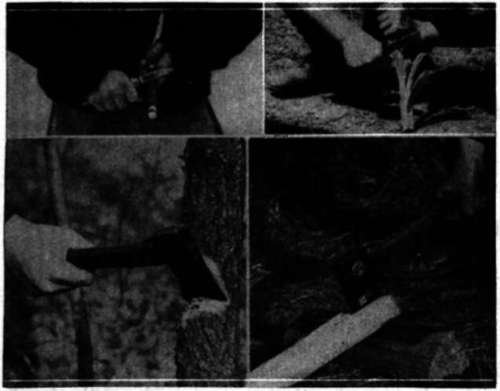
The Scout knife and axe are useful tools when properly used. Maine lumbermen can make almost anything with these tools.
Examination
Have the boy find appropriate wood and produce a fuzz-stick and a paper knife before the counselor. Select a sapling or a piece of dead timber for the boy to cut—with permission of the land owner. Have the boy show how to sharpen an axe and knife properly.
This examination should properly be combined with examination in fire building and cooking for Second Class.
Review
"Did you demonstrate to the counselor the use of knife and hatchet? Were your tools very sharp at the time? Do you own a Scout knife and a Scout hatchet? What safety rules do you practice when using a sharp-edged tool?" Etc.
Second Class Requirement No. 7
Prove ability to build a fire in the open, using not more than two matches, care for and put it out.
Object
To prepare the Scout in campcraft, and to teach him conservation of natural resources through the proper care and extinguishing of fires.
Interpretation
The wording "Prove ability . . " clearly precludes a Scout's meeting this requirement by attempting fire after fire and finally succeeding by chance. The Scout may practice as often as may be desired, but when he starts to build a fire with the purpose of meeting the requirement, he is permitted the use of two matches only and one trial with the same wood and the same fire-lay.
Grass, leaves, sticks, bark, pine cones and other materials found in the woods may be used, but paper, excelsior, kerosene, shingles, and boards from boxes are taboo. Merely setting fire to a bundle of sticks does not meet this requirement. The Scout must make a fire suitable for cooking. The Scout should know the principles involved in the selection of proper kindling and fire woods, the making of a fire in wet weather, and the different types of fires desirable for various occasions.
Preparation
Demonstrate on a hike various types of fires and provide opportunity for experimentation. Make use of the following Patrol activities: String-burning, water-boiling and fire-making speed contests on a rainy day or on a day following a period of drenching rain.
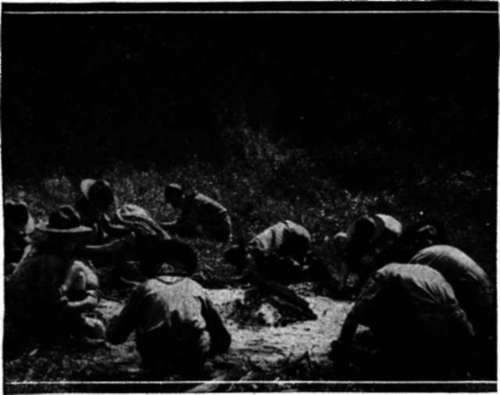
Fire is one of man's oldest friends. Indispensable on camping trips. It must be made whatever the weather. Scouts learn how.
Examination
The examination should cover the following points: Clearing inflammable material from the ground, gathering of a sufficient amount of wood before starting the fire, laying the fire properly, the actual lighting of it with not more than two matches, keeping it going until enough coals have been produced for cooking, using it for that purpose, putting it out, down to the last ember, with water, and clearing the spot afterwards for unburned sticks, chips, etc. This examination should properly be combined with examination in use of knife and hatchet and cooking for Second Class. Scouts should become acquainted with the natural practical relationships between requirements.
Review
"Where and how did you build your fire? Could you light a fire in the rain with only two matches? How did you extinguish your fire? Have you applied at home your camping knowledge of fire making and its dangers?" Etc.
Second Class Requirement No. 8
Cook a quarter of a pound of meat and two potatoes in the open without any cooking utensils.
Object
To prepare the Scout in campcraft and to teach him self-reliance.
Interpretation
This requirement must be met in the open over a fire built by the Scout himself. Frankfurters or other forms of prepared meat may not be used. No cooking utensils are permissible. A rustic cooking gadget made on the spot may be employed. Both meat and potatoes must be well cooked and edible.
Preparation
Cooking goes hand in hand with fire making. Encourage the boys to bring raw food stuff to prepare on Troop hikes rather than sandwiches. Explain and demonstrate methods of cooking meat and potatoes. Provide opportunities for experimentation.
Examination
The boy may prepare his meat—steak is recommended—as kabob or on a rustic (forked stick) broiler. Potatoes may be cooked by raking away the coals, scraping a small hole in the ground, placing the potatoes in it, covering them with a thin layer of dirt and pushing the coals over them. The fire is continued on top for approximately forty-five minutes, or until testing with a sharpened sliver, the boy finds the potatoes done. Burned meat and potatoes should not be accepted.
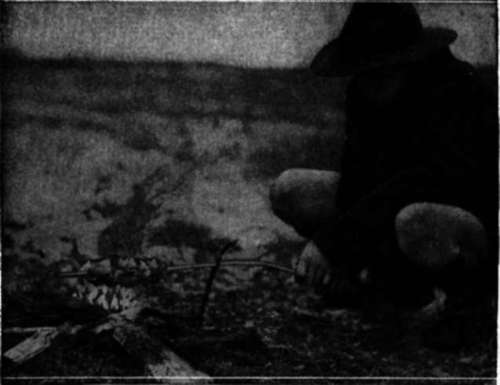
When all the wood seems wet, when fire making is difficult, Scouts succeed. They have mastered essentials and cook their kabobs.
This examination should properly be combined with examination in use of knife and axe and fire making.
Review
"How did your cooking turn out? How did you know when the potatoes were done? How did you prepare your meat? What did you do to the fire after you finished cooking?" Etc.
Second Class Requirement No. 9
Earn and deposit at least one dollar in a public bank or other savings institution (U. S. Defense Bonds or Stamps, premiums paid on life insurance are accepted, if earned); or earn, own and raise some farm animal; or earn and contribute at least one dollar or its equivalent to the family budget or to welfare work in the community,
Object
To teach and encourage industry, self-reliance and thrift, involving wise saving and wise spending.
Interpretation
The boy must have demonstrated, since becoming a Scout, his understanding of what thrift means, and must have shown tangible evidence of this in one of the ways provided in the requirement. The word "earn" should be interpreted to mean just exactly that. A possible "allowance" given him regularly does not satisfy the requirement, nor may the Scout violate the basic Scout principle that he will not accept pay for courtesies or "Good Turns."
Preparation
This is definitely an individual project which the boy will have to work out for himself. Encourage him to practice thrift and suggest to him ways and means of earning the money, but make him realize that thrift does not involve money alone. It also involves conservation of natural resources and property, the careful treatment of everything the boy uses—his books, his bicycle, his clothes, etc.
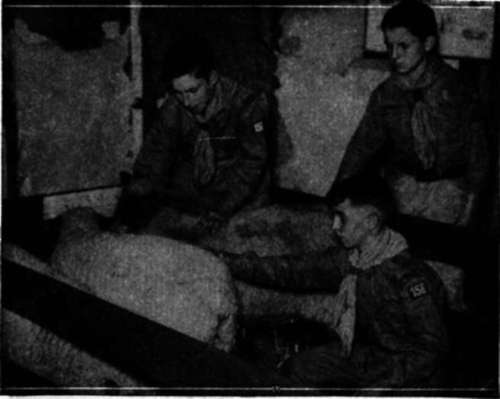
Rural Scours often make their start in Thrift and their future life work, by raising animals. These Scouts exhibit their pets.
Examination
The boy should produce a bank book showing that the amount had been deposited, Defense Bonds or Stamps, receipt of life insurance premium paid, or written testimony from his parents or guardian that he owns a farm animal or has contributed a dollar to the family budget or to welfare work.
Review
"What is the ninth point of the Scout Law? Tell in your own words just what it means. How are you applying thrift rules as to your school books? Your clothes? Your time? Your Troop's equipment? What are you doing to help pay your own way?" Etc.
Second Class Requirement No. 10
Know the sixteen principal points of the compass.
Object
To teach a boy direction, use of compass, pathfind-ing, and prepare him for map-reading and map-making.
Interpretation
The Scout should be able to explain the construction of a compass and use it in the field to ascertain directions. He must be able to "box" the compass, starting with any given point. He must know the relationship of the points, that is, be able to state which point comes between which, and which is opposite which. If any direction is designated he should be able to point out any other direction. He must know the difference between "magnetic" north and "true" North.
Preparation
The use of the compass should be introduced on a hike, not in the meeting room. Have the Patrols in turn lead the Troop, using a compass, and calling out change in direction from time to time. Try a Bee-Line Hike. Develop Treasure Hunts where the clues give compass directions.
Play "Lost Patrol": Blindfold the boys, and take the Patrols, under the leadership of Assistant Scoutmasters and junior leaders, to as many spots in the woods as there are Patrols. Have Scouts remove their blindfolds, give each Patrol a compass and written directions for finding their way out. This is particularly effective as an evening game, after twilight has fallen, at which time the Patrols should be provided with a flashlight also. Of course, no route involving dangerous hazards should be chosen for this game.

Down through the years the compass has been the camper's friend. Early in their training, Scouts learn practical uses for it.
Examination
Have Scout establish true North direction with a compass; then have him point out all other directions without it, consecutively first, then as requested by the counselor.
Review
"What did the counselor have you do to meet this requirement? Have you made any use of your compass knowledge? How did compass knowledge assist Lindbergh and Byrd? What practical every-day use is made of compass direction? (Description of locations, making maps, reading highway maps, flying airplanes, etc.)" Etc.
Second Class Requirement No. 11
Demonstrate his practice of at least five rules of safety at home, or work, or school, or on the street, or road, or farm.
Object
To teach safety principles, and inculcate habits of safe conduct.
Interpretation
Safety practices are described in full detail in the Handbook for Boys. The emphasis should be placed on the statement "at least . ." in the requirement, since the observance of many more is necessary for general safety.
Preparation
Make the Troop visualize the terrific waste of human life in our country from preventable accidents —more than 90,000 victims killed yearly! Compare this figure with the population of your city or town, and figure out how quickly it would be wiped out if all these accidents should concentrate upon it! Get your boys eager for a crusade against all safety hazards. Explain such hazards, then have the Patrols put on safety demonstrations in the meeting room.
But first and foremost, insist that individuals and
Patrols follow proper safety procedures at all of their undertakings, including check on the safety of the Troop meeting room in case of fire, proper hike formations on highways, safety with fires, axes, and in water when camping. Encourage Scouts to participate in safety campaigns in their schools, and on playgrounds.
Examination
Take the Scout on a short walk through the streets or along a highway to see if he naturally observes ordinary traffic safety rules. Then have him demonstrate five specific safety practices he carries out daily. If the indirect and the direct examinations are both satisfactory, he is considered as having met the requirement. In other words, "practice what you preach" should be the theme of the examination.
Review
"What did you demonstrate before the counselor?'* Etc.
Second Class Requirement No. 12
Furnish satisfactory evidence that he has put into practice in his daily life the principles of the Scout Oath and Law.
Object
To keep before the boy continuously the promise he made when he joined the Brotherhood of Scouting, and to make him stop and measure himself in his accomplishment of that promise.
Interpretation
The Scout may be requested to submit a written statement confirming "satisfactory evidence," from his parents or guardians, his school teacher and religious leader. Far better than a written statement from the parents is a personal, informal talk between the boy's parents and his Scoutmaster, during which they may discuss the ideals of Scouting and the measure in which the boy has tried to live up to them in his daily life since he became a Scout. Finding time for such an interview may involve a hardship for the Scoutmaster, but it will prove of great value in his work with the boy in the Troop and is a fine way to build the relationship between the home and Scouting.
Preparation
The preparation for this requirement starts on the day that the boy enters Scouting. No instruction can be given in this. It is not a knowledge, but a state of mind, which can only be developed from the inside, from the boy's own heart. But it can be fostered, through the spirit of leadership, through the traditions of the Troop, through its positive efforts of community service and Troop Good Turns, through numerous small activities in the meeting room, on the hike and in the camp.
Examination
No formal examination should be made. The Scoutmaster should sit down with the boy and discuss with him his life as a Scout, what he hopes to do and to be, challenging him and spurring him on to an even greater effort to live the Scout Oath and Law.
Review
The reviewers may ask the Scout to come to attention, give the Scout Sign and recite the Scout Oath, and afterwards request that he tell in his own words what he understands by his duty "to help other people at all times." Etc.
Continue to:


My Books

