


Chat 36. First Class Requirements
Description
This section is from the book "Handbook For Scoutmasters. Volume 1 & 2", by Boy Scouts of America. Also available from Amazon: Handbook For Scoutmasters.
Chat 36. First Class Requirements
ALL of the statements made in the introductory paragraphs of Chat 35 apply equally to the following discussion of First Class Requirements. Here again you should remember that these are suggestions only and that other helps appear in the Handbook for Boys and in the Handbook for Patrol Leaders.
And as you consider the following pages, recall the words of the Chief Scout: "The Requirements for First Class Scouts were laid down with the idea that a boy who proved himself equipped to that extent might reasonably be considered as grounded in the qualities which go to make a good, manly citizen."
First Class Requirements
A Second Class Scout may, upon meeting the following requirements to the satisfaction of the proper local Scout Authorities, be enrolled as a First Class Scout and is entitled to wear the First Class Badge of the Boy Scouts of America:
1. At least two months' service as a Second Class Scout and be able to identify the rank, length of service and position of leadership of Scouts and local Scouters by means of their Badges and Insignia.
2. Swim fifty yards. (Jump overboard, feet first, into water slightly over his head, swim twenty-five yards, make a sharp turn about, and return to the starting point.)
3. Earn and deposit at least two dollars in a public bank or other savings institution (U. S. Savings Bonds or Stamps, premiums paid on life insurance are accepted, if earned) ; or plant, raise and market a farm crop; or earn and contribute at least two dollars or the equivalent to the family budget or to welfare work in the community.
4. Send and receive a message by Semaphore Code, including conventional signs, thirty letters per minute; or by the General Service Code (International Morse), sixteen letters per minute, including conventional signs; or by Indian Sign Language Code, thirty signs per minute; or by the Manual Alphabet for the Deaf, thirty letters per minute.
5. Make a round trip alone (or with another Scout) to a point at least seven miles away (fourteen miles in all), going on foot, or rowing a boat, and write a satisfactory account of the trip and things observed.
6. First Aid. (a) Tell what First Aid is and what are its limitations.
(b) Review Second Class First Aid requirements including demonstrations.
(c) Show what to do for (1) frost-bitten foot; (2) snake bite on hand; (3) mad dog bite; (4) heat exhaustion and sunstroke, describing difference in appearance.
(d) Tell what to do for: (1) internal poisoning from food or drug; (2) freezing; (3) poisoning caused by poison ivy, poison sumac, or poison oak.
(e) Show how to: (1) use triangular bandage as sling, and as directed for four of the following injuries—head, eye, hand, chest, hip, knee, foot (in each case with dressing over wound); (2) apply splint to broken upper arm and place properly in cravat sling; (3) immobilize broken collar bone; (4) use neckerchief over shoe to support sprained ankle; (5) apply finger pressure (digital) to control arterial bleeding of wrist, ankle, and temple; (6) apply tourniquet on upper arm and upper leg at correct pressure points; and (7) control venous bleeding below knee.
(f) Explain necessity for immediate use of finger pressure control of bleeding; its advantages over tourniquet, and danger and necessary precautions in use of tourniquet.
(g) Demonstrate with another person: (1) four-hand carry and (2) blanket or coat-litter carry; (3) a two-man carry with a chair; (4) with three other persons, method of lifting and transporting through a door and through a narrow passage a man who is unconscious, the Scout himself acting as captain of the team; (5) Fireman's drag.
(h) Describe symptoms of various degree of shock, when to expect and how to deal with them.
7. Prepare and cook satisfactorily in the open, using camp cooking utensils, at least one of each of the following three classes of food, as may be directed: (1) Eggs and bacon, hunter's stew, fish, fowl or game; (2) pancakes, cornbread, biscuit or "twist" baked on a stick; (3) oatmeal or other hot cooked cereal. Give an exact statement of the amount and cost of materials used, and the number of persons intended to serve.
8. Read a map correctly, and draw, from field notes made on the spot, an intelligible rough sketch map, indicating by their proper marks.important buildings, roads, trolley lines, main landmarks, principal elevations, etc. Point out a compass direction without the help of the compass.
9. Use properly an axe for felling or trimming light timber; or produce an article of carpentry, cabinet making, or metal work made by himself; or demonstrate repair of a decaying or damaged tree. Explain the method followed.
10. Judge distance, size, number, height and weight within twenty-five per cent.
11. Describe fully from observation ten species of trees or plants, including poison ivy, by their bark, leaves, flowers, fruit, and scent; or six species of wild birds, by their plumage, notes, tracks, and habits; or six species of native wild animals, by their form, color, call, tracks and habits.
Find the North Star, and name and point out at least three constellations of stars.
12. Furnish satisfactory evidence that he has put into practice in his daily life the principles of the Scout Oath and Law.
13. Enlist and train a boy as a Tenderfoot for his own or any other Troop, Tribe, or Neighborhood Patrol, or as a Lone Scout; or enlist and train a boy as a Bobcat in a Cub Pack or as a Lone Cub; or, if such enlistment is impossible because of local conditions, train another Scout in at least three Second Class Requirements involving Scout skills.
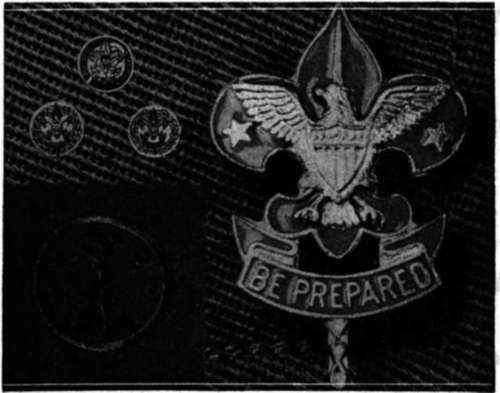
Badges illustrated above are those of the Troop Chaplain, Scout Executive, Scout Commissioner, Lone Scout and Scoutmaster.
First Class Requirement No. 1
At least two months' service as a Second Class Scout and be able to identify the rank, length of service and position of leadership of Scouts and local Scouters by means of their Badges and Insignia.
Object
See Second Class Requirement No. 1.
Interpretation
Two months must have elapsed from the date that the boy received his Second Class award before the Troop Court of Honor. During this time he must have participated regularly in Troop and Patrol undertakings.
As far as the Badges and Insignia are concerned, he must be able to recognize metal and embroidered badges for the ranks of Tenderfoot, Second Class, First Class, Star, Life and Eagle Scout; he must know the significance of Service Stars and be able to figure out the number of years for which any combination of them stands; he must know the insignia of Patrol and Troop Leaders, and of those Council Scouters with whom he is apt to come in contact.
Continue to:


My Books

