


Special Camp Fires
Description
This section is from the book "Handbook For Scoutmasters. Volume 1 & 2", by Boy Scouts of America. Also available from Amazon: Handbook For Scoutmasters.
Special Camp Fires
Special camp fires may be announced and prepared for, depending upon the leader's imagination.
1. First Camp Fire—Ashes from the previous year's last camp fire have been kept and are used in a ceremony, such as this for first year campers:' The boys are called forward, and the Scoutmaster says, "Scouts, you have now been in camp one day and you have attended part of our first camp fire. Earlier in the evening you listened to the traditions of our group and the responsibilities of each Scout. They are ours to fulfill. Will you help us keep these traditions as good campers should?" (Answer: "I will.") "I hold in this vessel some of the ashes of last year's camp fire.
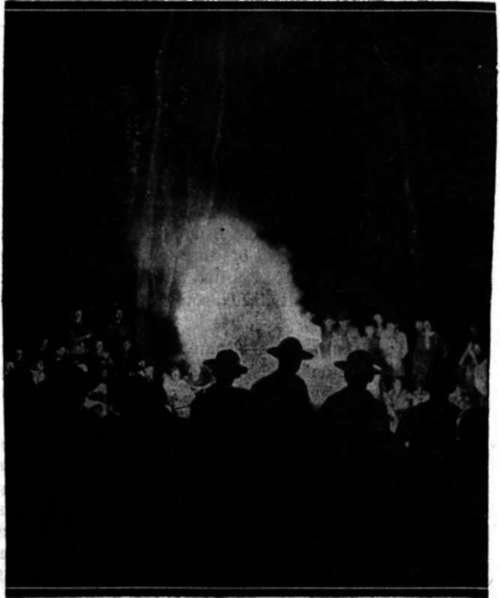
"Day is done. Gone the sun, from the lake, from the hills, from the sky. All is well. Safely rest. God is nigh."
It stands for all that we enjoyed in our past. I now place some of these ashes on the right shoulder of each of you (sprinkles ashes on each Scout) and pronounce you campers in good standing in this camp, entitled to all its rights and obligations."
2. Tall Story Camp Fire—will contain the telling of Paul Bunyon tales and related fables. Make it a contest to find out who is the champion tall story teller of the Troop.
3. Indian Camp Fire—The boys arrive at the camp fire in Indian file, stripped to the waist, but covered with a blanket, and made up with war paint and feathers. Indian ceremonies, songs, and dances are featured.
4. Surprise Camp Fire—A raft may be constructed of empty oil cans and board. On top of the wood is placed a two inch layer of dirt on which the camp fire is lighted. The raft is pulled out into the lake and the Scouts form a boat circle around it. Feature nautical songs.
5. Patrol Camp Fires—Some of the evenings in camp should be definitely designated for Patrol camp fires for which the Patrols will make up their own programs entirely.
6. Inter-Troop Camp Fires—If the Troop is camping in an Inter-Troop camp the biggest evening events will undoubtedly be when the Troops gather for big camp fires together. Here the Scouts and the Scouters will catch the true spirit of the Local Council and come to realize the greatness of our Movement. For such events the Troop will, of course, provide some of its best talent and best efforts for the mutual enjoyment.
7. Camp Fires in the Rain—Such a camp fire may be held with the fire near the edge of the mess-fly, or as near the most compact group of several tents as may be, or near opening of the Troop's general assembly tent, leaving the Scouts under cover. Build fire in safe but mammoth manner. Devote the program largely to songs and yells, tapering off as usual.
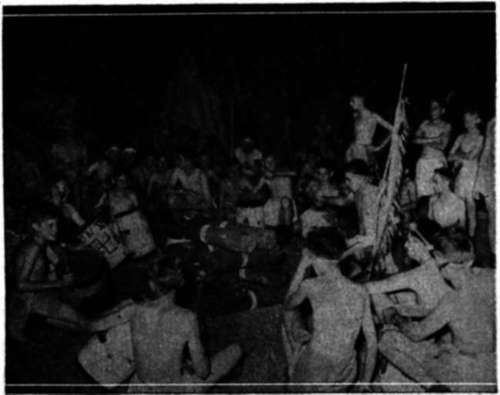
An Indian camp fire is always popular. Appropriate costuming is available to every boy with imagination.
8. Camp Fire Snacks—An unusual but sometimes appropriate pre-ending for a camp fire, if damp or chill settles about, is to serve hot cocoa, light cookies, hot beef tea, small crackers, or such.
9. Last Camp Fire—At the last camp fire, honor campers and honor Patrols are announced. Often the program is made up of the features which have proved most popular the previous evenings.
It should be ended on a high level, on a note for future promises. During the closing ceremony, some of the ashes may be lifted out to be kept for the opening of next year's camp fire.
"By the Blazing Council Fire's Light" will prove an appropriate last song.
Other Evening Activities
Occasionally, during the camp a game may be put on instead of the camp fire, although after the game is over and the spoils of war have been disposed of, the boys all gather around a large fire and relate their experiences in the game. This camp fire is for the purpose of toning down the boys so that when they get to bed the excitement of the game will have worn off.
The following are suitable games:
1. Smugglers in the Square—is played by having the camp divide into two groups. One half of the camp as Guards and one half as Smugglers. Ordinary lanterns are placed at four corners of a large square, a red lantern is placed in the center. The Guards are placed between the white lanterns, making the four sides of the square. Near the red lantern are placed a number of boxes with each box having a miscellaneous assortment of cakes, candy, peanuts, etc., with only a small quantity in each box, and several of the boxes are filled with stones. The Smugglers try to get through the square, get a box, and get out of the square without being tagged. Other rules may be made if desired.
2. The Night Attack—For this game also the camp is divided into two parts, with about three-quarters of the Scouts as Guards and one-quarter of the Scouts as Attackers. The invading party try to place cards with their names on them, on the tents, the flag pole, etc., each spot having a certain value in points according to its strategic position in camp. The Guards attempt to capture the cards before they are placed. At the end of a certain period, the Attackers are called in and points are totalled up for either side.
Other games which may be adapted into evening games may be found in Chat 31.
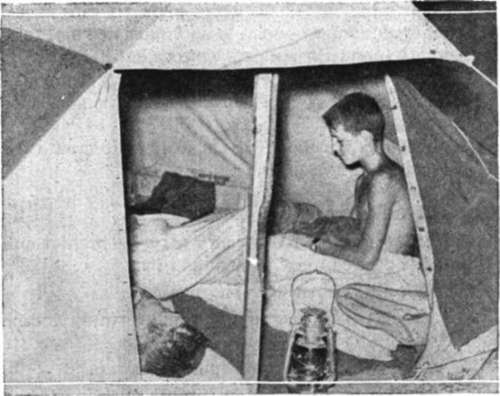
The fun, the excitement, the thrills, the swims, the eats, the camp fires make the hours go rapidly. Restful sleep and a new day dawns.
And So To Bed
At last the evening's activities are ended and the Scouts go to bed. One by one the lanterns which have turned the tents into eerie castles are extinguished. The Scoutmaster makes his final round. Then, he, too, retires.
And tomorrow is another glorious camping day, another health-bringing, character-building opportunity.
May you succeed in making the most of it!
Breaking The Camp
It is advisable to start to think of breaking camp the day before departure. There are many items which may be done then to insure a speedier "get-away," such as cleaning certain pots and pans, packing away Scoutcraft equipment which is no longer needed, taking down some of the gadgets. One thing that must be done is to settle all bills with the local tradespeople. Also, make the final check of transportation back to town.
But here is a warning: Be careful not to create the slightest appearance of "abandonment."
Breaking Camp
The order in which the camp may be broken and equipment packed may be such as this:
1. Clean all kitchen gear and pack.
2. Pack all personal equipment and form duffle line by Patrols.
3. Take down all tents and pack them up.
4. Clean all tent sites, filling in all ditches and replacing sod.
5. Take down all kitchen arrangements, including fire places; fill in garbage pits and grease pits.
6. Clean out washing place, fill in latrine, and clean camp fire circle.
7. Form a line of all Scouts across the camp site and have them move forward slowly, picking up every trace of scrap found on the ground.
8. Have the owner of the place (or in an Inter-Troop Camp, the Camp Director) make an inspection and declare the clean-up satisfactory.
Then,
9. Gather around the flag pole for a short closing ceremony, while The Flag is slowly lowered, officially closing the camp.
And, finally,
10. Take down flag pole and put it away.
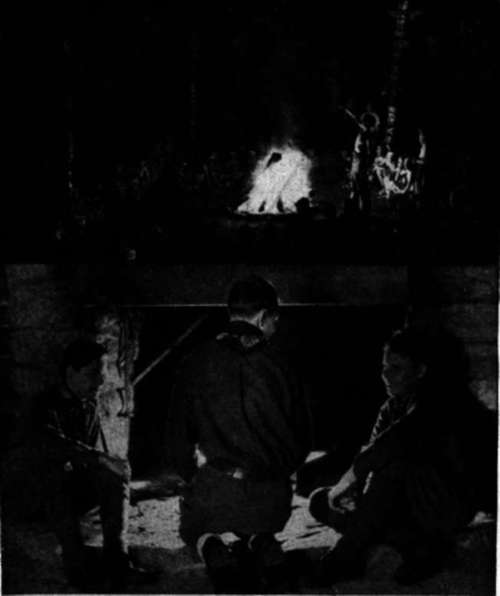
"Remember the last camp fire?" "Remember the Olympic Games?" Remember this? Remember that? Camp memories linger.
And follow the advice of Baden-Powell as to the two things which you are to leave behind you on breaking camp:
1. Nothing.
2. Your thanks to the owner of the ground.
After Camp
As soon as you have returned from camp, sit down and write letters of thanks to all those who have assisted you in making the camp a success. If possible, have these signed by the Patrol Leaders also on behalf of their boys.
Make a full report of your camping experience, together with any recommendations you may have to make based on that experience, to your Local Council and to the Troop Committee.
Get the Camp Log completed, with prints of photographs taken, copies of menus, programs, notices, camp newspaper, possible drawings, so that it may be a valuable memento of the past camp and a treasure trove from which to get ideas for future expeditions.
And use the increased Scoutcraft knowledge, the experiences shared, for the growth of the Troop and for its boys throughout the Scouting year ahead, until another Troop camping experience comes along.
Continue to:


My Books

