


Part XII. Activities Features. Chat 31. Games, Contests And Ceremonies. 1. Games And Contests
Description
This section is from the book "Handbook For Scoutmasters. Volume 1 & 2", by Boy Scouts of America. Also available from Amazon: Handbook For Scoutmasters.
Part XII. Activities Features. Chat 31. Games, Contests And Ceremonies. 1. Games And Contests
IT is impossible to even suggest which games may meet with success in a given Troop. Like cake recipes, the same game ingredients will give different results with different "cooks." Games popular with one group of boys may fall flat with another. Even the available space plays its part, as obviously games which, for example, may fit into a gymnasium or a field at the camp have no place in a Troop den twenty feet by twenty feet.
Evidently, then, the games for use in your Troop will have to be chosen over a period of trying and testing. When a certain game has proved popular it may be played regularly. Yet don't overwork any one game. Make a change, even if the game is still going good— or, rather, while it is still good. A large number of games is not necessary. Many successful Troops get along splendidly for a full season with a small dozen of favorite recreational games. The main point is to find these favorites.
An important thing about games in Scout activities is that all the boys be given a chance to participate actively. Boys who are only "looking on" will soon lose interest and will start getting into mischief. Get everyone into the game. It is imperative that game teams should be the Patrols. If two teams only are required, each team should be made up of full Patrol groups. If the Troop has an odd number of Patrols, use games that call for an odd number of teams. Make it a rare exception to break up Patrols to form teams.
Contests
It is difficult to say at what point a game ceases to be a game and becomes a contest. But possibly the difference may be found in the subject matter and in the amount of formality entering into the contest as contrasted with the game.
A contest in Scouting may be considered a matching of skills for the purpose of improving skills. The matching may be against an already established standard, making it possible for every participant to become an actual winner over himself—he must beat his own record—or the matching may be against the Patrol's own previous standard or between Patrols or Patrol representatives. In this latter case there will be a winner, yet all participants may be considered partial winners, through the increased practice which they have gained.

Learning Nature Lore by new games causes the Scouts to think, to judge, to decide quickly and accurately, to become mentally awake.
Boys take to contests as they take to fishing. In fishing they may catch a prize fish—or none. Whether they win or not, they have had the fun of "fishing." This same spirit should enter into every contest of the Troop. "We will do our best" should be the idea. "If we win, fine! If we lose, we have had the fun of 'fishing'!"
Game And Contest Leadership
Games and contests may appropriately be under the leadership of the Junior Assistant Scoutmaster, pos-' sibly alternating with the Senior Patrol Leader, although each Patrol should be encouraged to stage and lead new ones from time to time.
In introducing a game be positive that every one understands it before starting to play it. The game leader should explain it fully beforehand. If necessary, one Patrol previously coached may go slowly through it for the benefit of the rest. However, don't try to teach and play the game at the same time. It may easily result in failure. And another good game has met its Waterloo.
During the game period you, as Scoutmaster, will be an onlooker or an active participant—sometimes One, sometimes the other. As an onlooker you will have an opportunity to study the reaction of every boy to the game and to his comrades—a study which may often explain obscure points in the boy's character. As an occasional participant you will be "one of the boys." They will like it and so will you.
Classification Of Games And Contests
The games and contests in the following pages have been classified as:
SCOUTCRAFT GAMES—which may be used for teaching of or for practice in the various Scout Requirements.
RECREATIONAL GAMES—tor general fun, recreation and physical action and to provide variety in the game "menu."
WIDE GAMES—over wide territory, involving various Scoutcraft features and physical exercise.
An attempt has been made under each game to suggest further classification which may help the Scoutmaster or game leader to decide whether the game is suited for the purpose he has in mind. This includes:

The Where Book of Games is a mine of useful references, telling you where to find games for any occasion—indoor or outdoor.
1. The main object for which the game aims.
2. The type of activity inherent in the game. The games are identified as being Quiet, Lively, Vigorous or Strenuous.
3. The teams participating, such as Whole Troop,
Whole Troop against "It", Half Troop teams, Patrol teams and Patrol Representatives.
4. The space required, such as Small (close Troop circle formation, Patrol corners, camp fire circle, and the like), Medium (the average Troop meeting room), Large (very large Troop meeting room, gymnasium or playground) and Wide (cross-country territory). Games suited for Indoor uses are marked I, for Outdoor uses O. I-O indicates that the game may be played indoors as well as outdoors.
5. The material needed.
Scoutcraft Games and Contests
Scout Law Games. Scout Law Relay
Object—Scout Law
Teams—Patrols
Training Space—Medium, I
Type—Quiet
Material—One hat for each Patrol with slips of papers numbered from 1 to 12. Pencils.
Parallel file formation. Hat with slips placed about 20 feet in front of each Patrol. On signal first Scout runs up to hat, draws slip, reads number, writes on paper the point of the Scout Law of that number, drops paper beside the hat, runs back and tags next Scout, who repeats performance, etc. First Patrol finished with most correct answers wins.
Scout Law Story
Object—Scout Law
Teams—Whole Troop
Training Space—Small, I
Type—Quiet
Material—Written story, paper and pencil per Scout.
Troop circle formation, Scouts seated. Scoutmaster
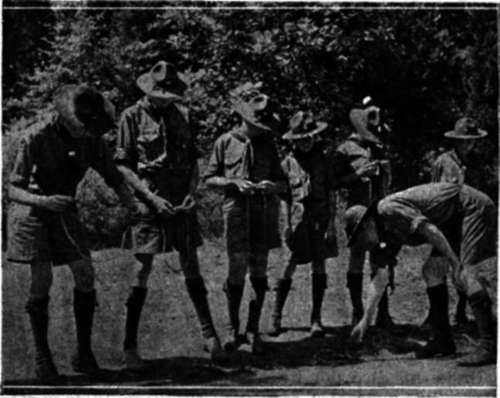
"Champ-Nit." An old favorite to make rope work more interesting. Variations of this game may include signaling, bandaging.
(or other leader) tells story illustrating Scout Law, such as: "Bobby Jones was a Scout. One summer day another boy from his Patrol came to take him swimming. 'sorry I can't go yet. I first want to cut our lawn (help my father clean the basement), because a Scout is......It is a shame, but I suppose a Scout is......
After I have finished, I'll need a bath, for a Scout is
......, etc." The Scouts write down the points of the
Law represented. The answers are collected. Patrol with most correct answers wins.
Newspaper Study
Object—Scout Law
Teams—Patrols Training Space—Small, I Type—Quiet
Material—One current newspaper per Patrol.
Patrols in Patrol corners, each with the same day's issue of a newspaper. On signal Patrols start a search for news items which definitely illustrate the Scout Law. Items are cut out and numbered according to number of Law. Patrol with most clippings in given time wins. (The smart Patrol Leader will distribute the pages between his Patrol members and have everyone search).
Knot Games. Champ-Nit Contest
Object—Training in various subjects representatives
Teams—Patrol Type—Quiet Space—Small, I
Material—As needed.
Patrols in corners in charge of Patrol Leaders. Under his direction members race to tie a square knot (for instance) and drop it to the floor. Winner steps out and rest of Patrol repeat contest. Winner steps out each time, so that the last one is the "Champ-nit" of the Patrol. Troop assembles and have Patrol Champ-nits compete to find Troop Champ-nit. This method may be used for numerous Scout subjects. The merit of it is that the Scout most in need of practice gets the most work.
Knotting Circle (Knot Run)
Object—Knotting Training against "It"
Teams—Whole Troop Type—Lively
Space—Medium, I Material—One knotting rope.
Circle formation, Scouts facing inward, hands behind their backs. "It" walks around outside circle, places rope in someone's hands, yells name of a knot and starts speedy run around circle. If recipient succeeds in tying knot correctly before "It" comes back,
"It" must proceed again. Otherwise recipient becomes "It" and previous "It" takes his place in the circle.
Save My Child
Object—Knotting Training
Teams—Patrols Type—Quiet
Space—Medium, 1-0
Material—One hat per Patrol, one rope per boy.
Parallel file formation. "Child" (hat) placed about forty feet in front of first boy of each Patrol. On signal the last boy in each Patrol file ties his rope to rope of boy in front of him, who in turn ties it on to the next, etc. Front Scout in each Patrol ties bowline around himself, "swims" to hat, picks it up, is pulled back by rest of Patrol. First Patrol finished wins.
Knotting Contest
Object—Knotting Training
Teams—Patrols Type—Quiet
Space—Medium, 1-0
Material—One rope per boy.
Parallel file formation. Last boy ties timberhitch on his rope, passes it to next who ties his own rope onto it with sheet bend, passes it on to next who ties square knot, etc., according to order of knots announced in advance. Patrol first to complete is winner. If Patrols are uneven in size, it may be necessary in some instances for one boy to tie two knots.
Man Overboard
Object—Knotting Training
Teams—Patrols Type—Quiet
Space—Medium, 1-0
Material—One rope per boy, chalk.
Parallel file formation, first boy of each Patrol toeing chalk line. First boy "falls overboard," is carried away "by current" (walks backward slowly). Second boy throws him a line. Third boy ties his own rope onto the end of this before it has been pulled beyond the chalk line, fourth boy the same, etc. When last boy has added his rope, the man overboard is pulled in. (All number ones must move with equal speed).
Cannibal Rescue
Object—Knotting Training
Teams—Patrols Type—Lively
Space—Medium, 1-0
Material—One long rope per Patrol.
Parallel file formation, first boy of each Patrol toeing chalk line. Another chalk line is drawn parallel to this, twenty feet apart. Patrols, pursued by cannibals, have come to wide river, only one can swim. First boy "swims" to other "shore," throws end of rope to second boy, who ties a bowline around himself and is pulled over. And so on. First Patrol rescued wins.
Chain Gang Race
Object—Knotting Training
Teams—Patrols Type—Lively
Space—Medium, 1-0
Material—One rope per boy.
Parallel file formation. On signal, first boy ties rope around his ankle with a bowline and hands end to second boy. Second boy ties his rope on to first boy's with a square knot and then ties rope to his own ankle with a clove hitch and hands loose end to third boy who treats himself likewise. When all are tied together Patrol races to a finishing line.
Knot Hoop Relay. Object—Knotting Training
Teams—Patrols Type—Lively
Space—Medium, I Material—One rope per Patrol.
Parallel file formation. On signal, first Scout ties rope into a loop with a square-knot (or sheetbend, fisherman's knot, etc.) and passes it over his head and down around his body. He steps out of the hoop, unties knot and passes rope to next Scout, who repeats procedure, and so on down the line.

One hand knotting is a novel way of checking the knot-tying abilities of the Scouts. Besides—it's fun.
Knot Relay
Object—Knotting; Training
Teams—Patrols Type—Lively
Space—Medium, 1-0 Material—One rope per boy.
Parallel file formation, with one boy from each Patrol standing about twenty feet in front of the Patrol. On signal, first boy runs up and ties bowline around standing boy, runs back and tags second boy who runs and ties his rope on to the other with square knot. Following boys tie sheetbend, fisherman's knot, etc. Last boy ties his rope on with square knot and then ties rope around his own ankle with clove hitch.
One Hand Knotting
Object—Knotting Training
Teams—Two Scouts Type—Quiet per Patrol
Space—Small, I Material—One rope per boy.
Boys of each pair facing each other, each boy with rope in right hand, left hand in pocket. On signal they attempt to tie their ropes together using knot called. First pair successful wins. Ropes must not be laid on floor during tying.
Continue to:


My Books

