


Troop CIVIC Service
Description
This section is from the book "Handbook For Scoutmasters. Volume 1 & 2", by Boy Scouts of America. Also available from Amazon: Handbook For Scoutmasters.
Troop CIVIC Service
Through planned Civic Service projects, the Scoutmaster has his greatest opportunity for inculcating in his Scouts an unselfish spirit of service to others.
* Based on Civic Service Manual. Wilmington, Del., Area Co.
A Service Program For The Troop
In order to be effective, the service program of the Troop must be planned in such a way that it will gear in with the work that is being conducted by other agencies in the community and with the policy and activities of the Local Council. A careful study of the situation by the Scoutmaster and other leaders of the Troop including Troop Committee members, as to where the Troop's services will do the most good and as to what the boys are best qualified to do, should result in a worth while service program.
But remember, the participation of the Scouts themselves in planning, in selecting service projects, and in directing their performance, is a necessary basis for their genuine interest in the program. So use your Troop Leaders' Council and give every Scout a chance to suggest Troop service projects.
Service projects which may arise may be of periodic, occasional or emergency character.
Periodic Service
Annually recurring opportunities, such as the following, are considered as periodic service:
1. Collection of old clothing, or toys for repair and distribution to needy families.
2. Assistance to Sponsoring Institution at annual meeting and special events.
3. Observance of state and national holidays.
4. Poster distribution for social and charitable organizations.
5. Participation in Community Chest campaigns.
Meeting the opportunities for this class of service is dependent upon the alertness of Troop leaders in planning ahead to offer the services of the Scouts in time for adequate preparation and organization.
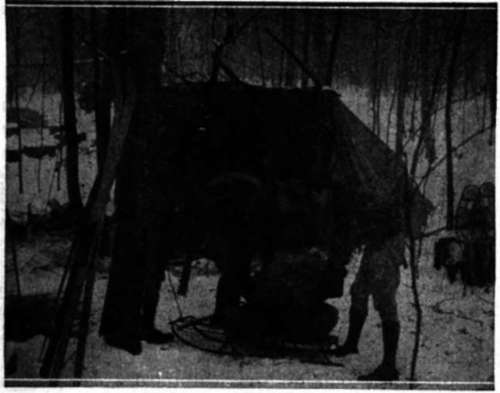
When all other communication had broken down in the '34 blizzard. Scouts with sleds, snow shoes and skis carried food to the snow bound.
Occasional Service
Opportunities for this type of Scout service arise from the calls of institutions and organizations to meet specific needs, such as:
1. Messengers, guides, or ushers for conventions, concerts and public meetings of various kinds.
2. Distribution of posters or literature for hospitals and other community organizations.
3. Duty at parades, community gatherings, school athletic events.
4. Assistance in safety drives, clean-up campaigns, and other community projects.
5. Cooperation with police in locating lost children.
6. Safety patrols for small children at dangerous crossings.
7. Assistance at church or community functions as ushers or special helpers.
Emergency Service
Scout service is invaluable in time of emergency or calamity-flood, fire, explosion, windstorm, or other disaster.
Scout training should result in preparedness to render assistance in the nature of rescues, life saving, first aid, signaling, messenger service, cooking, and camping, to a greater degree than that of the average citizen.
The brightest pages of Scouting history have to do with the heroic performance of emergency service by Scouts who personified the Scout Motto: "BE PREPARED." The Emergency Service Plan (see Part XV) of the Boy Scouts of America prepares every Scout in the Troop so that in case of disaster he will be ready to do his part.
Every Troop should perfect a mobilization plan, by which the Scouts and Troop equipment may be quickly assembled. Tests of the efficiency of the mobilization organization should be made at least annually. It must be more than a mere paper plan.
CIVIC Service Policies
Every Civic Service project must conform to the policies of the National and Local Councils regulating Scout participation in community service. Before undertaking any project, check it against the following principles:
1. Definite assurance of character or citizenship training value to the Scouts.
2. Service to be in keeping with the dignity of the Scout Movement.

First Aid Requirements for Second and First Class Ranks, as well as First Aid and Life Saving Merit Badges, prepare Scouts to help others.
3. Service must be non-remunerative, non-political, and non-commercial.
4. Service must involve no solicitation nor handling of money by Scouts.
5. Service must be carried out in Scouts' leisure time. School duties must not be interfered with.
6. Service which Scouts may render must not deprive men of employment.
7. Leadership must conform to highest Scouting standards. Scout shall not be placed in an environment inimical to health, safety or moral development.
8. In the case of specific requests for Scout service, any expenses which the Scouts may incur, such as carfare or meals, should be paid by the agency requesting the service.
Our Record Of Service
The Boy Scouts of America is proud of its record of services rendered. Look at the chain of them. Consider the list of small things and common things: cleaning public parks, assisting in public celebrations, helping traffic, planting trees. Ponder the services rendered during the World Wars-service upon service, day in and day out. And think of the more spectacular things, the part Scouts played in national disasters-in a Mississippi flood, a St. Louis tornado, a Perth Amboy ammunitions explosion. The accounts of those disasters carry with them in red letters the story of service by Scouts-at times, service unto death.
But let us not rest on our laurels! When one service is performed, another beckons us on. So let us go!
To the citizens of our country Scouting has come to stand for SERVICE. It is the responsibility of every Troop to uphold this great tradition.
Cooperation For The Asking
Departments of the local, state and national governments, nation-wide organizations and various institutions are ready and willing to give valuable aid to Scouting as a movement or to any of Scouting's Troops.
CIVIC Departments
The local Fire Department may supply instructors in Firemanship. The Board of Health or a local hospital may furnish men to teach First Aid, Public Health, and like topics. A short talk on police regulations will prepare the boys to be called upon to help in an emergency.
Among the teachers of the schools, of the high schools especially, are to be found experts for such subjects as Art, Athletics, Carpentry, Chemistry, Civics, Craftsmanship, Electricity, Interpreting, Music, Scholarship.
Playgrounds and athletic fields may be borrowed for rallies, and also they offer training facilities for Athletics and Physical Development.
A museum trip is a good winter substitute for a hike. Special attention should be directed to the nature material and the woodcraft devices of the Indians. Reference books on all Scout subjects may be obtained from the libraries. School Boards frequently give the use of school buildings without charge.
Continue to:


My Books

