


Pingijicula
Description
This section is from "The American Cyclopaedia", by George Ripley And Charles A. Dana. Also available from Amazon: The New American Cyclopædia. 16 volumes complete..
Pingijicula
Pingijicula (Lat. pinguis, fat), a small genus of plants belonging to the bladderwort family (lentibulacem). They are stemless herbs with a cluster of broad radical leaves, from the centre of which rises a naked scape bearing a solitary drooping flower, with a two-lipped calyx and a spurred monopetalous corolla, which is somewhat two-lipped, the upper lips two- and the lower three-lobed; the plants are usually found in wet places, such as the margins of ponds and on wet rocks. There are five species in the United States, four of which are peculiar to the southern states, and one, P. vulgaris, rather rare on our northern borders, is found throughout the northern portions of the old world. This species has the common name of butterwort, from the greasy feel of the leaves, which also gives the botanical name; the flower stalk is 3 to 5 in., high, and the handsome flower bluish purple. The leaves have long been known to possess the power of coagulating milk in the same manner as rennet, and it is the custom of the Laplanders to pour' reindeer's milk over the leaves for this purpose. The digestive power (so to speak) of the leaves has been examined by Darwin, whose investigations show that this must be added to the now considerable list of insectivorous plants.
When an insect, meat, cartilage, or other animal matter is placed upon a leaf of the pin-guicula, its margin curls over to embrace it, and the glands at the edge of the leaf pour out a slightly acid secretion which envelops the object and digests it. (See DionAEa, and Insectivoeous Plants).
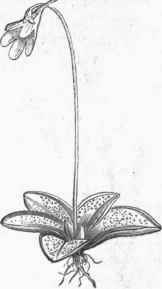
Butterwort (Pinguicula vulgaris).
Continue to:


My Books

