


Sheep's Head
Description
This section is from "The American Cyclopaedia", by George Ripley And Charles A. Dana. Also available from Amazon: The New American Cyclopædia. 16 volumes complete..
Sheep's Head
Sheep's Head, a spiny-rayed fish of the family sparidoe and genus sargus (Cuv.); the scup-paug (pagrus) belongs to the same family. The gill covers are unarmed, the palate toothless, the jaws not protractile, and the scales large; the front incisors are cutting, almost like those of man, and there are several rows of rounded molars. This fish (S. ovis, Cuv.) is about 20 in. long, though some grow considerably larger; the ground color is light gray, with six distinct, dark brown, transverse bands, broad and nearly equidistant, and another across the neck; the head is much darker, the gill covers with silvery and golden reflections, throat somewhat reddish, and irides golden; scales with dark margins; the pectorals nearly colorless, the other fins blackish brown. The body is short and thick, and the back rounded; lips large and fleshy, jaws equal, eyes large, and nostrils high on the head and double; the first 12 rays of the dorsal and first three of the anal strongly spinous, pectorals very long, ventrals stout, with spinous process at base and first ray spinous; air bladder large. The form of the head and blackness of the face give it a slight resemblance to the physiognomy of the sheep.
It is caught readily in nets and seines; it is difficult to take with the hook, as the line is very liable to be cut off by the sharp incisors; its food consists of mollusks and crustaceans. Its flesh is highly esteemed. There are several allied species found on the coast from New York to New Orleans, and one in the Mediterranean.
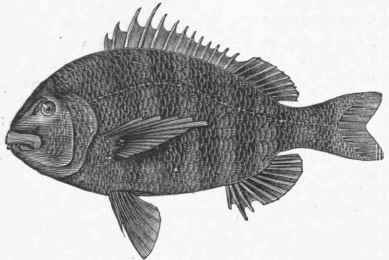
Sheep's Head (Sargus ovis).
Continue to:


My Books

