


Skimmer
Description
This section is from "The American Cyclopaedia", by George Ripley And Charles A. Dana. Also available from Amazon: The New American Cyclopædia. 16 volumes complete..
Skimmer
Skimmer (rhynchops, Linn.), a genus of web-footed birds of the gull family, and subfamily rhynchopsinae. The bill is of singular shape, broad at the base, from which it is suddenly compressed laterally to the end; the upper mandible is considerably the shorter, curving gradually to the tip, which is pointed and grooved underneath; the lower mandible is straight and truncated, more compressed, with a sharp cutting edge received into the groove of the upper; nostrils basal; wings very long and narrow, with the first quill the longest; tail moderate and forked; tarsi longer than middle toe; feet very small, toes short with indented web, hind toe elevated, and claws ' curved and sharp. Three or four species are described; they are most abundant in the tropics, where they frequent quiet bays and inlets; they feed chiefly at night on fish and crustaceans, which they catch as they skim along close to the water, dipping the under mandible beneath the surface and closing the upper suddenly upon it when prey is encountered; the flight is swift, graceful, and undulating, and the gait awkward; they rarely if ever swim or rest upon the water.
The best known species is the black skimmer (R. nigra, Linn.), found on the Atlantic and gulf coasts of North America from New Jersey to Texas, on the E. coast of South America as far as the tropic of Capricorn, and, according to Lesson, on the W. coast. The length is about 19 in. and the alar extent 48 in.; the general color above is deep brownish black; the front to the eyes, throat, and under parts white; inner tips of four inner primaries white, and secondaries broadly tipped with the same; the central tail feathers dark brown, the others mostly white; the bill carmine for the basal half, thence black to the end, the upper mandible about 3½ in. and the lower 4½; tarsi and feet red, and iris hazel; the female is smaller. They are nocturnal, resting by day on the sand bars, in large flocks. The nest is a slight hollow in the sand, and the eggs are usually three, 1¾ by 1⅜ in., white with large black or dark patches; the female sits only at night or in wet and cold weather; the young closely resemble in color the sand upon which the nest is made; they migrate to the south when the young are able to fly; their eggs are as good as those of the gulls.
This species is sometimes called razor-billed shearwater, and scissors-bill. Other species are found on the W. coast of Africa.
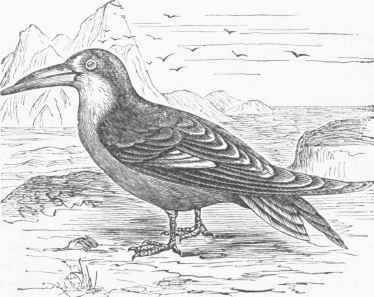
Black Skimmer (Rhynchops nigra).
Continue to:


My Books

