


Sphinx
Description
This section is from "The American Cyclopaedia", by George Ripley And Charles A. Dana. Also available from Amazon: The New American Cyclopædia. 16 volumes complete..
Sphinx
Sphinx, a fabulous monster of Greek mythology, which was represented generally as having the winged body of a lion and the breast and head of a woman, but sometimes with a female face, the breast, feet, and claws of a lion, the tail of a serpent, and the wings of a bird; and sometimes the fore part of the body is that of a lion, and the lower part that of a man, with the claws of a vulture and the wings of an eagle; all which forms were used as architectural ornaments. In the legends of the poets the sphinx is said to have been the daughter of Orthus and Chimaera, or of Ty-phon and Chimaera, or of Typhon and Echidna, and to have come from the most distant parts of Ethiopia. She is also said to have been sent by Mars to avenge the death of his son the dragon slain by Cadmus, or according to others sent by Bacchus or by Pluto; while others again represent her as one of the women who with the daughters of Cadmus were thrown into madness and metamorphosed into monsters. She was ravaging Thebes and devouring those who could not solve a riddle which she proposed to all whom she met, when Oedi-pus, being offered the crown of Thebes on condition of delivering the country from the monster, solved the riddle, upon which the sphinx destroyed herself. (See Oedipus.) - It is probable that the Greeks derived the idea of the sphinx from Egypt, where from remote antiquity such figures had been used to embellish the avenues which formed the approaches to temples.
Among the Egyptians they had the head of a man, bearded and capped, and the body of a lion, thus differing from the Greek sphinxes, which had a female head and the body of a winged lion. Clemens and Plutarch say they were placed before the temples as types of the mysterious nature of the deity. Some sphinxes have the head of a ram, and are called crio-sphinxes, and others the head of a hawk, called hieraco-sphinxes; the former were sacred to Amen or Jupiter Ammon, the latter to Ra, the god of the* sun. The great sphinx at the pyramids was supposed by Lep-sius to represent King Cephren, the builder of the second pyramid; but an inscription has lately been discovered which renders it probable, that, it was sculptured even before the time of Cheops, the builder of the first pyramid. Tho Egyptians called it Hor-em-khu, or Har-ma-khu, "the setting sun," the name of the god to whom it was dedicated, which was converted by the Greeks into Armachis. It is near the eastern edge of the platform on which the pyramids stand, with its head turned toward the Nile. The head measures 28 ft. 6 in. from the top to the chin. The total length of the body, which is that of a lion crouching close to the ground, is 146 ft. Across the shoulders it measures 36 ft., and the paws are extended about 50 ft.
Between the paws was built a small temple, which was of masonry, as were the paws, while all the rest of the sphinx seems to be carved out of solid rock. Col. Vyse drilled a hole 27 ft. deep into one of the shoulders, and found that it was one piece of stone throughout. Near the sphinx Mariette discovered a vast temple buried in the sand, which is supposed to have been dedicated to the worship of the divinity of the sphinx. The countenance is now so much mutilated that the outline of the features can with difficulty be traced. The head had been covered with a cap, the lower part of which remains, and it had originally a beard, the fragments of which were found below.
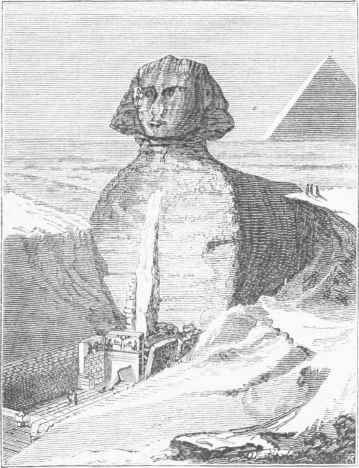
The Great Sphinx.
Immediately under the breast stood a granite tablet, and another of limestone on either side resting against the paws. The first contains a representation of Thothmes IV. offering incense and making libation to the sphinx, with a long inscription in hieroglyphics reciting the titles of the king. On the paws are inscriptions of the Roman times, expressive of adoration to the sphinx or to the Egyptian deities.
Sphinx #1
Sphinx, one of the names of the Guinea baboon (cynocephalus papio, Desm.). It is rarely seen in menageries, though it is remarkably intelligent; it is probably one of the species represented on the Egyptian monuments. It was known to Pliny. (See Baboon).
Continue to:


My Books

