


Turkey (Meleagris Linn)
Description
This section is from "The American Cyclopaedia", by George Ripley And Charles A. Dana. Also available from Amazon: The New American Cyclopædia. 16 volumes complete..
Turkey (Meleagris Linn)
Turkey (Meleagris Linn), a well known gallinaceous bird, the type of the family meleagridce, of the group alecteromorpTim of Huxley. The bill is moderate and strong, shorter than the head, compressed on the sides, with culmen arched, and upper mandible overhanging the lower; the cere is elongated into a loose, pendulous, round, fleshy caruncle; head and upper neck bare, with only a few scattered hairs, and carunculated; base of lower mandible sometimes wattled; a tuft of long, black bristles on the breast, largest in the males; wing short and rounded, the first four quills graduated, and the fifth and sixth the longest; tail broad and rounded, pendent during repose, but capable of being raised- and extended like a fan; tarsi robust, longer than middle toe, covered in front with broad, divided scales, and armed with a short obtuse spur; anterior toes united at base by a membrane, the inner the shortest, the posterior moderate and elevated; claws short and slightly curved. All the species in the wild state are indigenous to North America. The common wild turkey (M. gallopavo, Linn.) is about 3½ ft. long and 5 ft. in extent of wings, weighing from 15 to 20 lbs.; the naked skin of the head and neck is livid blue, and the excrescences purplish red; the general color is copper bronze, with green and metallic reflections, each feather with a velvet-black margin; quills brown, closely barred with white; tail feathers chestnut, narrowly barred with black, and the tip with a very wide subterminal black bar; the female is smaller and less brilliant, without spurs, often without bristles on the breast, and with a smaller fleshy process above the base of the bill.
It has a crop and gizzard, and an intestine four times the length of the body; the cartilaginous tissue of the stomach is less hard than that of the common fowl. The full plumage is attained at the third year; the females usually weigh about 9 lbs. They fly in flocks of many hundreds, frequenting woods by day, feeding on acorns, all kinds of grain, buds, berries, fruits, nuts, grass, insects, and even young frogs; they make considerable journeys in search of food, flying and swimming across rivers a mile wide; though their flight is heavy, they are able to reach with ease the tops of the highest trees; they are so strong as not to be easily held when slightly wounded; they perch at night on trees. Quitting the woods in September, they come into the more open and cultivated districts, where they are killed in great numbers; they were formerly abundant in the middle, southern, and western states, but are now rare except in thinly settled regions, and have never been found west of the Rocky mountains.
Although the turkey was exclusively an inhabitant of North America in its wild state, the earlier naturalists supposed it to be a native of Africa and the East Indies, and its common name is said to have arisen from the belief that it originated in Turkey; it was carried to England in the early part of the 16th century by William Strickland, lieutenant to Sebastian Cabot. Since that time it has been acclimated in most parts of the world, but the domestic bird, contrary to the usual rule, lias degenerated in size, flavor, and beauty. The flesh of the wild turkey is more pheasant-like than that of the domesticated varieties. The old males keep by themselves, as do the females and young, the former being apt to destroy the eggs in order to prolong the honeymoon; they are polygamous, the males in the breeding season, in March, strutting before the females, with tail spread and elevated, wings drooping, feathers ruffled, head and neck drawn back, emitting a puffing sound; the males also utter singular notes, resembling the word "gobble" several times repeated; they fight desperately for the possession of the females.
The nest is a slight hollow in the ground filled with withered leaves, in a dry and sheltered situation, and usually contains, when full, 10 to 15 eggs; after this time the males conceal themselves while recovering their condition; the females alone incubate, carefully concealing the nest, approaching it with great caution and always in a different way, covering the eggs with dry leaves when going in search of food, and bravely defending them against depredators; sometimes three or four females lay in one nest, one remaining to guard it while the others seek for food. The males are attentive to the young, which run as soon as hatched, but are very tender and easily killed by cold and wet. Turkeys run very fast, and when pursued trust more to their legs than to their wings for escape; they are generally shot from their roosts at night, or entrapped in a pen or enclosure into which they are enticed by grain; their feathers are employed by the Indians in ornamental work; their greatest enemies are lynxes and owls, and other carnivorous mammals and birds. - Two other species of turkey, the M. ocellata (Cuv.) and M. Mexicana (Gould), have been described as inhabiting Central America, Mexico, and the table lands of the Rocky mountains, both closely resembling in plumage and habits the common wild species. - The progenitor of the present race of domesticated turkeys is not known with certainty; some naturalists incline to the belief that it is the M. gallopatio, while others consider it to be an allied species, perhaps now extinct.
Domesticated turkeys thrive best on high, dry, and sandy soil, and when grasshoppers are plentiful can pick up their own living; in temperate climates they generally lay twice a year, 15 eggs or less, white with small spots of reddish yellow. One male will suffice for 12 to 15 females, the latter being prolific for about five years, though those of two or three years are the best hatchers; incubation lasts 27 or 28 days, and they are such close sitters that food must be placed within their reach; when they are raised on a large scale they are made to hatch in darkened places, and so that the turkey pouts, or young turkeys, shall all come out together; the young require warmth, proper food, and pure water, and must be protected against rain and the hot sun; they are liable at all ages to many diseases, for the treatment of which special works in abundance can be consulted. - Several fossil turkeys have been described by Professors Cope and Marsh in the post-tertiary.
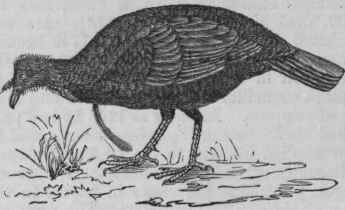
Wild Turkey (Meleagris gallopavo).
Continue to:


My Books

