


Wood Duck, Or Summer Dock (Aix Sponsa, Boie)
Description
This section is from "The American Cyclopaedia", by George Ripley And Charles A. Dana. Also available from Amazon: The New American Cyclopædia. 16 volumes complete..
Wood Duck, Or Summer Dock (Aix Sponsa, Boie)
Wood Duck, Or Summer Dock (Aix Sponsa, Boie), an American duck, with the bill very high at the base, shorter than the head, the upper lateral angle running back much behind the lower edge; nostrils very large, the feathers of the forehead reaching to their posterior edge; nail very large and much hooked, occupying the entire tip; head crested; tail about half the length of the wings, wedge-shaped, truncated at the tip, the coverts nearly as long as the feathers. The principal characters of the plumage are: head and crest metallic green, glossed on the sides with purple; line from upper corner of bill, one behind eyes, two bars on side of head meeting under the chin, and upper throat white; lower neck and sides of tail purple, the former with triangular spots of white; lower parts white; sides yellowish banded with black and posteriorly with white; speculum bluish green, tipped with white; primaries silver white externally at tip; back uniform, with bronzed and green reflections; a white crescent in front of wings bordered with black; scapulars and inner tertials velvet black with violet gloss; in the female the back is more purplish, the sides of head and neck ashy, about the bill white, and lower neck brownish; the eyes are red. It is 19 in. long, and 29½ in. in alar extent.
It is distributed over North America as far as the British provinces, confined to fresh water, especially secluded ponds in woods; the flight is noiseless, very rapid, graceful, and as easy among the branches of trees as that of the wild pigeon; flocks of 50 are often seen. It breeds from April to June, according to latitude, the nest being made in the hollow or broken portion of a tree, and usually in deep swamps; the eggs are 6 to 15, 2 by 1½ in., pale buff and greenish, smooth, and laid on dried plants and feathers; they are much attached to their breeding places, and the young run and swim as soon as hatched, feeding on aquatic insects, flies, and seeds; the adults are excellent divers, and feed on acorns, nuts, grapes, berries, rice, insects, snails, tadpoles, and small fry; the flesh is best in autumn. The sense of hearing is very acute, rendering the bird rather shy. The chief enemies of the adults are minks, raccoons, and snakes, and many of the young are destroyed by snapping turtles, alligators, and predaceous fishes. - The only other species is the famous mandarin duck of China (A. galericulata, Boie), which resembles the former, especially the females, with some of the quills enlarged and standing vertically when the wings are closed.
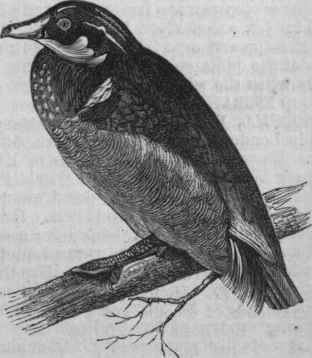
Wood Duck (Aix sponsa).
Continue to:


My Books

