


Wrasse
Description
This section is from "The American Cyclopaedia", by George Ripley And Charles A. Dana. Also available from Amazon: The New American Cyclopædia. 16 volumes complete..
Wrasse
Wrasse, the common name of the spinyrayed fishes of the family labridoe comprised in the genus labrus (Cuv.). The mouth is protrusible, with double large and fleshy lips, and jaws armed with formidable conical teeth in a single row, or with smaller and crowded ones in a second row; no teeth on palate, but broad grinders on the coalescent lower pharyngeal bones; scales large, thin, and cycloid, with lateral line interrupted, and cheeks and gill covers scaly; there is a single long dorsal, the spines of the anterior portion being surmounted by short membranous filaments, and the posterior having soft and split rays; ventrals under pectorals; air bladder simple and strong, and stomach without pyloric caeca. The species are numerous, especially in the tropical seas, and are of moderate size, stout form, and beautiful colors; they are also called rock fish and old wives. They are generally seen in troops among the rocks, hiding under sea weeds, and feeding on crustaceans, mollusks, and sea urchins; they bite eagerly, and are often caught by baits intended for other fish, as their flesh is not much esteemed, being generally used as bait.
In the temperate regions they spawn in April, the young, about an inch long, being numerous about the rocks in summer; some of the Mediterranean species spawn twice a year. One of the most common species in the temperate seas of Europe is the ballan wrasse (L. maculatus, Bloch), about 18 in. long, varying greatly in color, being blue or green with orange spots, or entirely of different shades of the latter; the colors change rapidly after death. The striped wrasse (L. variegatus, Gmel.) is of a general orange color, reddish on the back, yellowish below, with the sides striped with blue, and the fins blue and orange; the female is very unlike the male; it is found in the same waters. The rainbow wrasse (julis vulgaris, Cuv.) has the lateral line uninterrupted and the head without scales; the colors are varied, orange, blue, yellow, and silvery; it is common in the Mediterranean, and at Nice is considered good eating. The gilt-headed wrasse (crenilabrus tinea, Risso) has the edge of the preoperculum denticulated; it is about 6 in. long, red varied with green, fins greenish blue, and head blue, with reddish orange stripes and spots on the cheeks; it is found on the English coasts.
These fish are represented on the North American coast by the salt-water perch (ctenoktbrus cceruleus, De Kay) and the tautog or black fish.
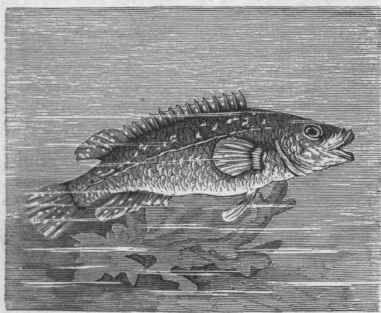
Ballan Wrasse (Labrus maculatus).
Continue to:


My Books

