


Constantine. I
Description
This section is from "The American Cyclopaedia", by George Ripley And Charles A. Dana. Also available from Amazon: The New American Cyclopædia. 16 volumes complete..
Constantine. I
The eastern province of Algeria, bounded N. by the Mediterranean, E. by Tunis, W. by the province of Algiers, and S. (where the limit has not been precisely fixed) by territories occupied by native tribes; area, from 70,000 to 110,000 sq. m.; settled pop. in 1870, according to the report of the governor general, 137,-156, of whom 33,288 were French, 21,692 other Europeans, 7,835 Jews, and 74,351 Mohammedans. Besides these there are many nomadic natives, estimated at upward of 1,000,000 in number. The territory is divided into three parts by the two ridges of the Atlas mountains: the part sloping N. to the Mediterranean and broken by spurs of the mountains; that lying between the two ridges, forming a series of fertile and well watered valleys; and that sloping S. toward the Sahara from the principal ridge of the Atlas. The largest streams are the Kumel and Seybouse. The olive and cereal grains are produced; tobacco is raised in considerable quantity, and some progress has been made in the cultivation of cotton. Mines of iron, lead, tin, and antimony have been opened, and marble quarries are worked at several points. Coral is gathered on the coast.
The province is governed by a prefect, and includes the arrondissements of Constantine, Setif, Phi-lippeville, Bona, and Guelma. It corresponds nearly to the ancient kingdom of Numidia. II. A city (anc. Cirta), capital of the province, 200 m. E. S. E. of Algiers; pop. in 1866, 35,417, of whom nearly 10,000 were Europeans. It stands on an eminence shut in on three sides by the Rumel, and connected by a low ridge on the fourth with the neighboring mountains. Its position is further strengthened by walls built by the Arabs from old sculptured stones of the Roman ruins, and by a citadel. A bridge, also of sculptured stone, crosses the ravine on one side. The old church, in the Byzantine style, is enclosed in the citadel. There are many Roman relics in and about the city. The streets are narrow and dirty, and the buildings inferior. The city has considerable trade with Tunis and with the Algerian ports, mainly in grain, fruits, and wool, while manufactures of woollen and leather goods are carried on.
A bishopric was established here in 1867. - Ancient Cirta, being nearly destroyed in A. D. 311, was rebuilt and called Constantina by Constantine the Great. It belonged to Tunis for a long time, was taken by the Algerines in 1520, and came nominally into the possession of the French with the rest of Algeria in 1830, but held out against actual occupation till Oct. 13, 1837, when it was captured after a siege under Gens. Damremont, who fell there, and Valle.
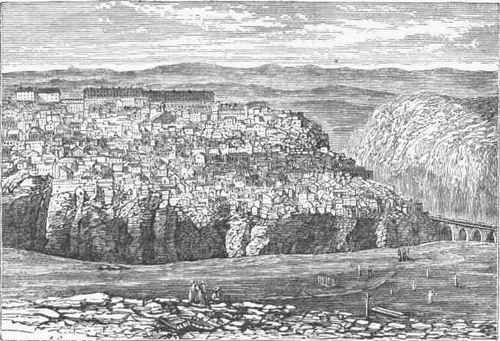
Constantine, Algeria.
Continue to:


My Books

