


Ergot
Description
This section is from "The American Cyclopaedia", by George Ripley And Charles A. Dana. Also available from Amazon: The New American Cyclopædia. 16 volumes complete..
Ergot
Ergot (Fr. a spur, as of a cock), a protuberance which grows out in a curved form resembling a cock's spur from among the grains of the plants of the graminaceoe, or grass tribe, as wheat, barley, and especially- rye. As it is most commonly met with in the last, the substance has been known by the name of spurred rye (secale cornutum). Some have thought it to be the seed altered by a diseased growth, caused by the attack of an insect, or by unfavorable circumstances of moisture, heat, etc. De Candolle thought it a fungus occupying the place of the seed, and called it sclero-tium clavus. But the evidences are now generally regarded as conclusive of its being the grain itself, diseased and deformed by the influence of a parasitic fungus, attached to it from its earliest development. This fungus, distinguishable by the microscope, has been detected in other parts of the plant; and the white dust or sporidia on the surface of the ergot will engender the disease in other plants if scattered in the soil at their roots or applied to the grains. - Ergot as collected for medicinal purposes is in solid grains from 1/2 to 1 1/2 in. long, of cellular structure, the cells containing oily particles.
Its aqueous infusion is claret-colored, has an acid reaction, and possesses the peculiar properties of the substance. Ergot contains a volatile alkaloid, secalia, supposed to be identical with propylamia obtained from herring pickle. The fixed oil, which at one time was supposed to partially represent the active principles of ergot, probably owed its properties to an incomplete separation from the other constituents. The so-called ergotine is not a definite chemical principle, but an extract. Ergot is used in medicine to promote the contractions of the uterus either during and after labor, or when independently of pregnancy it is desired to expel any morbid contents. The frequent or routine use of ergot to hasten labor or to expel the placenta is much to be deprecated as productive of danger, in the latter case to the mother, in the former to both mother and child. Although promoting uterine action, ergot cannot be relied upon for this purpose at all times. Its action has been shown to extend to other organs possessing smooth muscular fibres similar to those of the uterus, and it has accordingly been used to produce contraction of the blood vessels, as in haemoptysis, haematemesis, aneurism, varix, and congestion of the spinal cord and brain.
It is probably by this action upon the blood vessels that the epidemics of ergotism, from the use of diseased grains as food, have occurred in different parts of Europe. Ergotism assumes two forms, spasmodic and gangrenous, and probably requires for its production not only the poisonous action of ergot, but the additional depressing influences of cold, moisture, and insufficient food; a combination which is likely to take place in seasons favorable to the growth of the fungus. - Ergot may be administered in substance, infusion, decoction, fluid extract, or tincture. The dose for a woman in labor is about 20 grains of the substance repeated every 20 minutes till its physiological action is obtained; for other purposes, the dose is from 3 to 10 grains, according to the result sought for. It is apt to deteriorate by keeping, and therefore should be freshly prepared when used. A drop of the fluid extract is intended to represent a grain of the substance. The tincture is a little weaker.
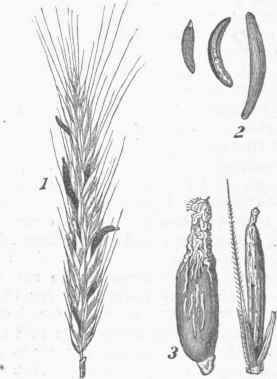
1. Ear of Eye with Ergot (Spurred Eye). 2. The Ergot. 3. Diseased Grains of Eye.
Continue to:


My Books

