


Amaranth
Description
This section is from "The American Cyclopaedia", by George Ripley And Charles A. Dana. Also available from Amazon: The New American Cyclopædia. 16 volumes complete..
Amaranth
Amaranth (amarantus; Gr.  unfading, because the flowers retain their bright colors when dead), a genus of plants of the family of amarantaceae. This genus is rich in species, most of which grow within the tropics (about 60 in Asia, 105 in America, 10 in Africa), some without the tropics (about 20 in Asia, 25 in America, 28 in New Holland, several in Africa, 5 in Europe), either in groups or singly, in dry stony situations or among thickets, few in salt marshes. The most ornamental exotic species, cultivated in Europe and in the United States, all annuals, are: A. caudatus (love-lies-bleeding), native of India, from 2 to 3 feet high;
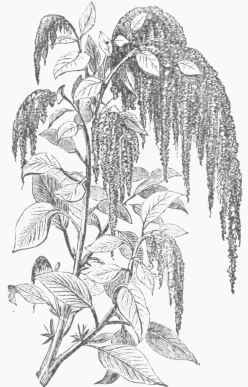
Amarantus caudatus (Love-Lies-Bleediug-).
leaves oval, oblong, reddish; flowers crimson, in long hanging clusters; a gigantic variety is 9 feet high. A. sanguineus, of India; stem and leaves blood-red; leaves oval, often emar-ginate; flowers red, small, axillary, with inter-nudal clusters. A. speciosus, of Nepaul; pyramidal, 6 feet high; flowers purplish crimson along the branches. A. tricolor, of China; branchy, 3 feet high; leaves yellow, red, and green; flowers green, lateral. A. hypochon-driacus (prince's feather), with erect flower spikes and purplish foliage, is a native of Virginia. These hardy species can be sown in the open border, while the less hardy require a gentle hot-bed, whence 'they may be potted off singly, in rich soil, and well watered. The above-named species blossom from June to October. Many of the species, having mucilaginous leaves, are used as pot herbs, with lemon juice. A. viridis is emollient, good for cataplasms. The seeds of A. frumentaceus and anardhana are eaten in India. A. obtusifolius is diuretic. Some others are variously employed in South America.
Continue to:


My Books

