


American Antiquities. Part 5
Description
This section is from "The American Cyclopaedia", by George Ripley And Charles A. Dana. Also available from Amazon: The New American Cyclopædia. 16 volumes complete..
American Antiquities. Part 5
It was attended by 4,000 priests. "The ground," says La Vega, "for 200 paces around the temple, was considered holy, and no one was allowed to pass within this boundary but with naked feet," Nor even under these restrictions were any permitted to enter except of the blood of the incas, in whom were centred the priestly and civil functions of the government. Besides the great temple of the sun, there was a large number of inferior temples in Cuzco, estimated by Herrera at 300. Numerons others are scattered over the empire, all of which seem to have corresponded very nearly in structure to that already described.
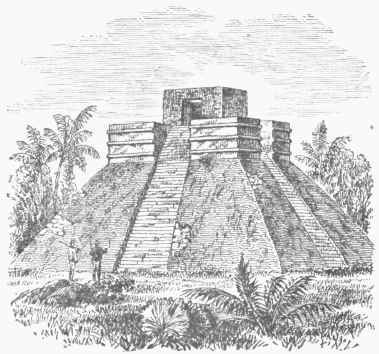
Pyramidal Temple, Palenque.
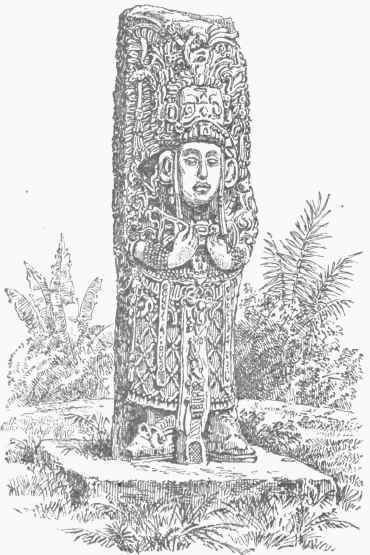
Monolith, Copan.

Remains of Temple of the Sun, Cuzco, Peru.
The one most celebrated, next to that of Cuzco, was that of Pachacamac, which contained a considerable town, the grand pyramidal shrine of the divinity Pachacamac, and, after the conquest of the coast by the incas, a temple of the sun and a convent of the vestals of the sun, the whole surrounded by a wall of several miles in extent. According to Roman, who speaks, however, with little authority, "the temples of Peru were built upon high grounds or the tops of hills, and were surrounded by four circular embankments of earth, one within the other. The temple stood in the centre of the enclosed area, and was quadrangular in form." A structure corresponding very nearly with this description is noticed by Humboldt, who denominates it, in accordance with local traditions, Ingapilca, "House of the Incas," and supposes it to have been a sort of fortified lodging place of the incas, in their journeys from one part of the empire to the other. It is situated at Cannar, and occupies the summit of a hill. The "citadel" is a very regular oval, the greatest axis of which is 125 feet, and consists of a wall, built of large blocks of stone, 16 feet high. Within this oval is a square edifice, containing but two rooms, which resembles the ordinary stone dwellings of the present day.
Surrounding these is a much larger circular enclosure, which, from the description and plate, we infer is not far from 500 feet in diameter. This series of works possesses few military features, and it seems most likely that it was a temple of the sun. This opinion is confirmed by the fact that at the base of the hill of Cannar was for-merly a famous shrine of the sun, consisting of the universal symbol of that luminary formed by nature upon the face of a great rock. Ulloa describes an ancient Peruvian temple, situated on a hill near the town of Cayambe, perfectly circular in form and open at the top. it was built of unburnt bricks, cemented together with clay. The most wonderful and probably among the most ancient monuments of Peru (or rather Bolivia, formerly Upper Peru) are those at Tiahuanaco, already referred to, on the shore of Lake Titicaca. Their origin is lost in obscurity, and they are supposed by many writers to have been the work of a race anterior to the incas, denoting perhaps a more advanced civilization than the monuments of Palenque. They have been described by a number of the early writers, commencing with Pedro de Ceica, one of the followers of Pizarro, in whose day their ruins seem to have differed but slightly from what they are now.
The latest and probably the most exact account of these enigmatical remains is that of Mr. Squier, who spent several weeks in their investigation in 1864. He describes them as situated in a broad, open, arid plain, cold in the wet and frigid in the dry season, where no cereals will ripen, the only production fit for human use being a variety of small bitter potato. The monuments consist of rows of erect stones, some of them rough or but rudely shaped by art; others accurately cut and fitted in walls of admirable workmanship; long sections of foundations with piers and portions of stairways; blocks of stones with mouldings, cornices, and niches cut with geometrical precision; vast masses of sandstone, trachyte, and basalt, but partially hewn; and great monolithic doorways, carved from single blocks of stone, and bearing symbolical ornaments in relief, besides smaller rectangular, and symmetrically shaped stones, rising on every hand or scattered in confusion over the plain. The central and most conspicuous portion of the ruins is a great rectangular mound of earth, 050 feet long, 450 wide, and now about 50 feet high. It was originally terraced, each terrace being faced by a massive wall of cut stones, artfully dovetailed and clamped together, and had on its summit various stone edifices.
This mound, which is called "the fortress," has on its E. side an apron or dependent platform, 320 x 180 feet. A short distance to the N. of this mound is what is called "the temple," a rectangle of 445 by 388 feet, defined by lines of erect stones, some entirely rude, and others apparently partially shaped by art. They support a terreplein of earth, on which are traces of structures, and on the E. side of which are ten great stone pilasters, suggestive of Stonehenge, perfectly alligned, and of varying sizes; the largest being 14 feet high above ground, by 4 ft. 2 in. broad and 2 ft. 8 in. thick. Near "the temple" are the foundations of what is called "the palace," the piers which supported the walls being of hard trachyte admirably cut, in this respect equalling the finest stone work of ancient or modern times. Besides these there is an enclosure called "the hall of justice," rectangular, 420 by 870 feet, within which are the ruins of a nameless structure, "sanctum sanctorum," 131 by 23 feet, composed of massive stones beautifully cut, some of which arc 25 1/2 feet long by 14 broad, and 6 ft. 0 in. thick, held together by bronze clamps.
Continue to:


My Books

