


Amphisbaena
Description
This section is from "The American Cyclopaedia", by George Ripley And Charles A. Dana. Also available from Amazon: The New American Cyclopædia. 16 volumes complete..
Amphisbaena
Amphisbaena (Gr. an animal that can move or walk in both directions), the name of a genus of saurians. The head is so small and the tail so thick and short that it is difficult to distinguish one from the other at first sight; and this peculiarity of form, in addition to the animal's habit of proceeding with equal facility either backward or forward, has given rise to the popular belief in Brazil and other parts of South America, where the ara-phisbaena most abounds, that it possesses two heads, one at each extremity. These saurians are distinguished from others by their nearly uniform thickness of body from the head to the extremity of the tail, by their small mouths and extremely diminutive eyes, remarkably short tails, and numerous rings of small square scales, completely surrounding the body and the tail. The jaws are furnished with a single row of small conical teeth, few in number and distant from each other, and the palate is toothless. These reptiles are also destitute of fangs, and are therefore harmless. They live mostly on ants and other small insects, and inhabit ant hills and burrows which they make for themselves under ground.
The genus am-phisbaena contains only a few species, confined to Brazil, Guiana, and other tropical parts of the American continent. The A. fuliginosa is the best known species. It is found in the hotter regions of South America, and does not inhabit Ceylon or any part of the East Indies, as Linnaeus and Lacepede were led to believe, on the authority of Seba. The general color of this animal is a deep brown, varied with shades of white, more or less clear, according to the season of casting the old and acquiring the new external coat or "skin." It grows to the length of 18 inches or 2 feet, the tail measuring only one inch or thereabouts. The body, about as thick as the wrist of a child of 10 years, is surrounded by upward of 200 rings, and the tail by 25 or 30. The eyes, exceedingly diminutive, are covered by a membrane which almost conceals them; and this has given rise to the popular opinion that the amphisbaena has no eyes.
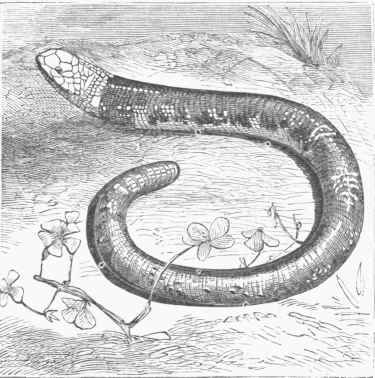
Amphisbaena fuliginosa (Sooty Amphisbaena).
Continue to:


My Books

