


Battle Of Gettysburg. Continued
Description
This section is from "The American Cyclopaedia", by George Ripley And Charles A. Dana. Also available from Amazon: The New American Cyclopædia. 16 volumes complete..
Battle Of Gettysburg. Continued
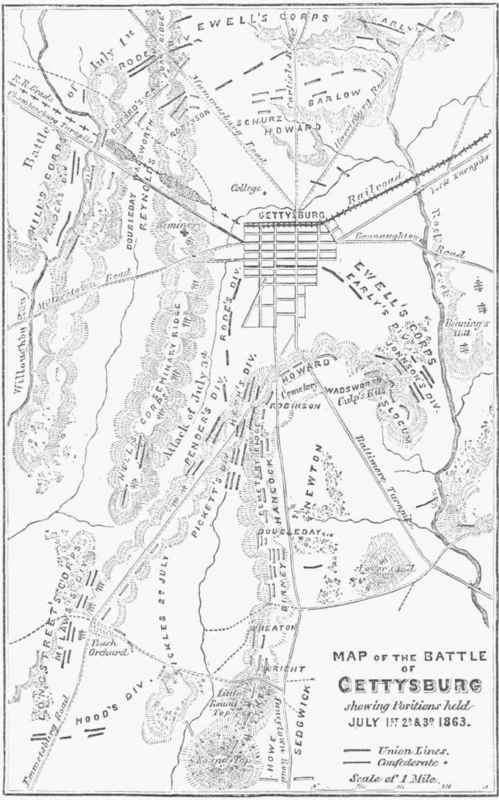
Opposite this is Seminary ridge, upon which the greater part of Lee's army was posted; Ewell's corps, however, lay at the foot of Gulp's' hill, 2 m. distant. The forces present or close at hand were about equal, each numbering from 70,000 to 80,000 infantry and artillery. Be-tween the two ridges is a valley in which and on the slope of Cemetery ridge were fought the actions of July 2 and 3. It is clear from what followed that Lee greatly underestimated the force opposed to him, and he resolved to attack it in its strong position. Longstreet was to assail the Union left at Round Top, while Ewell was to make on the right, at Gulp's hill,a demonstration, to he converted into a real attack should opportunity offer." Meade had intended that his line should be posted on the ridge directly between Round Top and Cemetery hill. But this ridge, in the centre where Sickles was placed, is comparatively low, sinking down into a valley a few hundred yards wide, beyond which rises another wooded crest running diagonally to the former; and Sickles supposed this to be the one which he was to occupy.
Before the error could be corrected the confederate attack had begun, and Meade decided to support Sickles in his present position, although it left an unoccupied space between him and Round Top. As it happened, Hood's division of Longstreet's corps struck this opening. Moreover, by some mischance. Little Round Top had been left unoccupied, and this was the key to the entire Union position; for if the enemy could seize this, and place a few guns upon it, the whole line would be enfiladed. The confederates perceived this, and began to swarm up the rugged sides. But just in time Warren, who as engineer was examining the line, discovered the error, and brought up a few regiments. They reached the summit just a moment ahead of the enemy, and forced them back. Again and again until nightfall the assault was unsuccessfully renewed. In the mean time the remainder of Longstreet's corps were pressing fiercely upon Sickles, who was soon borne from the field with his leg shattered. His corps made a stubborn resistance, but was forced back until it reached the crest of the ridge, where a new line was formed. The confederates charged this, but were met with a fire from which they recoiled.
Hancock, who now commanded the centre, ordered a countercharge, by which the enemy were driven back to the ridge previously occupied by Sickles, which they continued to hold. Ewell's demonstration on the Union right was delayed until the action on the left was nearly over; but as most of the Union force had been withdrawn from Culp's hill to aid Sickles, he succeeded in effecting a lodgment within the Union intrenchments. The Union loss in this action was fully 10,000, half of which was in Sickles's corps, which lost nearly half its numbers. This action decided nothing; for the ground which the confederates had won on the Union left was never meant to be held by Meade, and he would gladly have withdrawn from it without a fight; and Ewell's foothold on the Union right was of no importance unless it could be followed up. Still the confederates had gained some apparent advantages; and, says Lee,These partial successes determined me to continue the assault the next day."" From what be could then know, he was justified in this; for he had every reason to suppose that he had encountered the entire Union force, while less than half of his own had been engaged.-July 3. Lee's general plan of attack was similar to that of the preceding day.
Ewell was to follow up his advantage, while the main attack was to be made on the centre. But early in the morning Meade had taken the offensive against Ewell, and forced him from the foothold which he had gained. By some unexplained accident Lee was never informed of this mishap, by which a third of his force was left out of action, while Meade was at liberty to concentrate his whole strength upon any point which might be assailed. All the morning was spent in preparation. Seminary ridge formed an admirable position for the confederate artillery, and here directly in front of the Union line they placed 120 guns. A great part of Cemetery ridge is so rugged that artillery could not be placed there; so that although Meade had 200 guns, he could use only 80 at a time. At 1 o'clock the confederates opened fire, which was immediately returned. Many of the Union guns were disabled, but their place was supplied by others. The infantry were so well sheltered behind the crest that they suffered little. After two hours, Hunt, the chief of artillery, gradually suspended fire,in order to see what the enemy were going to do." Lee, supposing that the Union batteries had been silenced and that the infantry must be demoralized, now ordered the grand attack of the day.
This was to be made mainly by Pickett's division of Virginia veterans, who had not yet been engaged. They were to be aided by the brigades of Wilcox and PettigreAV. Exclusive of Wilcox, who did not fairly advance, the attacking column numbered about 18,000. Lee had intended to advance his artillery to support the infantry, but found at the last moment that the ammunition was nearly exhausted, and there was no time to replenish it. The column moved swiftly down the slope of the ridge, and across the plain. All the Union batteries, from Round Top to Cemetery hill, opened upon them, ploughing great furrows through their lines, which were closed up as fast as made. The column at first headed for the left of the Union centre, where Doubleday was posted with 2,500 men, a little in advance of the main line and protected by breastworks of rails and stones. To avoid this the column bent to its left and exposed itself to a severe Hank fire. Still it pressed on, until Pettigrew's brigade was within 300 vards of Hancock's line, which had re-served its fire. In five minutes the whole brigade was streaming back in wild disorder.
Pickett's division pressed steadily on until it reached Gibbon's front line thinly posted behind a low stone Avail. They charged straight over this, among the federal batteries, and for a quarter of an hour there was a struggle with pistols and clubbed muskets. The Union troops hurried from all sides and drove the enemy back down the slope, which was completely commanded by musketry and artillery. To advance, retreat, or stand still was alike impossible. The men flung themselves on the ground, holding up their hands in token of surrender. Of the whole number, not one in four escaped; the others were dead or prisoners. The attacking column being thus utterly routed in the centre, Meade ordered his right to advance and drive back the division of Hood, which had been held in check upon the ridge they had won the preceding day. This was easily done, and many prisoners were captured. The confederate loss this day was about 16,000 in killed, wounded, and prisoners; the Union loss was about 3,000. During the night Lee concentrated his force behind the crest of Seminary ridge, awaiting and probably desiring an attack.
In the morning Meade called a council of war, by which it was decided to remain a day and await the development of the enemy's plan." Before night a heavy storm set in, under cover of which Lee began his retreat to the Potomac, leaving a strong rear guard to defend the passes through the mountains. He reached the river, 40 m. distant, on the 7th. The stream, which he had crossed almost dry-shod a fortnight before, was now swollen by unusually heavy rains and unford-able. A bridge which he had flung across had been destroyed by a cavalry dash from Harper's Ferry, and he had no alternative but to intrench himself and await an attack or the falling of the waters. Meade advanced slowly by a much longer route, and on the 12th came in front of the confederate intrenchments. He called a council of war, which, against his opinion, voted to postpone the attack until reconnoissances had been made. On the evening of the 13th an order was issued for an advance the next morning; but when day broke the enemy had disappeared. A slight bridge had been constructed, and the river had fallen so as to be fordable at a single point. Ewell's corps crossed by the ford, the others by the bridge.
The remains of the confederate army stood safe on the other side; and the invasion of the north, upon which so much had been staked, was at an end.-The Union loss at Gettysburg, was 23*190, of whom 2,834 were killed, 13,713 wounded, and 6,643 missing. The confederate loss has never been officially stated; but by the best estimates it was about 36,000, of whom about 5,000 were killed, 23,000 wounded, and 8,000 unwounded prisoners. The entire number of prisoners, wounded and unwounded, was about 14,000.-At almost the same moment when the final action at Gettysburg took place, the negotiations for the surrender of Vicksburg were concluded. These twin disasters mark the epoch of the decline of the confederacy.
Continue to:


My Books

